Extended Repayment: Count Direct Loans
Separate the loan programs.
Estimated reading time: 5 minutes
A combined federal student-loan balance can be the wrong number for the Direct Loan Extended Repayment threshold.
Check the dates and loan program
This example concerns borrowers entering repayment on or after July 1, 2006, who received no Direct Loan on or after July 1, 2026. The rule requires more than $30,000 in outstanding Direct Loans accumulated on or after October 7, 1998.
Its new-borrower condition requires no outstanding Direct Loan principal or interest on October 7, 1998, or when obtaining a Direct Loan afterward.
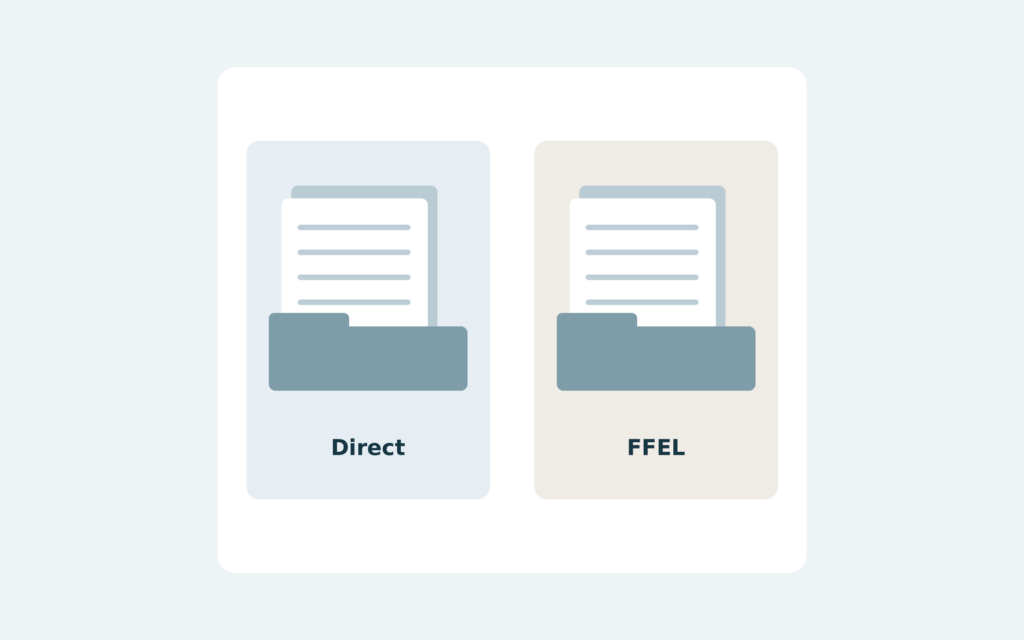
Suppose your first Direct Loan was in 2010, repayment began in 2014, and you received none after June 2026. Your outstanding balances are $22,000 Direct and $14,000 FFEL. The $36,000 combined total does not satisfy the Direct-only threshold: $22,000 is below $30,000. Exactly $30,000 also fails a requirement for more than $30,000.
Ask for a loan-specific comparison
Edfinancial describes Extended Repayment as fixed or graduated payments. Under the rule discussed above, the maximum 25-year period runs from when the loan entered repayment, excluding authorized deferment or forbearance periods.
Ask your servicer to verify each loan’s program, balance and relevant dates before evaluating eligibility.
Request the actual schedule and total repayment for available choices; a longer window does not prove savings.
This illustration does not establish FFEL eligibility, evaluate consolidation, or cover the older pre-July 2006 Extended rules or newer Tiered Standard plan. It is general education, not individualized advice.
Source: Edfinancial repayment options.
A lower payment and a lower cost are different goals
Consider a separate mathematical illustration, not a quote for the borrower above: $35,000 of principal at a constant 6% annual rate, with equal monthly payments and no fees, missed payments, rate discounts or pauses. Assume a fresh amortization schedule and use a monthly rate of 0.5% for this simplified comparison.
- Over 120 months, the calculated payment is about $388.57. Total payments are about $46,629, including $11,629 of interest.
- Over 300 months, the calculated payment is about $225.51. Total payments are about $67,652, including $32,652 of interest.
The longer schedule frees roughly $163 per month in this example but adds about $21,023 in interest if followed to the end. Totals use unrounded calculated payments; rounding and the final installment can change the actual amounts.
This is an ordinary amortization model, not a federal servicing calculation or a determination that someone receives a new 25-year period when switching plans. Federal student loans accrue interest daily, so obtain the actual schedule for your account. The point of the illustration is to compare both the monthly burden and the lifetime cost, not to predict your bill.
Check how the change is confirmed
Edfinancial says a new repayment schedule is communicated by mail or email when an account is placed on a new option. It also explains that longer repayment generally increases interest and that student-loan interest accrues daily. Its guidance identifies Extended Repayment as not a qualifying plan for Public Service Loan Forgiveness. If forgiveness is part of your goal, ask about that separately before changing plans.
Prepare a useful comparison rather than a single balance
Build a small worksheet with one row per loan. Include the program label, the date shown on the record, the outstanding amount, the interest rate and the servicer. Note the date you collected the figures so you can explain differences between records rather than silently combining snapshots from different months.
If a label is unclear, leave it marked “needs confirmation.” Do not classify a loan by the company collecting the payment or by a familiar-looking account nickname. Ask the servicer to resolve the uncertain row and retain the explanation alongside your worksheet.
For each option being compared, request the first payment, any later changes, the last scheduled payment date and the estimated total remaining payments. Make sure both estimates use the same starting date and balance. Otherwise, an apparent difference might reflect different assumptions rather than a better plan.
Put the proposal through a household-budget test
Write down what the proposed payment would leave after housing, food, transportation and other essential bills. Then test a less comfortable month, such as one with reduced overtime or a predictable annual expense. If a payment increases later, use that later amount in a second version of the budget rather than relying only on the initial bill.
Keep a short decision note: the problem you are trying to solve, the options you compared and the tradeoff you are willing to accept. That record can help you revisit the choice when your circumstances change without starting the comparison from memory.
Before treating a requested change as active, ask which payment amount and due date apply while it is being processed. Save the request confirmation and the eventual schedule separately. A submission receipt answers whether your request arrived; the schedule answers what you are expected to pay.
Sources checked November 4, 2026. The examples are educational and do not establish eligibility or recommend a particular repayment plan.

Parent Pays Student Loan Interest: Who Deducts?
Separate payment and obligation.

Returned Loan Debit: Two Fees?
Trace the payment and fees.

Rehabilitation Payment Too High?
Check an alternative request.