2026–27 FAFSA: Family Business and Farm Assets
Check business size, farm residence and related debt before reporting assets.
Estimated reading time: 3 minutes
Before using an older FAFSA asset figure in a college funding plan, check the award year’s rules. For 2026–27, changes to business and farm reporting can affect what belongs in the asset questions.
Three exclusions to check for 2026–27
Federal Student Aid identifies these exclusions from business and farm net worth:
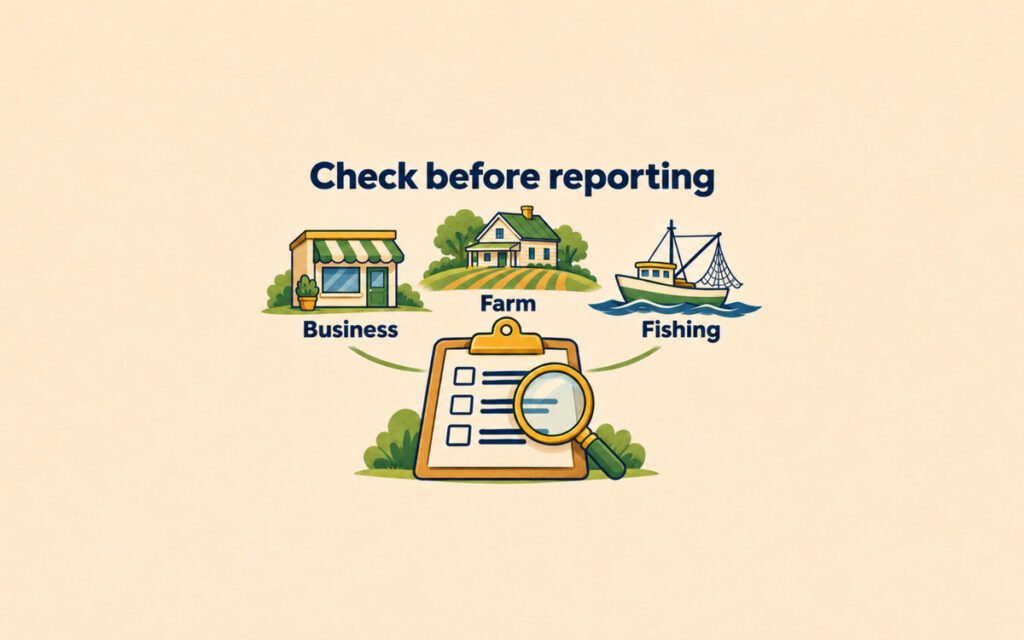
- A business owned and controlled by the family with 100 or fewer full-time or full-time-equivalent employees.
- A farm on which the family resides.
- A commercial fishing business and related expenses owned and controlled by the family.
Use the instructions for the named award year. Do not assume an earlier application’s asset answer should be copied unchanged.
Separate the business-size and farm-residence tests
The current handbook describes the small-business exclusion for businesses owned and controlled by the family. The farm exclusion turns on where the family resides. They are separate categories. Value assets as of the day the FAFSA is signed.
Consider these independent fictional cases, assuming the stated ownership and employee classifications have been confirmed:
- A family-owned and controlled shop has exactly 100 full-time-equivalent employees. It is within the business-size exclusion.
- A different family shop has 101. It is outside that particular exclusion; other applicable asset-reporting instructions still matter.
- A family lives on its farm. The farm’s value falls within the residence-based farm exclusion.
- A family owns an income-producing farm elsewhere. A small workforce alone does not establish the residence-based exclusion.
Do not replace full-time-equivalent staffing with a count that simply ignores part-time workers. If the classification, ownership or residence is unclear, ask the financial aid office before deciding the entry. These examples do not determine an aid award.
If an asset is reportable, match its value and debt
The official form defines net worth using current value and debts related to that same asset. Negative net values are entered as zero. Follow the form’s applicable skip instructions before answering asset questions.
Assume a fictional farm is reportable, no exclusion applies, and its supported current value is $240,000. Associated debt is $150,000. Its net worth is $90,000: $240,000 minus $150,000.
An unrelated $17,000 personal car loan does not reduce that farm figure to $73,000. The example assumes the car loan is not related to the farm. It is not a method for deciding whether a real debt qualifies.
The form separately asks for 2024 tax information and current assets. An asset exclusion is not an instruction to remove business income from the required income answers.
Keep the valuation date, ownership records and related-debt evidence together. Ask the school how to handle mixed ownership or uncertain classifications instead of inventing a value.
Resolve the entry before revising the borrowing plan
A useful school question identifies the award year, asset category, ownership, residence or staffing issue, and the answer that remains unclear. Provide private records only through the school’s verified route, not public comments or EasyLoanWorld.
This guide does not calculate an SAI, promise a grant or replace the school’s review. If income changed after the relevant tax year, read how to ask about a separate aid adjustment.

Transcript Hold? Check Each Payment Period
Separate paid periods, payment-plan status and the remaining balance.
Federal Work-Study: Build a Paycheck Plan
Connect hiring, hours and actual paydays before counting work-study earnings toward a bill.
Perkins Childcare Cancellation: Compare Local Salaries
Check the local salary benchmark before relying on early-education cancellation.