Federal Work-Study: Build a Paycheck Plan
Connect hiring, hours and actual paydays before counting work-study earnings toward a bill.
Estimated reading time: 5 minutes
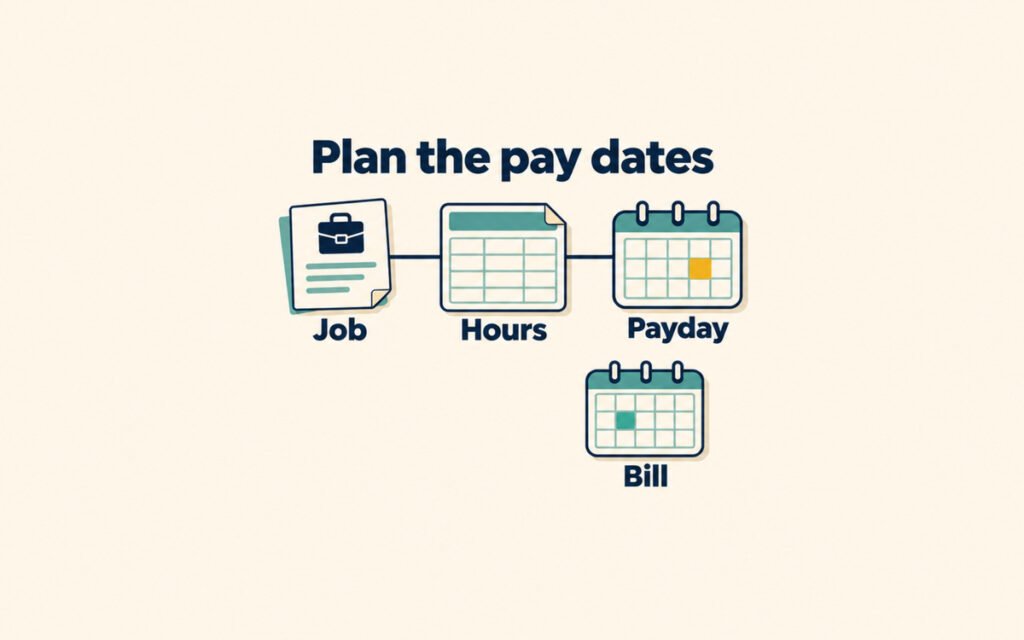
An offered Federal Work-Study amount is not a payday. To use the earnings in a borrowing or bill-paying plan, connect the award to an eligible job, worked hours and actual payment dates.
Turn the offer into a job plan
Federal Student Aid says jobs and funding are not guaranteed each year. Most schools require students to find positions, apply and interview, although some match students to jobs.
Ask the school and supervisor to confirm the job, pay rate, approved hours and how to track the earning limit. Check what happens as funding runs low. Do not assume another job automatically qualifies or that you can continue in the same role after work-study funding ends.
Trace the hours into the payment
Before an award period’s initial payment, the school must explain your authorized earnings and payment method and timing. The 2026–27 FSA handbook requires payment at least monthly for work performed.
Undergraduates are paid hourly; graduate students may be paid hourly or by salary. Timesheets must record daily hours and payment-cycle totals, with the required certification.
Compare hours and periods with payroll. Distinguish gross pay, deductions and net pay; multiplication alone does not establish the deposit.
Crediting your cash FWS earnings to a school account requires separate written authorization. A noncash institutional share in tuition, fees, services or equipment needs no permission, but requires a written explanation before employment. Ask whether pay will reach your bank, arrive by check or include that share.
Put the first payday beside the bill date
The University of Georgia gives one school example: work-study earnings are paid directly to students every two weeks for hours worked, and are not automatically applied to university charges. That schedule is not a nationwide promise.
Consider a fictional student with a $1,500 bill due September 1 and $1,200 already allocated to it. Assume the student’s first expected net paycheck is $300 on September 15.
The September 1 gap is $300: $1,500 minus $1,200. Counting the later paycheck as money already available would hide that gap. A $2,000 work-study offer does not make $2,000 available on the bill date.
Confirm the actual first payday and ask the billing office about available arrangements before the deadline. A future paycheck or an unanswered request does not, by itself, change the bill’s due date. The example is a timing exercise, not a recommendation to borrow the gap.
Give each dollar one job
Continue the fictional example, but now assume September 15 has arrived and the expected $300 has actually been received. The student lists $120 for groceries, $60 for transportation and $40 for supplies. Those planned uses total $220, leaving $80 unallocated: $300 minus $220.
The student cannot also treat the full $300 as available for another bill without changing those allocations or identifying other money. A paycheck can be counted once in the plan, even when several expenses are important. This example assumes the listed costs are accurate and makes no claim that these amounts are appropriate for another student.
Make a simple running balance for each expected payment date. Start with money actually available, subtract already committed expenses, and keep uncertain receipts in a separate column. That separation helps you see what depends on a future event rather than on cash you already have.
Test a less favorable week
Before relying on the schedule, ask yourself which expense would become difficult if an expected receipt were smaller or later. Write down the question you would need answered and the office you would contact. Do this while there is time to gather information, rather than on the morning a bill is due.
Keep the billing conversation separate from the employment conversation. A supervisor may explain the work schedule but may not be the person who can answer a question about a tuition arrangement. Record who actually confirmed each answer and avoid treating one office’s estimate as another office’s commitment.
Review the plan after the first receipt. Replace the estimate with the amount received, note any difference and update the next few weeks. Do not erase the earlier estimate: keeping both versions shows which assumption needs correcting.
Keep a short paycheck record
Record these separately:
- The job and approved earning period.
- The pay rate and permitted schedule.
- Hours submitted and certification status.
- The pay period, payday and actual net receipt.
- The next bill date and money allocated to that bill.
If a payment differs from your records, ask payroll about the specific period and entry. Ask the aid office separately about award authorization or changed eligibility. This guide does not decide eligibility, tax treatment or an individual borrowing choice.
For the separate task of comparing aid offers, use the college aid-offer practice exercise.
Sources checked November 4, 2026. School-specific procedures and your actual payroll records determine the practical schedule; the examples are planning exercises, not guaranteed earnings.

Parent Pays Student Loan Interest: Who Deducts?
Separate payment and obligation.

Returned Loan Debit: Two Fees?
Trace the payment and fees.

Rehabilitation Payment Too High?
Check an alternative request.