How to Spot Investment Fraud Before You Lose Money
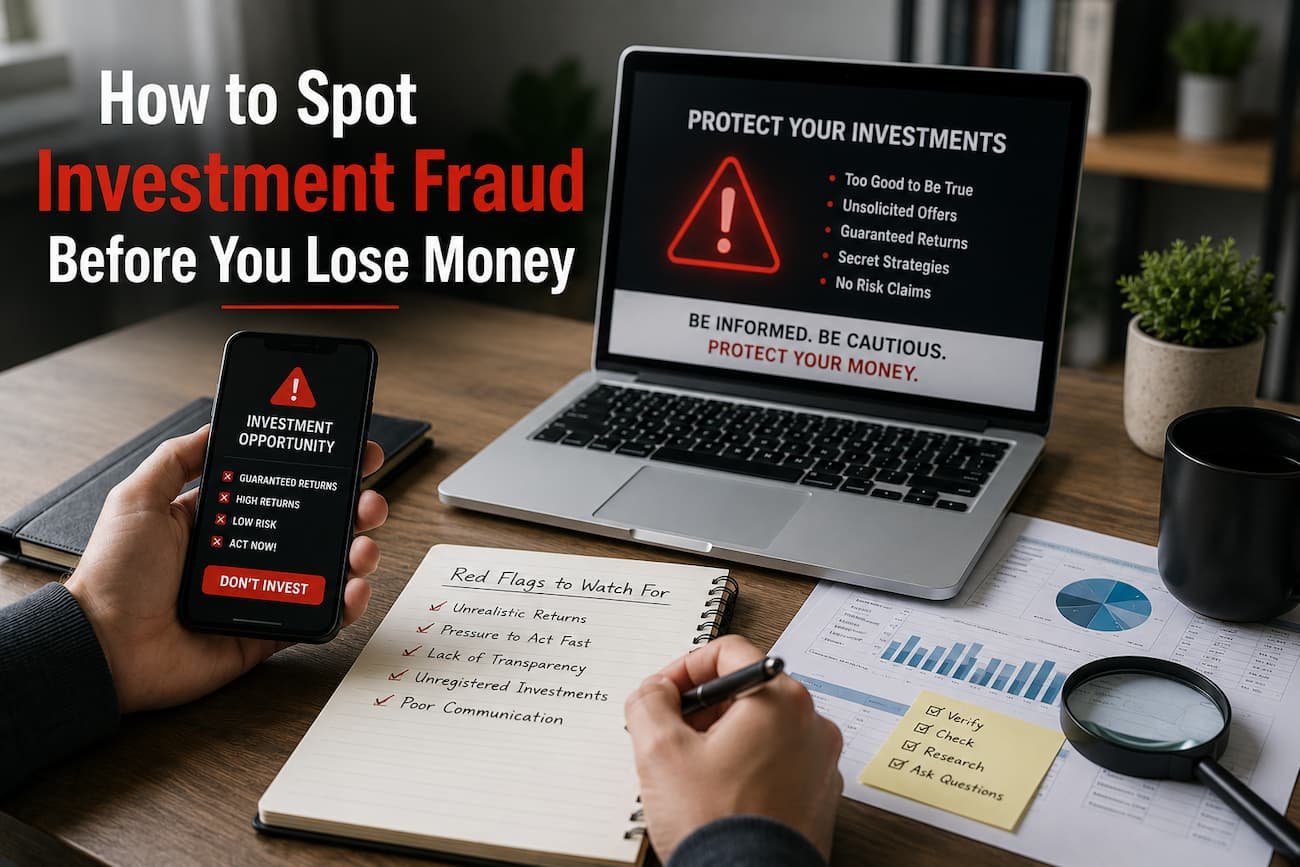
Fortunately, some commonalities help identify investment scams. Scammers frequently use tactics such as making victims feel rushed, promising unrealistically high returns, concealing crucial information, or pressuring them to send money before they can do their due diligence. Being aware of these actions can help you stay calm and improve your decision-making.
Learn the typical steps of investment fraud, the red flags to watch for, how to check an investment offer’s legitimacy, and what to do if you have doubts. You will also find out how to avoid falling victim to social media and messaging app scams, why even legal investments can lose money, and why it’s important to be cautious when moving funds online. We don’t want you to be scared to invest. Your goal should be to develop into a more cautious investor who knows when to demand answers and when to bail.
Understand That Investment Fraud Can Look Professional
A common mistake is that people assume scams are always fake. Today’s investment fraud is very well thought out and attempts to appear legitimate. Scammers can create professional-looking websites, use elaborate presentations, mimic the branding of legitimate financial companies, or pose as experienced investment experts.
People in your immediate circle may also try to offer you fake investment opportunities. Friends, family members, colleagues, or social media contacts may unknowingly mislead you and share scams. That is why it is important to evaluate investments yourself and not rely solely on recommendations. A professional appearance does not always equate to reliability. A striking logo, a beautiful website, or a confident salesperson do not provide the full picture. Before investing, focus on questions you can answer yourself: Who is selling this investment? How does this investment generate a profit? What are the risks? Where are your funds held? What are the costs? Is the person or company properly registered?
Be Wary of Promised Investment Returns
One of the clearest warning signs of investment fraud is the promise of guaranteed returns with virtually no risk. The actual value of the assets is often unclear. Even low-risk investments can lead to losses and lower returns than expected. Scammers often use phrases such as “guaranteed income,” “risk-free return,” or “certain profit.” These claims aim to dispel any doubts and make the investment opportunity sound safer than it actually is.
Real investment experts will tell you which aspects can lead to success and which to failure. If someone only emphasizes how much money you can earn without mentioning the potential risks, be immediately wary. Be extra careful when the expected return is much higher than you would expect for a comparable investment. In the real market, there can be enormous potential profits, but such an opportunity comes with higher risks. If someone promises high returns and absolute safety, be immediately suspicious.
Beware of Pressure to Invest Immediately
Scammers know that people often make different choices when they feel rushed. That is why many investment scams use false deadlines or the claim that “the opportunity is about to disappear.” They will tell you that there are a limited number of spots available, that investments are valid for a limited time only, or that you must invest money immediately to secure your investment opportunity. Their goal is to deter you from investigating the investment project.
Generally, a legitimate investment opportunity should allow you sufficient time to understand the product you are buying and determine if it fits your financial situation. If you need time to think and the other party becomes impatient as a result, that in itself is valuable information. You should not be forced to make important financial decisions simply because someone creates a sense of urgency. Pressure in itself does not prove that it is a scam, but if that pressure is accompanied by secrecy, promised returns, or difficulties in verifying the investment, then that is reason enough to stop and conduct thorough research.
Ask Where the Investment Returns Actually Come From
Inquire about the actual source of the investment return. Before investing, always explain the investment’s profit model in understandable language. If you do not understand the core concept, do not invest. Legitimate companies, for example, earn money from the sale of products and services. Bonds pay interest according to their terms. Stocks represent a share of ownership in a company, and their value can rise or fall. You can earn money by renting out real estate.
Not all serious investments are equally simple, but someone providing investment advice must be able to clearly explain the basic mechanism. If someone speaks only in generalities, such as “Our system uses advanced algorithms” or “Our experts can generate stable profits,” without explaining the underlying strategy, you should be wary. Sometimes people intentionally use complicated jargon to make investment opportunities sound attractive, while simultaneously preventing you from asking useful questions. If you receive a different answer to a question every time, that is also a warning sign.
Learn How Fake Investment Platforms Work
Some investment scams operate through fake websites or mobile applications that appear to show your money growing. You may see an account balance increasing every day, complete with charts and transaction histories. The problem is that the displayed balance may not represent real investments. The scammers may simply control the numbers.
Victims may initially be allowed to withdraw a small amount of money. This can create confidence and encourage them to invest more. Later, when they attempt to withdraw a larger amount, they may be told that they must pay a tax, processing fee, verification charge, or other payment before receiving their funds. Legitimate investments can certainly involve fees and taxes, but unexpected demands for additional money to unlock a withdrawal should be treated cautiously. Do not assume that a platform is legitimate simply because the dashboard shows profits. Verify the company independently and confirm where the assets are actually held.
Be Careful With Social Media Investment Opportunities
Social media has made it easier for scammers to reach large audiences. Investment fraud may appear through advertisements, direct messages, private groups, video comments, or accounts that claim to have discovered a special opportunity. Some scams use fake testimonials and staged screenshots showing large profits. Others use impersonation, where criminals pretend to be celebrities, business leaders, financial experts, or well-known investment companies.
A social media profile is not proof of professional credentials. A person may have thousands of followers and still have no legitimate connection to the investment being promoted. Be particularly cautious when someone you have never met personally contacts you with an investment opportunity. If the conversation quickly moves from casual discussion to requests for money, financial information, or cryptocurrency transfers, stop and investigate independently. Never use a social media message as your only source for deciding whether an investment is legitimate.
Do Not Confuse Cryptocurrency With a Guarantee of Easy Profits
Digital assets and cryptocurrency have become common topics in investment discussions, but scammers frequently use them in fraudulent schemes. Scammers may promise guaranteed profits from trading systems, mining operations, token launches, or automated investment platforms. The technology behind an investment does not automatically make the opportunity legitimate. A scam can use sophisticated technical language while still being designed to take your money.
Be cautious of anyone who claims to have a secret cryptocurrency strategy that produces guaranteed returns. Also be careful when someone insists that you must transfer money directly to a personal wallet or send cryptocurrency to an unfamiliar address. Transactions involving certain digital assets may be difficult or impossible to reverse. That makes it especially important to verify the recipient before sending funds.
Check the Person and Company Behind the Opportunity
One of the most important steps before investing is to verify who is actually offering the investment. Do not rely solely on information provided by the salesperson or promoter. Depending on the investment and your location, regulators may require financial professionals and investment firms to register or meet specific legal requirements. In the United States, investors can use resources from the Securities and Exchange Commission and the Financial Industry Regulatory Authority to research certain investment professionals and firms.
However, registration alone does not guarantee that an investment will be profitable or appropriate for you. It is one part of due diligence, not a guarantee of success. Be careful if someone claims to be registered but refuses to provide verifiable information. Search for the company independently rather than using only a link or phone number provided by the promoter.
Do Not Trust Fake Credentials or Awards
Scammers may claim to have professional certifications, awards, impressive employment histories, or relationships with respected financial institutions. Some may even create fake certificates or use legitimate credentials belonging to another person. When credentials matter, verify them through the issuing organization or an official regulatory database.
Be especially cautious when someone relies heavily on titles or awards instead of explaining the investment itself. A person’s background does not eliminate the need to investigate the opportunity. Also remember that criminals sometimes impersonate legitimate professionals. If someone contacts you claiming to represent a financial company, independently find the company’s official contact information and verify the person’s identity.
Understand the Difference Between High Risk and Fraud
Not every investment that loses money is a scam. This distinction is important because investing always involves risk. A legitimate investment can decline because of changing economic conditions, company performance, interest rates, market sentiment, or other factors. Losing money does not automatically mean you were defrauded. Fraud involves deception or dishonest conduct intended to obtain money or personal information. The key issue is whether important facts were deliberately misrepresented or concealed.
| Legitimate Investment Risk | Possible Fraud Warning |
|---|---|
| Returns are uncertain | Returns are guaranteed |
| Risks are clearly explained | Risks are minimized or hidden |
| You have time to decide | You are pressured to act immediately |
| Information can be independently verified | Claims cannot be confirmed |
| Fees are disclosed clearly | Unexpected fees appear later |
| Withdrawal rules are explained in advance | Money is blocked unless you pay more |
Understanding this difference can help you avoid two extremes: assuming every investment loss is fraud or assuming every investment opportunity is safe.
Be Cautious When Someone Asks for Unusual Payment Methods
How someone asks you to send money can provide useful clues. Be especially careful if an investment promoter insists that you transfer funds through methods that are hard to reverse or hard to trace. Requests to send money directly to a personal bank account, unfamiliar cryptocurrency wallet, gift card, or other unusual payment method should prompt additional questions.
A legitimate investment process should normally provide clear information about where it sends funds, who receives them, and how it documents the transaction. Before sending money, verify the payment instructions through an independent source. If you are investing through a legitimate financial institution, confirm that the account information matches the institution’s official records. Never assume that an urgent payment request is legitimate simply because the sender claims your investment will be lost if you do not act immediately.
Watch for “Recovery” Scams After an Investment Loss
One of the cruelest forms of financial fraud targets people who have already lost money. After an initial scam, someone may contact victims claiming they can recover the lost funds. The recovery scammer may pretend to be a lawyer, government official, investigator, or financial recovery specialist. They may ask for an upfront fee, tax payment, legal expense, or processing charge.
Unfortunately, the second scam can cause even more financial damage. If you have lost money to an investment scam, be extremely cautious about anyone who promises to recover it for a fee. Report the original fraud through appropriate official channels and seek advice from legitimate authorities or qualified professionals.
Warning: Someone who knows you lost money may use that information to target you again. A previous victim can become a target for a second scam.
Use a Simple Verification Process Before Investing
You do not need to become a financial expert to perform basic due diligence. The key is to slow down and verify important claims independently. Start by writing down exactly what you are being offered. What are you buying? Who is selling it? How are returns generated? What are the risks? How can you withdraw your money? Then verify the company and the person behind the offer using independent sources. Look for regulatory information where applicable. Search for credible complaints or enforcement actions. Review official documents rather than relying entirely on promotional materials.
Finally, discuss the opportunity with someone who is not connected to the seller. A trusted financial professional may be able to identify risks you overlooked. The purpose is not to find reasons to reject every investment. This ensures you understand what you are agreeing to before your money leaves your account.
Common Mistakes That Make Investors Easier Targets
- Investing because of fear of missing out: The fact that other people appear to be making money does not prove that an opportunity is legitimate.
- Trusting screenshots: Images of account balances or profits can be fabricated easily.
- Believing guaranteed returns: Legitimate investments involve risk, and certainty should be treated cautiously.
- Skipping independent research: Information supplied by the seller is not the same as independent verification.
- Sending money under pressure: Urgency reduces the time available for careful decision-making.
- Ignoring withdrawal problems: If you cannot access your funds and someone repeatedly asks you for additional payments, stop sending money and investigate.
- Assuming a recommendation is safe: A friend or family member may unknowingly recommend a fraudulent opportunity.
How to Build a Safer Investment Decision Routine
A good investment routine does not have to be complicated. The most useful habit is creating a pause between hearing about an opportunity and committing your money. When someone presents an investment opportunity, write down the claims they make. Then verify those claims independently. Check the risks, costs, registration information, and withdrawal conditions.
Ask yourself whether you would still want the investment if the promised return were lower. If the answer is no, you may be responding more to the sales pitch than to the actual investment. Also consider whether the investment fits your financial goals and risk tolerance. Even a legitimate opportunity may be inappropriate for your situation. A disciplined process helps you avoid emotional decisions and gives you time to notice inconsistencies.
A Quick Investment Fraud Warning Checklist
- Is the return described as guaranteed?
- Are you being promised unusually high profits with little risk?
- Are you being pressured to invest immediately?
- Is the opportunity difficult to explain in simple terms?
- Can you independently verify the company and person offering it?
- Are you being contacted unexpectedly through social media or messaging apps?
- Are you being asked to send money through an unusual payment method?
- Are you being asked for additional money before withdrawing your funds?
- Are the investment documents unclear or difficult to verify?
- Does the promoter discourage you from asking questions?
- Are fake-looking testimonials or screenshots being used as proof?
- Does the opportunity depend heavily on recruiting other people?
One warning sign does not automatically prove fraud, but several warning signs together should make you stop and investigate carefully.
FAQs
1. Is investing in cryptocurrency a scam?
Cryptocurrency itself is not necessarily a scam, but scammers often use it for fraudulent investments. The risk lies not only in the technology itself, but also in the specific investment opportunity, the platform, the person, or the transaction. Be wary when someone promises a guaranteed return on cryptocurrency, urges you to transfer money quickly, or asks you to send assets to an unknown wallet. Because some transactions involving digital assets can be irreversible, it is important to always verify the recipient’s identity and understand the details of the investment before transferring money.
2. Why do investment scammers show fake returns?
Fake returns are often used to build trust and entice victims to invest more money. Fraudulent platforms may display a balance that appears to be growing, but in reality, there are no real investments. In some cases, scammers allow small withdrawals to convince victims that the system is functioning correctly. Larger withdrawals may subsequently be blocked or subject to additional fees. Never assume that an online balance is proof of an investment’s authenticity. Always verify the actual location of your funds.
3. What should I do if I have already invested in a scam?
Take immediate action. Contact your bank, credit card company, or payment service provider to explain the situation and inquire about any protection or recovery measures. If you have shared sensitive information, secure your account and change your password. Save text messages, receipts, transaction details, and other evidence. Report the fraud to the relevant authorities or financial regulators. Be extra cautious with anyone who contacts you after a deposit and promises to help you recover your money back. Scammers claiming to be able to recover money often target people who have already suffered financial losses.
4. Will friends recommend fraudulent investments without your knowledge?
Yes. Some investment scams spread through social networks and personal connections. Friends may genuinely believe that an investment opportunity is legitimate because they received convincing information or initially made small profits. Their recommendation does not necessarily mean they are involved in a scam. You should always do your research and independently verify investments. Never invest simply because someone you trust is involved. Your financial decisions must be based on evidence that you can independently verify.
5. How long should I wait before investing?
There is no universal waiting period that guarantees safety. The appropriate investment period depends on the complexity and risk of the investment. However, you should take sufficient time to understand the product you wish to buy, assess the risks and costs, verify the identity of those involved, and consider whether the investment aligns with your goals. If someone does not give you a reasonable amount of time to conduct research and instead creates artificial urgency, you should remain calm rather than acting hastily.
Conclusion
Investment fraud often succeeds because it combines financial opportunities with emotional pressure. Scammers can enthuse you with the promise of quick profits, the fear of missing out, or the fear of losing a limited investment opportunity. The best defense is to stay calm and tell the difference between sales pitches and facts.
Before you invest, you should always inquire about the actual operation of the investment opportunity, the source of the return, potential issues, the fund manager, and whether the individuals or companies involved can be independently verified. Be especially cautious regarding promises of guaranteed returns, unusually high profits, urgent deadlines, false statements, unusual payment requests, and the payment of extra fees upon withdrawal.
Remember that even legitimate investments can lead to losses and that financial risk does not necessarily indicate fraud. It is important to understand the difference between normal investment risk and intentional deception. The most valuable investment habit is perhaps the simplest: never let someone else’s urgency become your financial crisis. Take the time to do research, ask questions, and seek independent advice if necessary. A few minutes of careful research can help you avoid financial decisions that you will have to rectify years later.
References and Reliable Resources
The following organizations provide reliable information about investment fraud, investor protection, financial professionals, and reporting suspected scams: