Bulk Inventory Discount: How Much Extra Carrying Cost Can It Absorb?
A fictional $720 bulk-order saving falls to $300 after storage and financing. Compare dated cash balances, then test a stop in demand with 200 units left unsold.
A bulk inventory discount can disappear before the stock is sold. In the fictional comparison below, buying 600 units at once saves $720 on goods and freight. Extra storage and financing leave just $300 of cash advantage if all 600 units sell and customers pay on schedule.
The larger order also ties up more cash early. And if demand stops at 400 units while repeat orders can stop, the bulk buyer finishes day 180 with $3,816 less cash and 200 unsold units. Those units remain stock, with no assumed cash recovery.
Start with matching quotes and a dated sales plan
Inventory planning includes deciding how much stock to buy and when to order it. A manufacturer’s minimum order quantity sets the smallest permitted order. Bank of America’s inventory planning guide provides this background. Your supplier’s written terms must establish the actual prices, minimums and delivery commitments.
This example uses six equal 30-day periods, measured from day 0. All prices, sales, storage charges and financing terms are invented for comparison, not supplier offers or a demand forecast.
- Repeat orders: receive 100 units on days 0, 30, 60, 90, 120 and 150. Pay $20 per unit plus $40 freight per delivery, or $2,040 each time.
- Bulk order: receive 600 units on day 0. Pay $19 for every unit plus $120 freight, totaling $11,520. This is an all-unit discount, not a lower price applying only above a quantity threshold.
- Matched sales: sell 100 units at $30 each on days 30, 60, 90, 120, 150 and 180. Collect the full $3,000 immediately at each sale.
- Replenishment: repeat deliveries are immediate and reliable, with no stockouts, order commitments or cancellation charges. Prices and freight stay unchanged. These favorable assumptions need supplier confirmation.
There are no transactions between boundary days. On each boundary day, first collect the ending period’s sales, then pay extra storage, then receive and pay for the next repeat order. Repay the bulk loan last on day 180.
Calculate the discount’s remaining cost allowance
Repeat purchase cash: (600 × $20) + (6 × $40) = $12,240.
Bulk purchase cash: (600 × $19) + $120 = $11,520.
Gross saving: $12,240 − $11,520 = $720.
That is $600 saved on products and $120 on freight. Next subtract only costs that change between the alternatives.
The invented storage tariff is $0.12 per extra unit held for each full 30-day period. It excludes financing and damage. Both policies’ equal baseline storage and handling costs are omitted.
| Days | Repeat units | Bulk units | Extra units | Extra storage paid |
|---|---|---|---|---|
| 0–30 | 100 | 600 | 500 | $60 |
| 30–60 | 100 | 500 | 400 | $48 |
| 60–90 | 100 | 400 | 300 | $36 |
| 90–120 | 100 | 300 | 200 | $24 |
| 120–150 | 100 | 200 | 100 | $12 |
| 150–180 | 100 | 100 | 0 | $0 |
Extra storage totals (500 + 400 + 300 + 200 + 100 + 0) × $0.12 = $180. Because sales occur at period end, these units are held for the entire period. Averaging beginning and ending stock would understate this example’s bill.
With the fixed $240 finance charge specified below, the remaining advantage is $720 − $180 − $240 = $300.
Under the same sales and collection schedule, another $300 of incremental cash costs or reduced collections would erase that advantage. This is a conditional cash tolerance, not a universal allowance for damaged inventory. Spoilage can change salable quantities, replacement purchases and disposal bills; markdowns change receipts. Rebuild the affected transactions instead of assuming the original result still holds.
Check the cash low, not just the ending balance
Each policy starts with $12,000 of usable project cash and no inventory, receivables, payables or debt. The business chooses a $6,000 cash floor for this illustration. It is not an industry or lender requirement.
Repeat orders use no borrowing. The bulk policy draws a stipulated $6,000 loan immediately before paying its day-0 supplier bill. It pays back $6,000 principal plus a fixed $240 charge on day 180 after sales and storage. There are no other fees, installments or early repayments in this model. This is a chosen funding policy, not an optimized loan size, an APR quotation or verified credit availability.
Without borrowing, the bulk purchase would leave $12,000 − $11,520 = $480, below the chosen floor. With the modeled loan, it leaves $6,480.
| Date | Repeat cash | Repeat units | Bulk cash | Bulk units |
|---|---|---|---|---|
| Day 0 | $9,960 | 100 | $6,480 | 600 |
| Day 30 | $10,920 | 100 | $9,420 | 500 |
| Day 60 | $11,880 | 100 | $12,372 | 400 |
| Day 90 | $12,840 | 100 | $15,336 | 300 |
| Day 120 | $13,800 | 100 | $18,312 | 200 |
| Day 150 | $14,760 | 100 | $21,300 | 100 |
| Day 180 | $17,760 | 0 | $18,060 | 0 |
The lowest cash is $9,960 for repeat orders and $6,480 for bulk. Bulk stays only $480 above the chosen floor at its tightest point. Its $6,000 debt remains outstanding until the day-180 repayment; both policies end debt-free.
Base ending cash reconciles as follows:
Repeat: $12,000 + $18,000 collections − $12,240 purchases = $17,760.
Bulk: $12,000 + $6,000 loan + $18,000 collections − $11,520 purchases − $180 storage − $6,000 principal − $240 charge = $18,060.
Cash-flow reporting follows money entering and leaving a business; it does not establish accounting profit. Borrowing and loan repayments also move cash. See the SEC’s financial statement guide.
In this ledger, record the loan receipt and its repayment once each. Do not subtract cost of goods sold, an inventory adjustment or a noncash write-down on top of the supplier payment. Do not charge the $240 twice or add an unexplained opportunity-cost percentage to the same borrowed dollars.
Stress the decision: sales stop after 400 units
Now change demand only: each policy sells and collects 100 units per period for four periods, then nothing for two. Assume the lack of further orders is known before the day-120 purchase. The repeat buyer can stop without penalty and skips purchases on days 120 and 150. The bulk delivery cannot be canceled or returned.
Both policies serve the same actual demand on the same dates. This tests the value of flexible reordering; it does not assume the buyer can predict future demand perfectly. If orders are irrevocable or replenishment takes longer, use those real constraints instead.
| Date | Repeat cash | Repeat units | Bulk cash | Bulk units |
|---|---|---|---|---|
| Day 120 | $15,840 | 0 | $18,312 | 200 |
| Day 150 | $15,840 | 0 | $18,288 | 200 |
| Day 180 | $15,840 | 0 | $12,024 | 200 |
Repeat purchases fall to 4 × $2,040 = $8,160. Bulk still paid $11,520 and holds 200 units throughout each of the last two periods. Its extra storage becomes (500 + 400 + 300 + 200 + 200 + 200) × $0.12 = $216. The same $240 finance charge remains due.
Repeat ending cash: $12,000 + $12,000 collections − $8,160 = $15,840.
Bulk ending cash: $12,000 + $6,000 + $12,000 − $11,520 − $216 − $6,000 − $240 = $12,024.
The cash gap is $3,816: $3,360 more purchase cash, $216 storage and $240 financing. The bulk loan and both policies’ supplier bills are fully settled, but bulk still has 200 units. Their original $3,800 product cost and $40 allocated freight are historical purchase amounts, not evidence of a resale price or money collected.
A separate later recovery test
To close that $3,816 gap at a later hypothetical endpoint, the 200 leftovers would need to produce $19.08 each in net receipts: $3,816 ÷ 200. Deduct all further storage, selling, delivery and financing costs before calling a recovery “net.”
At $15 net per unit, bulk would still be $816 behind; at $20 net, it would be $184 ahead. These are sensitivities, not forecasts. They assume no subsequent common operating flows and do not adjust for time value. They do not change day-180 cash or pay earlier bills. If repeat purchasing and ordinary sales resume, extend both alternatives on matching terms before comparing them again.
Get these answers before placing the bigger order
- Get comparable written quotes. Confirm all-unit versus tiered pricing, minimum quantities, freight, delivery dates and payment dates.
- Verify flexibility. Check reorder lead times, binding purchase commitments, cancellation charges and return rights. The stress result depends on genuinely avoidable repeat orders.
- Price the holding period. Check storage capacity and actual incremental bills. Add separate handling, damage or disposal cash flows where relevant.
- Build a collections calendar. Use customer orders and payment evidence. Include slower collections and a demand-stop case without crediting unsold units as receipts.
- Confirm funding and the reserve. Record the draw date, every fee and repayment date. Choose a cash floor that reflects the business’s actual obligations.
This is a project cash comparison, not a whole-business affordability test, accounting-profit calculation or tax guide. It omits taxes, returns, selling fees, fulfillment costs and other operating flows. Equal overhead may cancel in the comparison but still needs funding in the business’s cash calendar.
Decision rule: the larger order earns consideration only if its savings survive the additional cash costs, the dated balances meet your reserve, and the demand-stop exposure is acceptable. Here, $720 of headline savings buys only $300 of base-case room while creating a much larger cash gap when repeat purchases can stop.
Export Payment Documents: A Two-Packet Review
A worked export-packet review follows an unresolved instruction proposal, an incomplete selected inventory and an unknown carrier arrangement, without inventing the missing evidence.
Profitable Business, Falling Cash: Reconcile the Difference
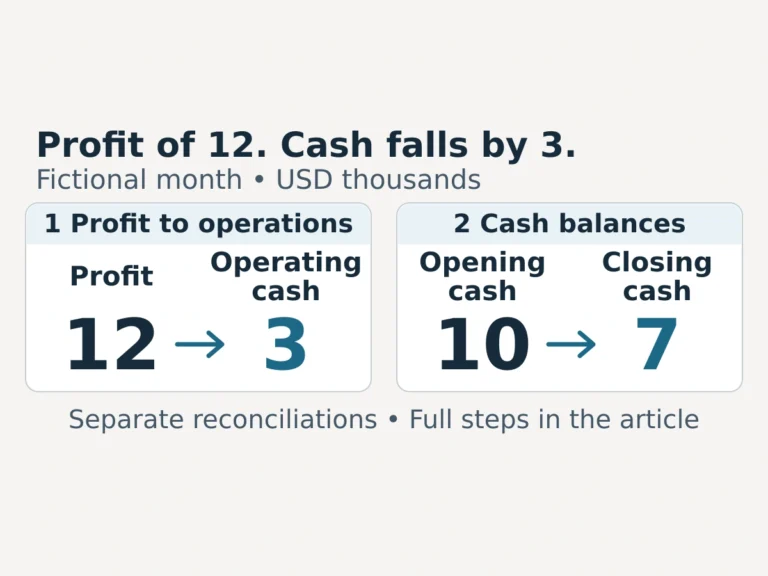
An invented one-month example reconciles net income, customer receipts, supplier payments, equipment, debt and an owner distribution to the closing cash balance.
One Customer Pays Late: Stress-Test Cash and Credit Availability Together
A fictional 13-week test shows how one late customer payment can reduce cash and credit capacity together, leaving a $6,000 gap before added financing…