Track Business Credit-Line Draws, Interest and Fees
Reconcile credit-line draws, principal payments and charges, then compare calculated unused credit with the lender’s confirmed availability.

A $6,200 payment does not necessarily reduce a business credit line’s principal by $6,200. And subtracting principal from the limit does not establish how much the lender will let you draw today. Reconcile those figures separately before using an apparent balance as spending capacity.
This U.S. educational guide builds a transaction ledger for an existing facility. Its purpose is to explain differences among money borrowed, charges, payments, remaining principal and confirmed availability. The fictional calculation is not a substitute for your agreement or statement.
Identify what each draw creates
Some facilities need separate draw records. The American Express Business Line of Credit drawing guide, checked October 19, 2026, describes separate loan agreements, monthly payments of principal and fees, and a combined payment schedule for multiple loans. Do not apply a single daily-interest calculation to that structure.
Start by identifying whether your records describe one revolving balance or separately scheduled loans under a facility. Read your applicable documents rather than assuming a current public product page changes an older agreement. No provider comparison or pricing recommendation follows from this distinction.
For separate draw loans, assign each a draw identifier, its own charges and its payment schedule. Then combine the actual due dates in a payment calendar. Keep the individual records so a payment assigned to one draw is not also counted against another.
Separate principal movements from cash payments
For a simple principal ledger, the identity is: beginning principal + new draws − payments applied to principal = ending principal. A draw brings in borrowed money, not sales revenue. A principal payment reduces debt; it is not itself a financing charge.
Give each transaction a dated entry containing:
- The effective date and transaction or draw identifier
- Money received and new principal recorded
- Interest or fees posted, identified separately
- Cash paid and the portions applied to charges and principal
- Principal remaining after the transaction
- The lender’s reported available credit, recorded separately
Retain the statement or confirmation behind each entry. If your ledger and statement use different cutoff dates, align them before looking for an error. A payment initiated today and a payment credited for calculation purposes are different entries until the applicable timing is established.
A fictional 30-day interest ledger
Assume an invented $30,000 facility starts with no balance. Its constant nominal annual rate is 12%, using actual days divided by 365. This example covers exactly 30 calendar days and charges interest only on principal. There is no compounding, minimum interest, other balance or rate change. A $60 fee is paid separately in cash and never added to principal.
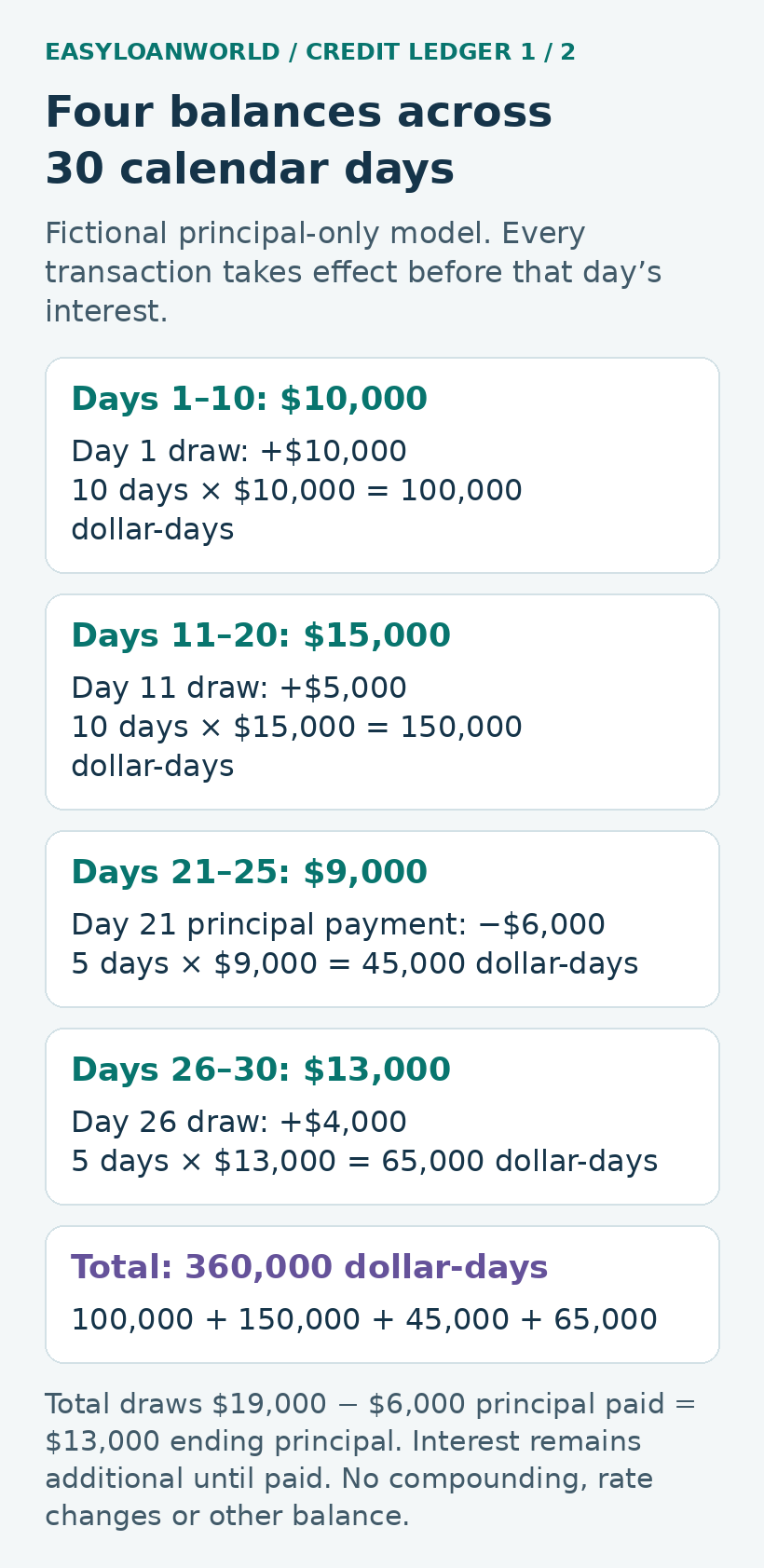
All transactions take effect before that day’s interest accrues. The ledger has four intervals:
- Day 1: draw $10,000. Principal is $10,000 on days 1–10, a total of 10 days.
- Day 11: draw another $5,000. Principal is $15,000 on days 11–20, another 10 days.
- Day 21: reduce principal by $6,000. Principal is $9,000 on days 21–25, a total of 5 days.
- Day 26: draw $4,000. Principal is $13,000 on days 26–30, another 5 days.
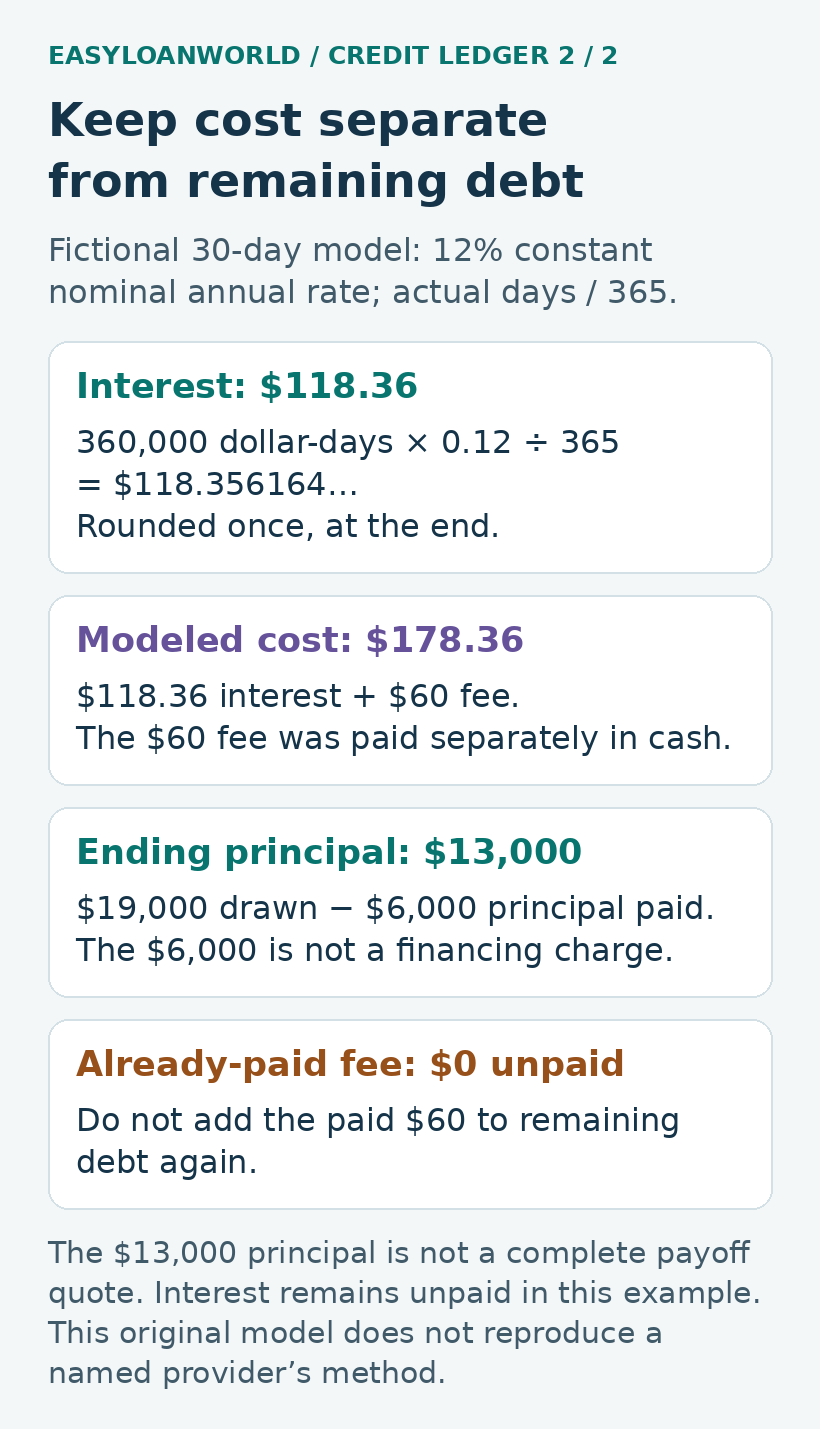
Total draws are $19,000. Subtracting the $6,000 principal reduction leaves $13,000 of ending principal. That is not a complete payoff quote: the modeled interest remains additional money owed until paid.
Check the dollar-days before the rate
Multiply each balance by its number of days: $10,000 × 10 + $15,000 × 10 + $9,000 × 5 + $13,000 × 5 = 360,000 dollar-days. Multiplying that result by 0.12 and dividing by 365 gives $118.356164…, rounded once at the end to $118.36 interest.
Add the separately paid $60 fee to get $178.36 in modeled financing cost. Do not include the $6,000 principal repayment in that cost. Do not add the already-paid fee to the remaining debt again. The exercise distinguishes costs incurred from amounts still unpaid.
Use your contract’s actual balance definition, day count, rate changes and rounding rules for a real reconciliation. A different daily rounding convention alone may produce a different result. This principal-only illustration does not reproduce either named provider’s calculation.
Explain a payment-allocation difference
The Wells Fargo BusinessLine agreement effective August 1, 2024 includes charge-specific balance calculations, allocation of payments to charges before principal, and possible holds on availability after payment. This example does not reproduce that agreement.
In a separate invented allocation example, a business pays $6,200. If $200 goes toward already-owed charges, principal falls by $6,000. Recording the whole $6,200 as a principal reduction would understate the remaining principal by $200. This mini-case illustrates allocation; it adds no new charge to the preceding 30-day calculation.
Keep calculated headroom separate from available credit
Under the fictional principal-only limit test, $30,000 minus $13,000 gives $17,000 of arithmetic headroom. Label it conditional. Do not replace the lender’s availability figure with that calculation.
As a separate hypothetical, a $6,000 hold against otherwise $17,000 headroom would leave $11,000 shown available until release. These are invented numbers, not a provider’s hold formula or a promise about duration. Ask for the explanation and applicable release conditions rather than treating the difference as spendable cash.
Leave unresolved differences visible
Finish with a short reconciliation note: statement period, difference found, transaction evidence, question for the lender and current status. Check for a missing draw, a duplicated payment, a charge allocation or a date mismatch. Do not force agreement by deleting an unexplained item.
Keep following the applicable payment obligations while seeking clarification; this model does not change a due date or establish a billing error. The useful endpoint is a ledger you can trace to documents, with remaining questions clearly identified and availability confirmed separately.
Public sources checked October 19, 2026. All worked amounts are hypothetical; existing agreements and current statements require individual review.
Featured photo: A blank notebook for organizing records. Photo: Amanda Lawrence / Unsplash. Used under the Unsplash license.

SBA Surety Bonds vs. Working-Capital Loans: Four Contractor Scenarios
Follow Riverton Build through four fictional alternatives at one pre-start review. Identify what remains unresolved and prepare a focused next conversation.
Export Payment Documents: A Two-Packet Review
A worked export-packet review follows an unresolved instruction proposal, an incomplete selected inventory and an unknown carrier arrangement, without inventing the missing evidence.
Profitable Business, Falling Cash: Reconcile the Difference
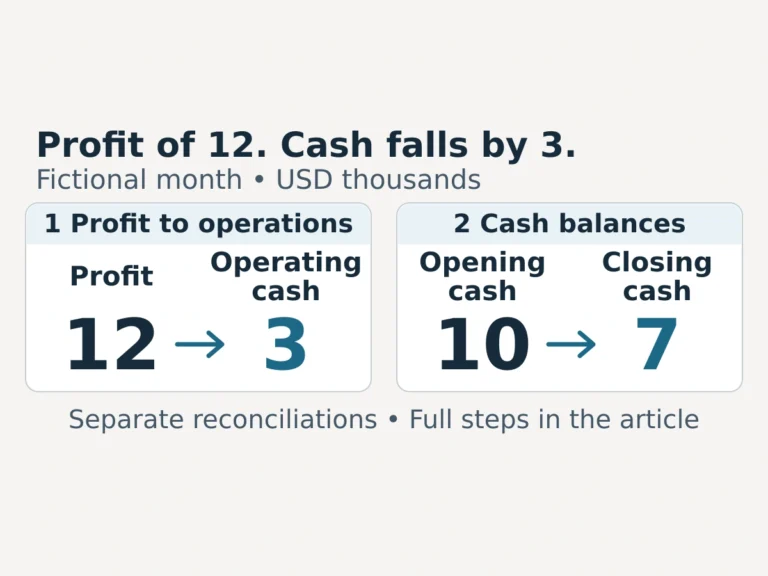
An invented one-month example reconciles net income, customer receipts, supplier payments, equipment, debt and an owner distribution to the closing cash balance.