Business Debt Refinancing: Lower Payments, Longer Debt?
Compare a fictional two-loan schedule with a replacement across three time bands, then track the evidence for each completed payoff.

Estimated reading time: 8 minutes
Business debt refinancing can change the timing of payments as well as their total. Compare the replacement loan with the old debts as they would actually run off, including what remains owed at each checkpoint.
A replacement loan can look attractive beside today’s combined payment. The more useful comparison follows what the old payments would become as each debt ends. This fictional exercise separates first-year breathing room from the amount and duration of the remaining commitment.
PNC’s refinancing guide notes that combining debts can simplify payments, while extending a nearly repaid loan can increase cost. Check payoff and prepayment charges, new origination and collateral-related costs, and overlapping interest. Actual written terms govern; this illustration isn’t an offer.
Business debt refinancing: trace the new principal
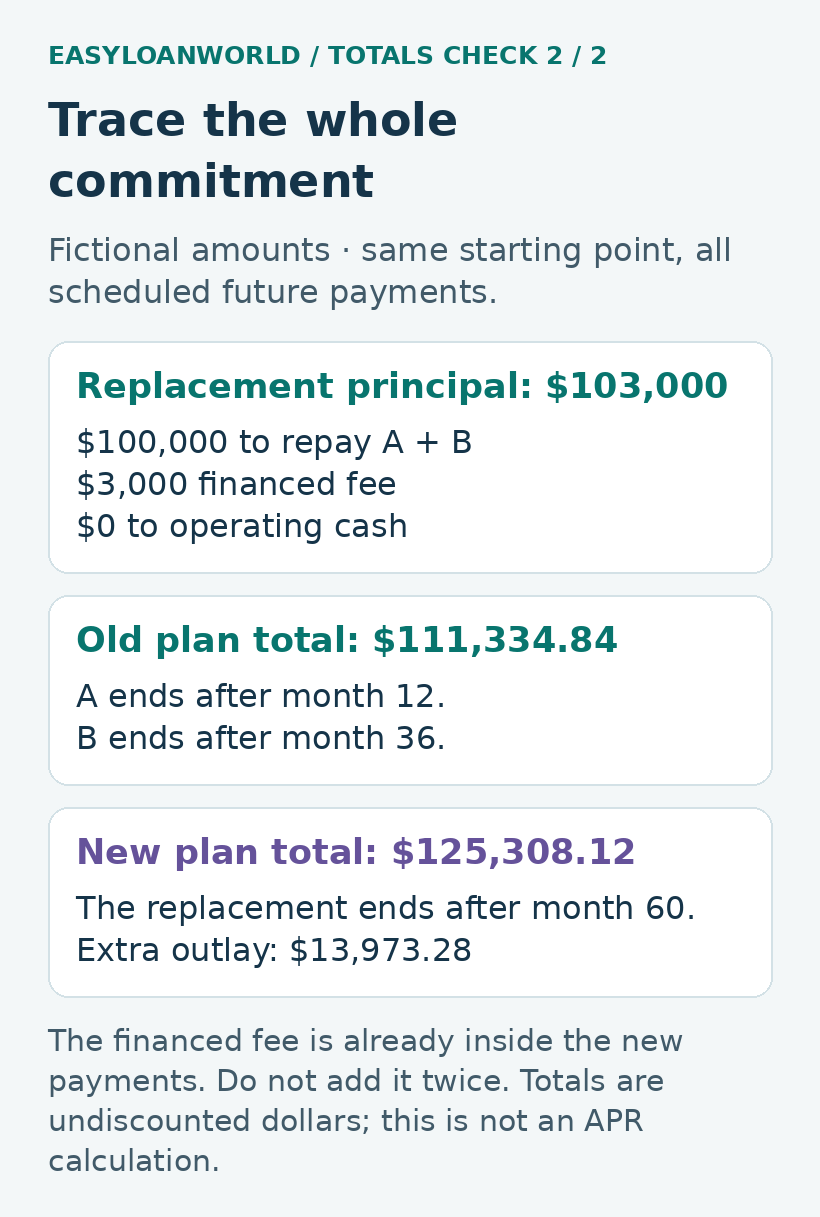
All figures are invented. Start immediately after the last old payment. Loan A’s $40,000 balance and Loan B’s $60,000 balance equal their immediate payoff amounts. The replacement principal is $103,000: $100,000 goes directly to the old lenders and $3,000 finances a fee. Nothing reaches operating cash.
After both payoffs are completed, the model contains $103,000 of new debt, not $203,000 of combined old and new debt. The fee is already inside the replacement principal and its payments; don’t add it again to the payment total.
- Old Loan A: $40,000, 12% nominal annual interest, 12 months remaining.
- Old Loan B: $60,000, 9% nominal annual interest, 36 months remaining.
- Replacement: $103,000, 8% nominal annual interest, 60 months.
Each rate is fixed in this exercise. Payments occur monthly at month-end, beginning one month later, using annual interest divided by 12. There’s no unpaid interest at settlement, penalty, other fee, refund, tax effect, cash-out, balloon or other debt. These are contract interest rates, not disclosed APRs. Actual lender rounding and schedules can differ.
Business debt refinancing: compare three calendar stretches
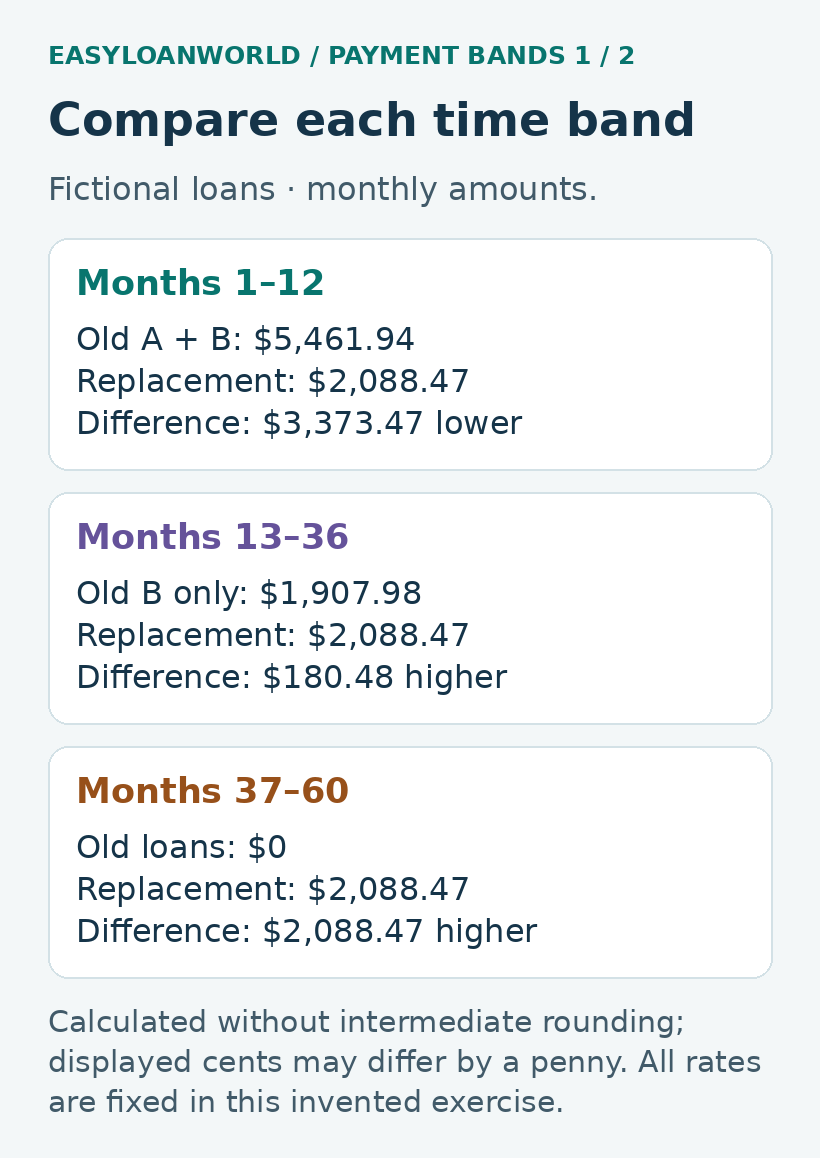
The calculated monthly payments are $3,553.95 for A, $1,907.98 for B and $2,088.47 for the replacement. All comparisons below use unrounded calculations and round only the displayed answer; adding or subtracting displayed cents may differ by a penny.
- Months 1–12: the old combined payment is $5,461.94, versus $2,088.47 new. Initial relief is about $3,373.47 a month.
- Months 13–36: A has ended, leaving $1,907.98 a month on B. The replacement is now about $180.48 more a month.
- Months 37–60: both old loans would be finished. The replacement still requires $2,088.47 a month for another 24 months.
The first difference can’t be multiplied by 60 and called savings. That would pretend Loan A survives its scheduled finish and Loan B continues beyond month 36. Put those two ending dates on the comparison before interpreting any payment reduction.
Check what remains owed at each milestone
Immediately after month 12’s payments, the old plan has $41,764.14 left, all on B. The replacement has $85,547.67 left. Lower first-year payments therefore leave a substantially larger balance in this scenario.
After month 36, the old plan’s balance is zero, while the replacement still owes $46,177.18. That amount is remaining principal, not a bill to add to all 60 replacement payments: those later payments already repay it.
Keeping the old loans produces $111,334.84 in remaining scheduled payments. The replacement produces $125,308.12, or $13,973.28 more. This compares all future scheduled outlay from the same starting point until both alternatives end. It’s undiscounted nominal dollars, not present value, a tax analysis or an APR calculation.
The example assumes no return earned by deploying first-year relief. A business evaluating that possibility would need a separate supported operating plan. Costs irrevocably paid before this comparison are excluded; principal still outstanding remains part of the debt.
Business debt refinancing: reproduce each component separately
Use the embedded calculator for the three fully amortizing components. Enter each remaining balance, fixed annual contractual interest rate and remaining whole-month term separately. The model uses monthly interest and excludes the additional charges already excluded from the original exercise.
For old Loan A, enter $40,000, 12% and 12 months. Expected monthly principal and interest is $3,553.95, with $2,647.42 interest and $42,647.42 total remaining payments.
For old Loan B, enter $60,000, 9% and 36 months. Expected payment is $1,907.98, interest $8,687.42 and total remaining payments $68,687.42. Combining the two unrounded totals produces the original $111,334.84 old-plan total.
For the replacement, enter $103,000, 8% and 60 months. Expected payment is $2,088.47, interest $22,308.12 and total payments $125,308.12. The $3,000 financed fee remains inside principal; entering only the $100,000 old payoff total would model a different loan.
Don’t enter a single blended term for the old debts. Loan A ends after 12 payments and B after 36. Their different ending months are the central reason today’s combined payment can’t be projected unchanged for five years.
Business debt refinancing: pair first-year cash with remaining principal
At the month-12 checkpoint, the old plan has paid $65,543.23 and the replacement $25,061.62, using unrounded installments before display. The modeled cash-payment difference is $40,481.60. That’s first-year payment relief, not a full-life saving.
The original remaining balances at that point are $41,764.14 old and $85,547.67 new. The replacement therefore leaves $43,783.53 more principal. Keep that debt difference beside the first-year cash difference rather than presenting only the smaller payments.
For an independent settlement-at-checkpoint illustration, assume the remaining principal could be paid immediately after month 12 with no added charge or interest. Paid installments plus principal would total $107,307.37 old and $110,609.29 new.
Using the underlying unrounded calculations, the new path’s difference is $3,301.93. Subtracting the two separately rounded displayed totals gives a one-cent display difference. These are hypothetical checkpoint settlements, not additional amounts to add to the complete scheduled-payment totals.
The new path has already started with $3,000 more principal because of the financed fee. Its lower first-year cash payments leave more debt outstanding. The checkpoint calculation makes both effects visible without assuming any return from investing the early relief.
Business debt refinancing: keep operational uses of relief conditional
Suppose the business proposes using part of the first-year cash difference to fund inventory. That’s a separate operating decision. It needs purchase timing, sales assumptions, collection dates and other costs before any profit or repayment benefit can be estimated.
Don’t treat the entire $40,481.60 as cash available at the refinance date. It accumulates through twelve smaller scheduled payments under the supplied model. Spending it all before those differences occur would require another source.
Likewise, the cash difference falls away when the old loans would have ended. A new recurring expense funded from the first-year difference needs a plan for months 13 onward, when the comparison reverses. The original three calendar bands remain relevant.
Business debt refinancing: verify the transition before relying on one payment
Keep payoff confirmations for both old lenders and the replacement’s first-payment instructions. A funded replacement doesn’t establish that both old balances reached zero or that automatic debits ended. Record unresolved amounts rather than assuming the transition is complete.
If an actual payoff differs from the modeled $40,000 or $60,000, reconcile the cause and rebuild the new principal. A separate fee paid in cash also changes the funding record compared with a financed fee.
The useful comparison matches starting payoffs, fees, payment timing and remaining debt. It can show meaningful early relief while still showing higher total cost. Neither result alone decides whether the actual commitment is workable for the business.
Another full-schedule check starts from the original $100,000 debt being replaced. The replacement’s $22,308.12 interest plus its $3,000 financed fee gives $25,308.12 above that starting debt. The old schedules contain $11,334.84 interest. Their $13,973.28 difference matches the original total-outlay comparison. This decomposition explains the fee’s contribution without adding the same financed $3,000 to scheduled repayments again.
Give each replaced account an evidence card
Use a separate private card for A and B. These are questions for completing the model, not promises about a lender’s process:
- Dated payoff and validity date?
- Sender, receipt and confirmed application of funds?
- Zero balance and open/closed status?
- Collateral/guarantee release questions for lender or lawyer?
- Old debit instructions confirmed?
For the replacement, record principal, payoffs, financed fee, operating proceeds, first payment, rate/reset terms, maturity, collateral and personal promises.
Unconfirmed payoff means the one-loan assumption remains unresolved. Funding alone doesn’t verify lien or guarantee release. A pending refinance doesn’t extend payment deadlines; keep required payments current.
General U.S. business-finance education, not individualized lending or legal advice. Source checked October 19, 2026. All loans and amounts are fictional.
After comparing the schedules, test the proposed commitment against your business’s available cash flow.
Featured photo: Empty office workstations, shown for illustration. Photo: Madeline Liu / Unsplash. Used under the Unsplash license.


