Business Credit Line Renewal: Prepare for the Review
Prepare an evidence-based credit line review packet, track separate deadlines, explain business changes and compare any proposed renewal terms.

Estimated reading time: 8 minutes
Credit line renewal preparation starts with the dates that govern your existing business facility. Distinguish the review, a possible decision, any draw cutoff and the repayment deadline before assembling the requested evidence.
A business credit review, renewal decision, draw cutoff and repayment deadline are different events. Before preparing a renewal packet, establish which events apply to your existing line and what each date means. A meeting on the calendar isn’t evidence that borrowing access continues afterward.
This U.S. guide helps an existing borrower explain what has changed since the last review. The goal is a consistent record of dates, business changes and unanswered questions, without treating preparation as a promise of renewal.
Credit line renewal: check the review arrangement
Bank of America’s unsecured-line disclosure describes availability generally lasting one year, with renewal at the bank’s discretion.
By comparison, Wells Fargo’s BusinessLine product page advertises no annual review. There’s no single annual-review assumption to apply to every business line.
That doesn’t mean permanent, unconditional access. The published BusinessLine agreement, sections 12–13, permits closing or reducing a line, subject to applicable law, even without default; payment responsibility continues. It also permits credit reevaluation and requests for current financial information. The bank’s agreement hub identifies its published documents as new-account agreements. Existing borrowers should obtain their own applicable terms.
Credit line renewal: make four separate date cards
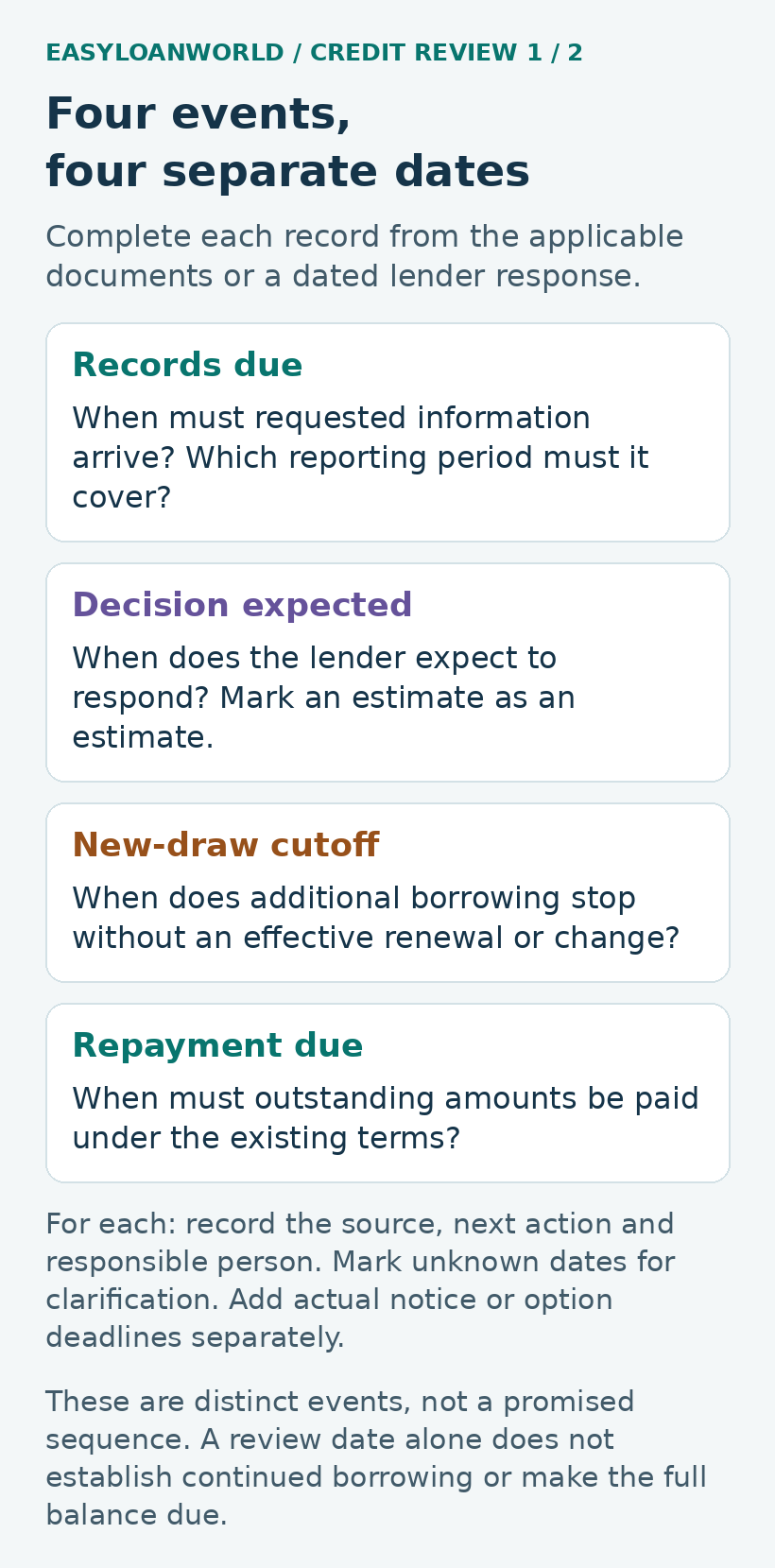
Use the current agreement and any lender notice to complete these cards. If a date is unavailable, record who will clarify it rather than selecting an assumed deadline.
- Records due: when requested information must arrive and which reporting period it must cover.
- Decision expected: when the lender expects to communicate a review or renewal decision, if known.
- New-draw cutoff: when additional borrowing stops without an effective renewal or change.
- Repayment due: when outstanding amounts must be paid under the existing terms.
For each card, record the document and page, or a dated lender response, plus the next action and responsible person. Add any actual notice or option deadline separately. Keep an estimated decision date visibly different from a contractual deadline.
Work backward from the earliest verified date and the time your accountant needs. If the expected decision follows a draw cutoff, ask how that gap will be handled. The sequence alone doesn’t establish an extension or change an existing payment obligation.
Explain what changed, using comparable periods
The OCC’s 2026 lending handbook describes monitoring required financial statements, covenant testing and periodic commercial reviews. It’s supervisory guidance for OCC-regulated institutions, not a uniform borrower checklist or a right to renewal. Confirm what your agreement and lender require.
Prepare a short cover note using the following structure. This is an organizational aid, not an official bank form. Keep supporting records private and submit only through the bank’s verified requested channel.
State the requested outcome
Write down whether you want the existing facility continued, a different size or another specific change. Explain its intended use and repayment source briefly. Label this as the business’s request, keeping it separate from anything the bank has approved.
Choose a fair comparison
Identify the last reviewed period and the current comparable period, with exact dates and the accounting basis used. Put a forecast in its own section. Nine months of completed results and twelve months of results need an explicit explanation before comparison.
For a seasonal business, identify whether the periods cover the same part of its cycle. A strong month isn’t an explanation for a full-year assumption. If the reporting basis changed, ask the accountant to explain how that affects the comparison.
Write one entry per material change
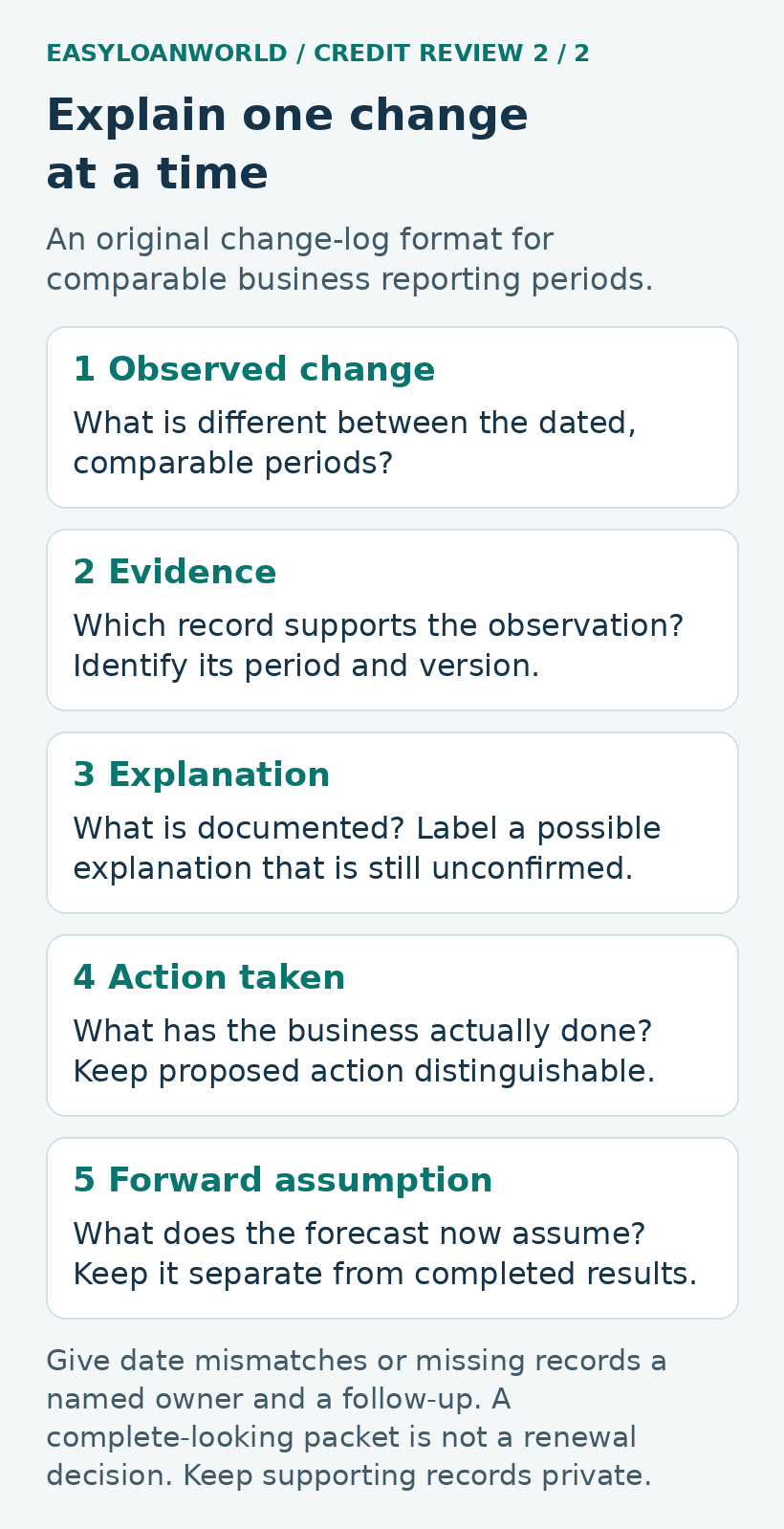
Use five short fields: observed change, evidence, explanation, action taken and forward assumption. For example, a customer paying later may warrant an entry. Attach the supporting record and distinguish a documented reason from a possible explanation you haven’t confirmed.
Other entries might concern changed supplier terms, a one-off asset sale or a new recurring debt. Keep unusual events visible rather than presenting them as ordinary repeatable performance. Financing proceeds shouldn’t be presented as customer sales, and outstanding obligations should remain visible.
Track the actual information request
Confirm whether the lender needs financial statements, tax information, debt details or applicable receivable, inventory or covenant records. The required documents, dates and frequency depend on the facility; this list doesn’t prescribe them.
For each requested item, record its period, format, preparer, ready date, submission date and acknowledgement. Give a late item its own follow-up. Sending the available files isn’t a reason to mark an incomplete request complete.
A fictional packet with three different dates
A fictional wholesaler has September 30 financial statements, an August 31 customer-aging report and a forecast relying on a large October collection. The dates differ. That alone doesn’t prove the figures are false, the customer will pay or a lender test has failed.
The preparation work is to make the relationship between those records understandable:
- Align the report dates, or label why a different cutoff is being used.
- Trace the expected October collection to supporting evidence and identify the uncertainty.
- Keep the completed September period separate from projected October activity.
- Tell the lender which corrected schedules are outstanding and when they will be available.
For each mismatch, name the person who will resolve it and retain the corrected version. Ask the accountant about genuine reporting differences; ask the lender which definitions govern its requested test. Don’t alter evidence simply to make a result look acceptable.
Compare any proposal with the current documents
Use a vertical card for each relevant term, with three fields: current documented term, proposed term and operating consequence or question. Inspect what is actually offered:
- Limit and period for new draws
- Maturity and payment structure
- Rate method and fees
- Reporting or covenant requirements
- Any collateral or guarantee changes
These are review prompts, not claims that every offer contains every feature. Mark an unanswered item “unconfirmed” rather than carrying an old term into the proposal by assumption. Obtain qualified legal or financial advice on a change you don’t understand.
Credit line renewal: test the no-new-draws cash plan
Add a separate fictional cash checkpoint to the renewal file. Assume new draws have stopped under the existing documented cutoff while the review remains unresolved. The business has $4,000 usable cash, expects a verified $3,000 customer collection before a $9,000 supplier payment, and has no other available funding. All other required payments and protected uses have already been allowed for outside this narrow checkpoint.
Cash available for that supplier payment is $7,000, leaving a $2,000 gap. A displayed $10,000 unused line limit doesn’t fill it when new draws are unavailable under the scenario. Don’t add that limit to the bank balance or treat a submitted renewal packet as permission to borrow.
The test doesn’t assume outstanding principal suddenly becomes due on the review date. Existing repayment obligations remain governed by the actual agreement. Keep their amount and deadline on the separate repayment card; if your opening cash hasn’t already allowed for them, include them once in the cash forecast before using this result.
Give each proposed solution an evidence status. An earlier customer payment, a revised supplier date or an effective lender change needs its own confirmation before it can replace the $2,000 unresolved amount. A request, discussion or estimated approval date isn’t a completed funding event. Don’t label an anticipated asset sale as cash already usable.
For actual credit line renewal preparation, attach the no-new-draws forecast to the change log and identify the first unfunded date. State which collection date is supported, which payment is contractually committed and which proposed change remains conditional. This makes the operating consequence clear without exaggerating it into a claim that the whole facility must be repaid immediately.
Recalculate when the lender communicates effective terms. If access resumes, record the available amount, conditions and resulting debt payments rather than simply deleting the gap. If it doesn’t, keep the cash problem visible while discussing feasible options promptly with the lender and qualified advisers. Preparation supplies a clearer decision record; it can’t guarantee renewal or create funding.
Track the decision while preserving the current plan
Keep separate statuses for information requested, packet acknowledged, decision communicated, conditions resolved and effective written terms verified. These are your tracking labels, not a required bank sequence. A receipt acknowledgement or willingness to review doesn’t establish renewed availability.
While waiting, test a contingency plan with no new draws after the actual cutoff and existing repayment duties unchanged. This doesn’t assume the whole balance becomes due at review. If the test reveals an urgent gap, discuss it promptly with the lender and qualified advisers.
Finish by recording what was decided, what remains conditional and which documents establish the effective terms. If renewal is refused or the facility changes, identify the actual written consequences before revising the operating plan.
Sources checked October 19, 2026. Product examples illustrate differing arrangements; your applicable agreement and lender communications need their own review.
Use a business credit-line ledger to reconcile draws, charges and principal before presenting the facility’s current position.
Featured photo: Photo by Swello on Unsplash. Used under the Unsplash license. Illustrative calendar; it doesn’t show a loan deadline. Photo by Swello on Unsplash.