Business Line of Credit vs. Term Loan: Match Funding to the Cash Need
Compare a business line of credit and term loan using cash timing, repayment, fees and renewal risk, with a practical funding worksheet.

Estimated reading time: 9 minutes
Before choosing a business line of credit or term loan, put two dates on paper: when the business must spend the money and when it can realistically repay it. Then test the required payments against a slower month. An approved limit alone doesn’t answer either question.
This guide compares the structures, then uses two separate hypothetical funding needs to show how to evaluate them. The examples are planning exercises, not current offers or a ranking of lenders.
Business credit line or loan: what changes?
A conventional term loan delivers a lump sum with a repayment schedule. A revolving line lets a business draw available funds, repay principal and borrow again while the agreement permits. That distinction concerns access to money; it doesn’t establish which offer costs less. Chase explains the two structures.
Don’t assume every term loan has a fixed rate or equal payments. For a specific example, Bank of America’s unsecured term loan describes fixed equal monthly payments and interest on the outstanding balance. Ask how your own offer calculates interest as principal is repaid.
Revolving doesn’t mean permanently available. Bank of America’s line disclosures say availability is generally one year, renewal is at the bank’s discretion, and an annual maintenance fee can apply without borrowing. A zero drawn balance therefore doesn’t necessarily mean zero cost.
Nor does a line necessarily require interest-only payments. Chase’s business and commercial line descriptions illustrate different minimum-payment and maturity arrangements. Its page also specifies personal guarantees. Check the complete agreement rather than treating an unsecured label or an LLC name as an answer about personal liability.
Business credit line and loan: compare three payment dates
- The spending date. Write the amount actually needed after deductions, and whether the seller requires one payment or several. If money arrives after the supplier’s deadline, an otherwise attractive quote doesn’t solve that expense.
- Every required payment date. Put the first installment and subsequent obligations beside expected customer collections. Include principal due later, not just an affordable-looking first payment.
- The end of availability or repayment. Ask when draws stop, when the balance must be repaid, and what happens if a requested renewal is refused. Don’t build a plan that only works if another financing offer appears.
Use those dates to describe the need precisely. “Pay a supplier now and repay from a named customer collection” is a different problem from “buy equipment that must earn its cost over several years.” The following scenarios deliberately address different problems. Their total costs aren’t a controlled price comparison.
Example 1: a $12,000 supplier payment and a 60-day collection gap
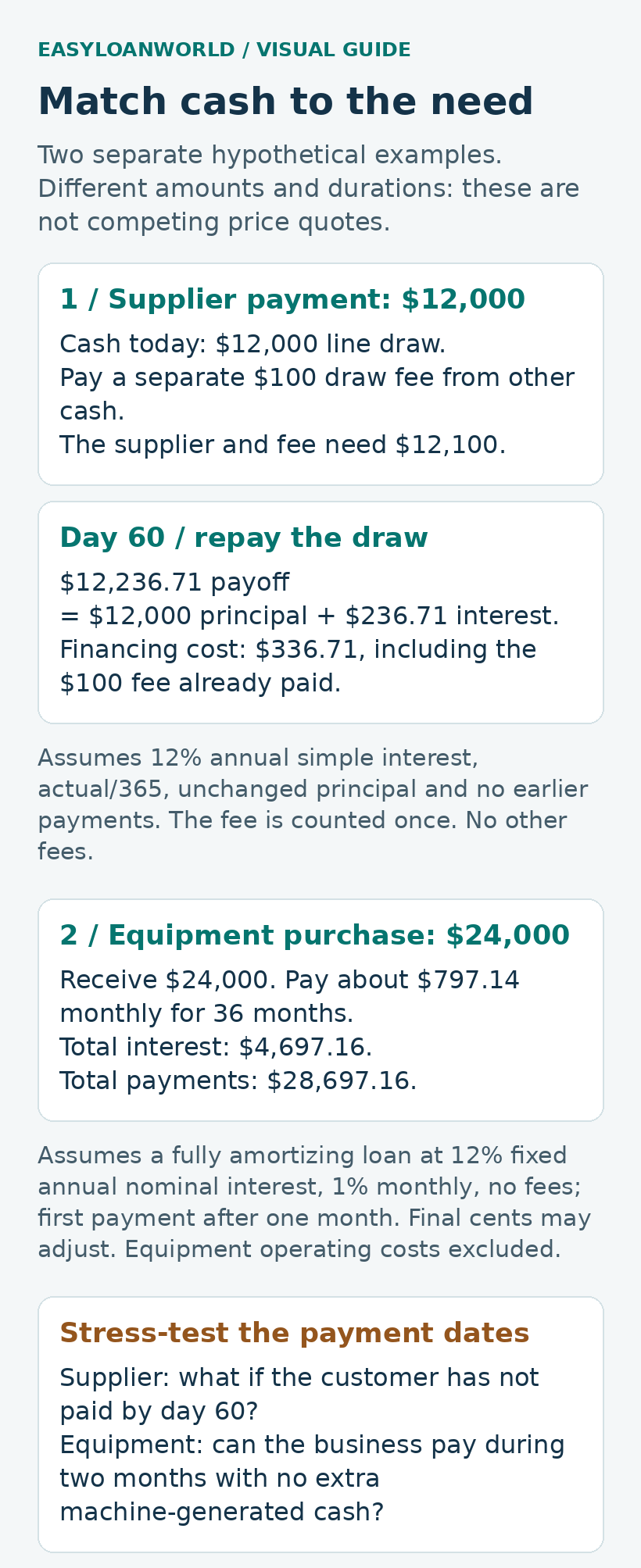
Hypothetical assumptions: A business draws $12,000 today. The line charges 12% annual simple interest using actual days divided by 365, plus a $100 draw fee paid separately today. Principal stays at $12,000, no payments are required before day 60, and the business pays the balance and interest then. There are no other fees. These are invented terms, not standard line-of-credit terms.
- Interest: $12,000 × 0.12 × 60 ÷ 365 = $236.71.
- Total financing cost: $236.71 interest + $100 fee = $336.71.
- Day-60 payoff: $12,236.71, because the $100 fee was already paid.
- Cash needed today: $12,100 for the supplier and fee. The $12,000 draw leaves $100 to cover from other cash.
The fee belongs in the cost comparison, but adding it to the payoff again would count it twice. Likewise, repaying the $12,000 principal is a cash obligation, not an additional $12,000 financing charge.
What if the customer pays 30 days later?
If the same balance and rate continue for 90 days, total interest becomes $355.07 and financing cost becomes $455.07. The additional 30 days add about $118.36 of interest.
That arithmetic doesn’t grant permission to miss the assumed day-60 payoff. If payment is due then, the business needs another cash source or an agreed change. The 90-day calculation assumes the balance can remain outstanding on unchanged terms without added charges; an actual agreement may produce a different result. A late customer payment and a late financing payment are separate events.
Decision prompt: Can existing cash cover the day-60 obligation if this customer hasn’t paid? If the answer is no, write “cash shortfall” before treating the expected collection as certain.
Example 2: a $24,000 machine with a 36-month repayment plan
Hypothetical assumptions: A business receives a $24,000 fully amortizing term loan at 12% fixed annual nominal interest. The monthly rate is 1%, with 36 monthly payments beginning one month after funding and no fees.
- Calculated monthly payment: about $797.14.
- Total payments: $28,697.16 using the unrounded payment calculation.
- Total interest: $4,697.16.
Rounding each actual payment to cents may change the final payment by pennies. These figures exclude the machine’s maintenance, installation, insurance and operating expenses.
Now write a conservative estimate of the machine’s additional monthly cash contribution after its operating costs. Compare that estimate with the $797.14 payment and the rest of the business budget. Sales attributed to the machine aren’t automatically cash available for debt payments.
Stress-test two months with no additional machine-generated cash. Can the business still make the required payments? Also ask whether the machine remains useful throughout the repayment period. This exercise assesses the proposed purchase and its timing; it doesn’t prove a term loan is always the better structure.
Test the business credit line and loan examples separately
Reproduce the supplier example with the simple-interest calculator below. Enter $12,000 principal, 12% annual interest, 60 elapsed days and the Actual days / 365 basis. Expected interest is $236.71, and principal plus interest is $12,236.71. This checks a constant balance with no interim payments; it doesn’t simulate a revolving account with several draws.
Keep the $100 draw fee on a separate cash line. Because this example pays it at the start, add it to interest to get $336.71 financing cost, but don’t add it to the day-60 payoff again. If a real agreement finances the fee or deducts it from proceeds, rebuild the cash record using that different treatment.
Change only elapsed days to 90. Expected interest rises to $355.07, with $12,355.07 principal and interest due under the illustration. Add the already separate fee to obtain $455.07 total cost. This business credit line sensitivity changes the collection delay; it supplies neither permission to miss an installment nor confirmation that a lender would extend the borrowing.
For the equipment loan, use the separate payment calculator: $24,000 principal, 12% annual rate and 36 months. The expected monthly installment is $797.14. Its interest declines as principal is repaid, so applying 12% to $24,000 for three whole years wouldn’t reproduce the amortizing schedule.
These business credit line and loan calculations answer different questions. The supplier case asks how long one balance remains outstanding; the equipment case asks how a lump sum amortizes over a fixed schedule. Before comparing two real offers, hold the funded purchase, usable proceeds and timing constant. Then list required payments by date alongside the cash expected from customers. A cheaper modeled cost can’t solve a payment that comes due before the business collects.
Business credit line and loan: build a cash worksheet
Complete one worksheet for the expense, then attach the written terms for each offer. Use actual expected collections rather than counting an issued invoice as money already in the bank.
- Expense: What are we buying? What net amount is needed, on which dates? Is this a one-time need or will it recur before the first borrowing is repaid?
- Repayment source: Which collections will cover the obligation? Write the expected dates and a second version with the main customer 30 days late.
- Useful life: How long will the purchase contribute to the business? Does the proposed payment period fit that expectation?
- Offer cash flows: Record cash received, every scheduled payment, separately paid costs, remaining principal at maturity, and the renewal or draw-expiry date.
- Operating room: For each payment period, start with cash on hand, add expected collections, then subtract ordinary expenses, taxes, existing debts, the new obligation and a business-chosen cash buffer.
- Lowest balance: Identify the tightest date in both the expected and delayed-collection versions. A positive balance at month-end doesn’t fix a shortage before payroll.
- Decision label: Mark “timing fits,” “needs clarification” or “cash shortfall,” and write the next fact or change needed. These are planning labels, not an approval or suitability test.
Questions to settle in writing
Review fees, collateral and reporting obligations for both offers. Chase’s comparison identifies annual, draw, origination and late-payment charges, along with line reviews and financial-statement requirements. Ask which apply to your contract; don’t assume an unused line is free or a term loan has no ongoing conditions.
- Is the rate fixed or variable? What changes it, and how is interest calculated?
- Does each payment reduce principal? Is any balloon or other unpaid balance due later?
- What is the exact early-payoff amount and treatment of fees?
- What assets and guarantees support the obligation, and what conditions restrict additional borrowing?
- Which documents must we submit after funding, by which dates?
SBA-backed loan programs are another avenue to investigate. Eligibility differs by lender and program; repayment ability and business purpose matter. Investigating a program doesn’t establish qualification or a lower price.
Bottom line: Choose a structure only after tracing the expense, usable funding and repayment dates through the business’s cash plan. If the plan needs an unconfirmed renewal or a perfectly timed customer payment, resolve that dependency before signing.
Primary sources checked October 19, 2026. U.S. general education, not individualized financial, legal or tax advice. A qualified business finance adviser or attorney can review the specific offer and obligations.
Size the usable amount with a working-capital gap calculation before treating an offered limit as the amount the business needs.
Featured photo: Photo by Alberto Rodríguez on Unsplash. Used under the Unsplash license. Illustrative stock photograph of warehouse inventory. No financing status is identified for the pictured business. Photo by Alberto Rodríguez on Unsplash.