Working Capital Loan Sizing: Find the Cash Gap Before You Borrow
Find the largest dated cash shortfall, account for withheld loan fees, and test whether collections can cover repayment—even when a customer pays late.

Estimated reading time: 9 minutes
Size a working capital request around the largest dated cash gap, then check the full repayment. The amount needed to pay suppliers before customers pay you is different from annual sales, accounting working capital or the largest credit limit a lender might offer.
The useful output is specific: how much usable cash is needed, when it must arrive, and which later receipts can repay it while keeping the business operating. This U.S. educational example shows that complete loop.
Working capital loan sizing: identify usable cash
Net working capital is current assets minus current liabilities at a date. It’s a balance-sheet measure that includes assets, such as inventory and receivables, that may not yet be cash. Bank of America’s working-capital guide also discusses forecasting receipts and outflows to identify the widest cash gap.
A shelf of inventory can’t directly fund payroll. A customer invoice needs a realistic collection date. The calculation below therefore follows usable cash through a supplier-and-customer cycle instead of treating a balance-sheet subtotal as the loan request.
The SBA’s finance guidance highlights receivables, payables, available cash and bank reconciliation. Reconcile those records before forecasting; an unexplained opening balance makes every later estimate harder to trust.
Chase’s public cash-flow instructions use deposit and withdrawal dates, amounts and starting cash. That timing distinction matters here: record when usable money arrives or leaves, not simply when an invoice is issued.
Build the cash calendar without counting anything twice
Start with available opening cash after setting aside unavailable amounts and known remittances. If you already removed an obligation from that balance, don’t deduct the same obligation again in a later row.
Then enter expected customer collections and each committed payment: supplier and inventory cash, payroll, business taxes, necessary owner distributions and existing debt principal and interest. Salary already included in payroll isn’t a second owner draw. An inventory payment shouldn’t also appear as cost of goods sold and an additional inventory adjustment in this direct-cash forecast.
Keep new financing on separate lines. Its proceeds are borrowing, not revenue. Its costs and repayment must appear on their actual dates, even when the customer who was expected to fund repayment pays late.
Check the cash inside each week before choosing the funding date
A positive Friday balance can conceal a Monday shortfall. Consider this separate, simplified example with $8,000 opening usable cash and a chosen $5,000 minimum cash balance. Assume no other movements.
| When | Cash movement | Cash remaining |
|---|---|---|
| Monday, before payroll | Opening balance | $8,000 |
| Monday, payroll clears | −$6,000 | $2,000 |
| Friday, customer payment clears | +$9,000 | $11,000 |
The week ends with $11,000, but Monday falls $3,000 below the chosen cash floor: $5,000 minus $2,000. If the business plans to preserve that floor, the usable funding or agreed payment-timing change must be in place before Monday’s payroll clears. The promised Friday collection can’t fund Monday.
To apply this check, copy your forecast into a dated list. For each row, record the opening balance, cleared receipt, payment leaving the account, closing balance and supporting evidence. Mark an expected customer receipt separately from cleared money. Recalculate the lowest balance after moving a major receipt to a later date.
This small example only identifies timing and the pre-financing gap. Add the actual funding proceeds, fees, interest and repayment on their own dates before deciding whether financing solves the entire cash cycle. The eight-week case below uses a different transaction schedule.
An eight-week wholesale cash gap
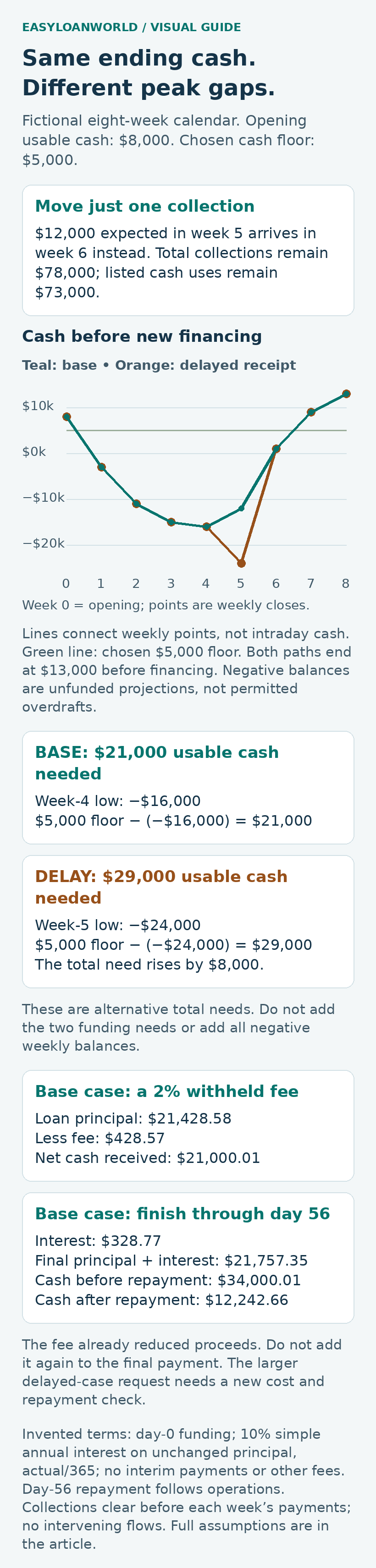
Consider a fictional wholesaler paying suppliers ahead of customer collections. It starts with $8,000 of usable cash and chooses a $5,000 cash floor. The floor is a planning choice, not a lender requirement or industry standard.
Each week’s cash out includes all the operating, tax, owner and existing-debt payments described above. Only the new financing’s proceeds, costs and repayment are excluded initially. No other cash flows are assumed.
Timing assumption: collections clear on days 7, 14, 21, 28, 35, 42, 49 and 56, before that day’s listed payments. There are no intervening transactions. These weekly closing figures therefore capture the operating low points in this invented schedule.
- Week 1: $3,000 in; $14,000 out; projected cash without new funding: −$3,000.
- Week 2: $4,000 in; $12,000 out; projected cash: −$11,000.
- Week 3: $6,000 in; $10,000 out; projected cash: −$15,000.
- Week 4: $8,000 in; $9,000 out; projected cash: −$16,000.
- Week 5: $12,000 in; $8,000 out; projected cash: −$12,000.
- Week 6: $20,000 in; $7,000 out; projected cash: $1,000.
- Week 7: $15,000 in; $7,000 out; projected cash: $9,000.
- Week 8: $10,000 in; $6,000 out; projected cash: $13,000.
Every balance equals the previous balance plus that week’s receipts minus payments. Negative figures describe an unfunded projection; they don’t mean a bank will allow the payments to clear.
Total receipts are $78,000 and listed cash uses are $73,000. Opening cash plus the $5,000 net inflow produces the $13,000 ending balance. That positive ending balance doesn’t fund the earlier shortfall.
The peak requirement is $21,000 of usable funding
The lowest projected balance is −$16,000 in week 4. To preserve the selected $5,000 floor, the business needs $5,000 − (−$16,000) = $21,000 of additional usable cash.
Don’t add all the negative weekly balances: each already carries the earlier gap forward. Don’t add opening cash again, either; the $8,000 is already inside every projected balance.
For a real business, inspect daily transactions when payroll or supplier payments come before the week’s receipts. Weekly closing balances can otherwise conceal a larger shortfall.
Adjust for a withheld fee, then test maturity
A $21,000 cash need doesn’t necessarily mean a $21,000 loan. Assume these entirely fictional terms:
- Funding on day 0, with a 2% origination fee withheld from principal.
- A 56-day loan charging 10% simple annual interest on unchanged principal, using actual days divided by 365.
- No interim principal or interest payments and no other fees.
- Full principal and interest due on day 56, after that day’s operating transactions.
Divide the usable cash needed by the proportion retained: $21,000 ÷ 0.98. Rounding the principal up to $21,428.58 avoids funding below the required cents. The fee rounds to $428.57, leaving $21,000.01 received. The funded operating trough becomes $5,000.01.
Day-56 interest is $21,428.58 × 10% × 56 ÷ 365, or $328.77 rounded to cents. The final payment is $21,757.35: principal plus interest. Don’t add the withheld fee again to this payment; it already reduced the proceeds.
Immediately before repayment, cash is $13,000 plus $21,000.01, or $34,000.01. After paying $21,757.35, the business has $12,242.66, above its chosen floor in this scenario.
The difference from the $13,000 no-financing ending balance is the $757.34 financing cost: $428.57 fee plus $328.77 interest. The 10% interest assumption isn’t a fee-inclusive APR or a current offer. A different disbursement date, payment schedule, fee or rate requires a new calendar calculation.
Working capital loan sizing: check the bullet repayment separately
The cash calendar identifies the usable funding gap. The simple interest calculator below checks a different part of working capital loan sizing: the maturity payment on the fictional 56-day note. Enter $21,428.58 principal, 10% annual simple interest, 56 actual elapsed days and the 365-day annual denominator.
The result is $328.77 interest and $21,757.35 principal plus interest. This reproduces the maturity amount used above; it doesn’t replace the dated operating cash forecast. Record both the day-zero net inflow of $21,000.01 and the day-56 repayment of $21,757.35 in that forecast.
Use the gross note principal in this interest calculation. The $428.57 withheld fee reduces usable cash at funding, but under this example’s agreement it doesn’t reduce the principal on which interest accrues. Using only $21,000.01 in the principal field would understate the modeled interest. Adding the withheld fee again to the maturity payment would count that deduction twice.
The calculator assumes the entered principal and rate remain unchanged for all 56 days. A revolving balance, interim principal payment, rate change or different day-count basis needs a calculation consistent with the actual agreement. Don’t carry this fixed-balance result into a changing-balance facility.
For working capital loan sizing, keep three checks visible together: cash available after deductions, the lowest projected operating balance and the full dated repayment. The $328.77 interest alone isn’t the total financing cost, and a correct maturity calculation can’t make a late funding arrival or delayed customer receipt harmless. Re-run the calendar whenever a cash date changes.
Stress one late collection, even if total sales are unchanged
Now move only the $12,000 week-5 receipt into week 6. Week 5 receives nothing; week 6 receives $32,000. All other transactions stay unchanged. Eight-week collections still total $78,000, and projected ending cash before financing remains $13,000.
But the week-5 unfunded balance falls to −$24,000. Maintaining the same $5,000 floor now takes $29,000 of usable funding, an $8,000 increase. The increase is smaller than the $12,000 delay because the original lowest balance occurred earlier, in week 4.
The $21,000 and $29,000 are alternative total needs, not amounts to add together. With only the original $21,000.01 proceeds, stressed cash reaches −$2,999.99. That’s an unfunded plan, even though the late receipt still arrives before maturity.
A larger request would need its own fee, interest, availability and repayment check. If a real collection slips beyond maturity, test that due date separately and contact the lender early. A later customer payment doesn’t change a signed loan’s due date.
Take six records to the financing decision
For a program-specific example of supporting records, the SBA’s Working Capital Pilot description discusses timely financial statements, receivables and payables aging, and inventory reports. The fictional loan above isn’t an SBA product or an eligibility test.
- Usable opening cash and exclusions.
- Dated collections, evidence and the least-certain customer payment.
- All nonoverlapping operating, owner, tax and existing-debt cash uses.
- The selected floor and lowest projected balance.
- New-financing proceeds, costs and every repayment date.
- A dated repayment source and at least one credible delay test.
Ask whether borrowing-base, availability, reporting or renewal conditions could prevent access to the requested cash. A calculated need isn’t an approved credit limit.
Keep temporary collection-cycle needs separate from persistent funding needs. Bank of America’s guidance makes that distinction; a forecast that stays short after realistic receipts calls for a broader operating-plan review.
Finish the calendar through final repayment. If the only way it works is to assume another loan will replace this one, the repayment question remains unresolved.
For a stock purchase, add the inventory-to-cash repayment check so sales aren’t mistaken for collected money available to repay debt.
Featured photo: Photo by Jacques Dillies on Unsplash. Used under the Unsplash license. Illustrative inventory storage. Photo by Jacques Dillies on Unsplash.