Business DSCR: Check the Inputs and Test Lower Revenue
Follow a fictional earnings bridge, catch an unsupported adjustment and compare the original case with a lower-sales scenario.

Estimated reading time: 8 minutes
Business DSCR is useful only when its earnings and debt-payment inputs mean the same thing in each comparison. Verify the adjustments first, then test how lower revenue changes the result.
Before testing a revenue decline, make sure both versions of your business calculation measure the same thing. A changed adjustment or missing loan can move the answer even when operations haven’t changed.
Debt-service coverage ratio (DSCR) compares defined earnings with debt payments. Commerce Bank describes EBITDA (earnings before interest, taxes, depreciation and amortization) divided by annual principal and interest, with business, personal and combined analyses. Confirm the actual lender’s adjustments, scope, dates and required level.
Business DSCR: define the inputs before calculating
The following business, agreement and figures are fictional. The invented agreement tests one complete 12-month period. It starts with net income, adds recorded interest, income taxes and depreciation/amortization, then removes a nonrecurring gain. It allows no ordinary payroll addback. Those are assumptions for this exercise, not Commerce Bank’s terms.
The example has no other debts, leases, balloon payments, arrears, fees or personal obligations. A real worksheet should identify unresolved items rather than silently giving them a zero.
Business DSCR: reconcile $100,000 to $150,000
First reconstruct the fictional income statement:
- Revenue: $600,000.
- Variable operating costs: $240,000, or 40% of revenue.
- Fixed cash operating costs: $210,000, including ordinary owner salary.
- Depreciation and amortization: $20,000.
Operating profit is $600,000 − $240,000 − $210,000 − $20,000 = $130,000. Add the $10,000 one-off gain, subtract $18,000 interest and $22,000 income taxes, and net income is $100,000.
The agreement’s adjustment bridge is $100,000 + $18,000 + $22,000 + $20,000 − $10,000 = $150,000. The gain was included in net income, so it’s removed once. Starting with gain-excluded net income of $90,000 and then subtracting the gain would remove it twice.
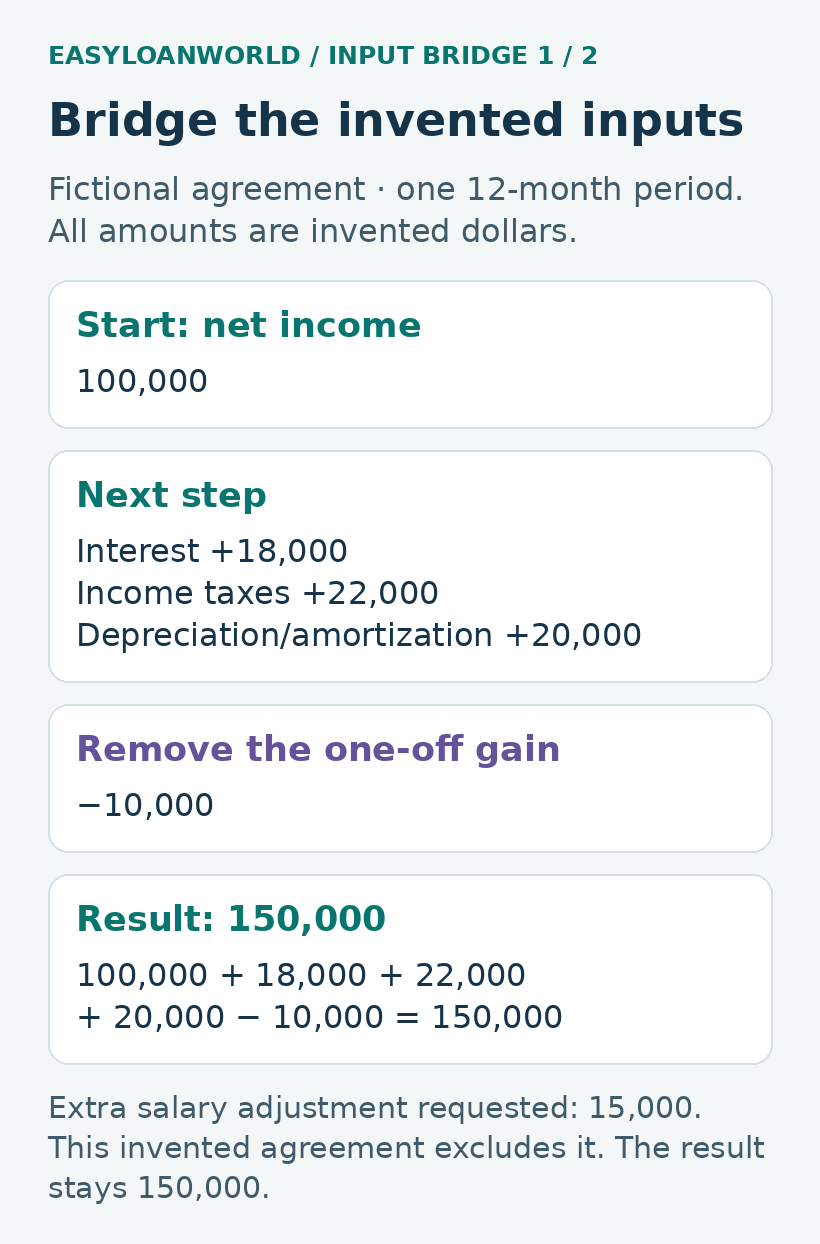
Suppose the owner requests another $15,000 adjustment for ordinary salary. The invented agreement doesn’t permit it. A $165,000 numerator would therefore be inconsistent with this example’s definition. Keep the requested adjustment visible as a rejected line, with the reason, rather than quietly inserting it.
Include the proposed borrowing in its own case
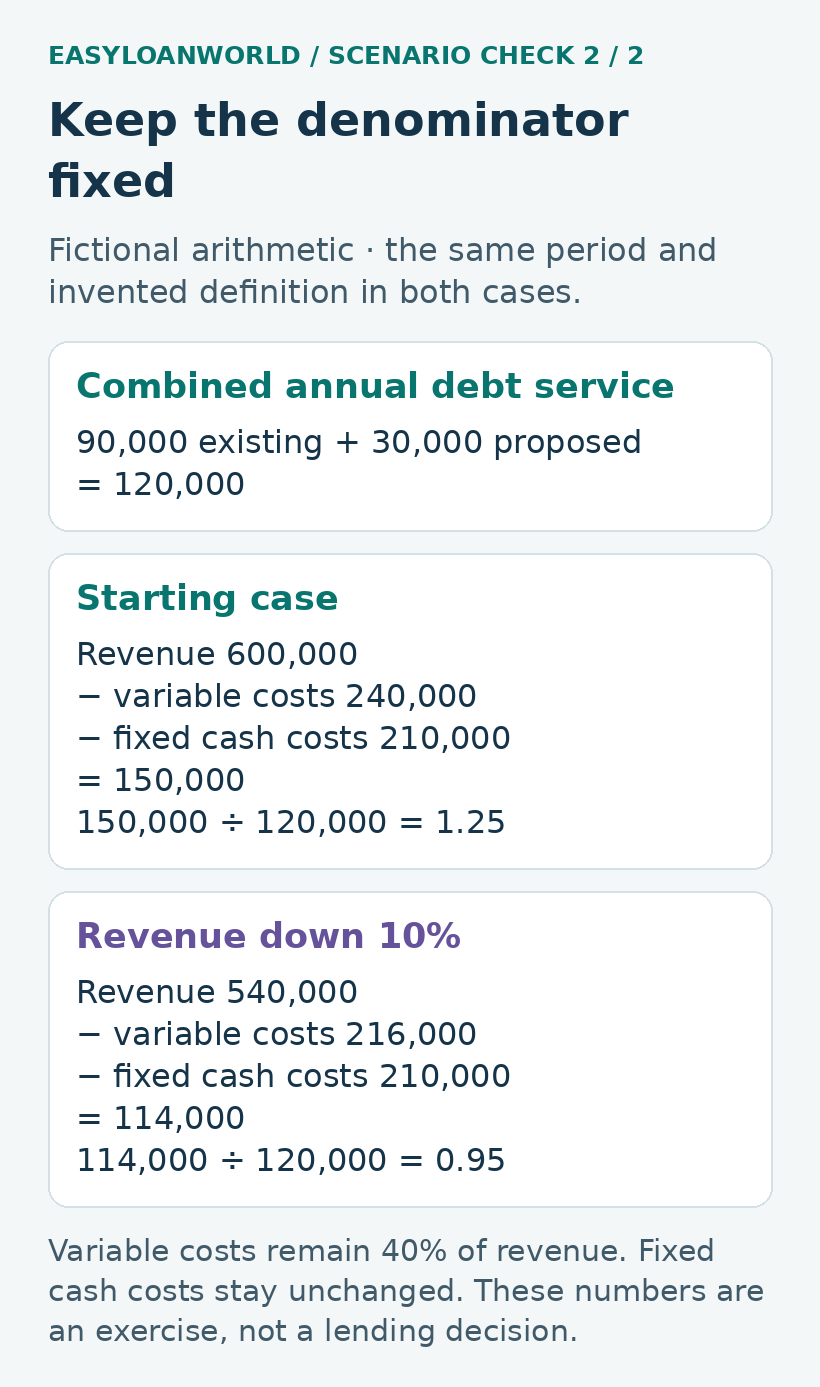
Existing annual principal is $72,000 and interest is $18,000, making $90,000 of debt service. The proposed loan adds $30,000 of annual principal and interest. Combined debt service is $120,000.
- Existing debts only: $150,000 ÷ $90,000 = approximately 1.67.
- Existing plus proposed debt: $150,000 ÷ $120,000 = 1.25.
The first answer doesn’t describe the second borrowing plan. Also notice that the $18,000 interest was added back when building the numerator and included once in debt service. These are different sides of the calculation; deleting it from the denominator would change the defined test.
For a private account-inclusion sheet, give each debt a nickname and record annual principal, annual interest, other required charges, any maturity amount, inclusion status and the lender’s confirmation. Identify the period next to every amount. Keep unconfirmed exclusions separate from the agreed calculation.
Reduce sales without changing the rules
Now reduce fictional revenue by 10%, to $540,000. Variable costs remain 40% of revenue, becoming $216,000. Fixed cash costs remain $210,000. Rebuild the same adjusted numerator directly: $540,000 − $216,000 − $210,000 = $114,000. This isn’t a new tax forecast.
Debt service stays $120,000, so the downside ratio is $114,000 ÷ $120,000 = 0.95. The numerator is $6,000 below that denominator. A 10% sales decline produced a 24% decline in the numerator because the fixed costs did not shrink.
For an algebra check only, revenue that makes the two sides equal is ($210,000 + $120,000) ÷ 60% = $550,000. That is an 8.33% decline from $600,000. Equality is not a safe borrowing threshold or a lender target.
Business DSCR: reproduce the defined ratio in the calculator
Enter $150,000 in the annual income numerator field, $90,000 existing annual debt service and $30,000 additional annual debt service. For this exercise only, choose 1.25 as the target input. That’s a user-selected calculation assumption, not a lender’s confirmed covenant or approval standard.
Expected current coverage is 1.67 times, and coverage including the proposed debt is 1.25 times. Annual debt service at the selected target is $120,000, with $30,000 of room above the existing $90,000 service.
The $30,000 room exactly matches the proposed service under these base assumptions. It isn’t an approved loan amount. The tool accepts a debt-service amount, not a principal balance, and has no rate or term information from which to infer principal.
Also keep the numerator’s meaning intact. Entering the unadjusted $100,000 net income wouldn’t reproduce the invented agreement’s test. Entering $165,000 with the rejected salary addback would be inconsistent too. The calculator can’t decide which adjustments an actual lender accepts.
Business DSCR: compare five-percent and ten-percent revenue declines
For an independent five-percent revenue decline, sales become $570,000. At the unchanged 40% variable-cost ratio, variable costs are $228,000. Fixed cash costs remain $210,000, so adjusted earnings become $132,000.
Change only the calculator numerator to $132,000, retaining $90,000 existing service, $30,000 proposed service and the illustrative 1.25 target. Expected current coverage is 1.47 times and proposed coverage 1.10 times.
Annual service at that target becomes $105,600, leaving $15,600 above the existing service. The proposed additional $30,000 exceeds that arithmetic room by $14,400. This doesn’t decide how a lender would respond to the scenario.
Now reproduce the original ten-percent decline using $114,000 adjusted earnings with those same debt inputs. Expected current coverage is 1.27 times and proposed coverage 0.95 times. At a 1.25 target, annual service capacity is $91,200 and room above existing service is only $1,200.
The existing-only ratio can therefore look stronger than the proposed-debt ratio in every branch. Reporting only current coverage would omit the borrowing being evaluated. Keep both outputs and the added-service input beside each other.
Business DSCR: separate a revenue change from a definition change
The five-percent branch reduces adjusted earnings by $18,000 from $150,000 to $132,000. The ten-percent branch reduces them by $36,000 to $114,000. Each revenue dollar lost removes 60 cents of contribution under the fixed 40% variable-cost assumption.
This relationship depends on fixed cash costs staying $210,000. If staffing, rent, prices or product mix change, rebuild those inputs. A percentage applied directly to the original numerator would describe a different model.
Likewise, accepting a new addback halfway through the downside analysis would mix operating sensitivity with a changed definition. Keep the same agreed adjustment rules when asking how sales affect coverage, then analyze a proposed definition separately if needed.
Use the same complete period for earnings and service. An annual numerator divided by a monthly installment would inflate coverage by a timing mismatch. A twelve-month debt-service record must include the obligations that actually belong in that period.
Business DSCR: connect the annual ratio with a dated cash plan
Suppose a business records a sale in the measured period but collects its cash after a major payment date. The ratio and bill-date cash can answer different questions. Don’t replace the lender’s defined earnings input with bank receipts without explaining the change.
Instead, keep a separate collection-and-payment calendar showing opening usable cash, actual receipt timing and required outflows. The coverage worksheet checks the agreed annual comparison; the calendar checks whether money is available when needed.
The complete decision file should retain the input bridge, included debts, selected target, stress assumptions and cash-timing questions. A reproducible ratio is a useful checkpoint while leaving approval, liquidity and business viability for their appropriate review.
For a separate cost sensitivity, return revenue to $600,000 but raise variable costs from 40% to 45%, or $270,000. With fixed cash costs still $210,000, adjusted earnings become $120,000. Using the same debt inputs, current coverage is 1.33 times and proposed coverage 1.00 times. At the illustrative 1.25 target, annual service capacity is $96,000, leaving $6,000 above existing service. This cost-ratio change is independent of the revenue-decline branches and shouldn’t be combined with them without rebuilding the figures.
Record what this calculation leaves unanswered
A ratio alone doesn’t establish loan approval or cash availability. Collection timing, capital spending, taxes, owner distributions and liquidity need separate review.
Keep three dated versions: the agreed starting inputs, the after-borrowing case and the downside. Next to each adjustment, record its original statement line, amount, inclusion status and unresolved question. Ask the lender and accountant to reconcile differences before using the result in a borrowing decision. Keep account details and financial records private.
General U.S. business-finance education. Source checked October 19, 2026. All example figures and agreement terms are invented.
Featured photo: A desk with a calculator and stationery, shown for illustration. Photo: Cht Gsml / Unsplash. Used under the Unsplash license.


