Business Loan Balloon Payments: Prepare for the Amount Due at Maturity
Check your business loan's maturity date, remaining balance and final payment. Build a cash plan without assuming a refinance or extension will happen.

Estimated reading time: 8 minutes
Business loan balloon payments require a separate maturity plan. Verify the final amount and date, then distinguish available reserves from proposed funding that hasn’t been confirmed.
A manageable monthly business-loan payment can leave a much larger amount due at maturity. Check the final obligation separately: the schedule used to calculate installments may run longer than the contract allows you to keep the debt outstanding.
The practical task is to verify the amount and date, match usable payment sources to that deadline, and identify any gap early. This guide uses a fictional business loan and reserve plan, not a real offer or payoff quote.
Business loan balloon payments: read the maturity date
The Office of the Comptroller of the Currency’s commercial refinance-risk guidance discusses loans with principal still outstanding at maturity, including commercial property loans whose installment calculation extends beyond their contractual term. Its guidance is directed to banks; it doesn’t give borrowers an entitlement to renewal or refinancing.
For a specific product example, Chase’s commercial real-estate financing description distinguishes repayment through equal installments from repayment involving a final balloon. Your signed documents determine which structure and obligations apply to you.
Find the signed note and all amendments. Record the actual maturity date, any contractual notice deadlines and the period used to calculate the ordinary payment. A reference to “ten-year amortization” isn’t enough to establish when the full debt is due.
Business loan balloon payments: request a dated breakdown
Request the lender’s projected amount due on that date, with the components separated. Ask whether the figure includes the last regular installment, remaining principal, accrued interest, fees and any other charges. Recheck the dated amount near payment.
A current principal balance, an old schedule and a model answer different questions from a final payoff quote. If the quoted final amount already contains the ordinary payment, adding that payment again overstates the cash needed.
Also identify rate changes or extra payments that could alter the projected balance. Review relevant prepayment, extension, collateral, guarantee and covenant terms with the lender or a qualified adviser. Don’t assume a grace period or a changed due date because an application is pending.
A three-year maturity with a ten-year installment calculation
Assume this entirely fictional business loan:
- Original principal: $120,000.
- Fixed nominal annual interest rate: 9%, or 0.75% monthly.
- Ordinary payment calculated over 120 months.
- Actual maturity after 36 months.
- First installment one month after funding; remaining principal due immediately after installment 36 on the same date.
The calculation excludes fees, extra principal payments, arrears, rate changes and irregular periods. It uses unrounded payments internally; actual cents-rounded lender schedules may differ slightly.
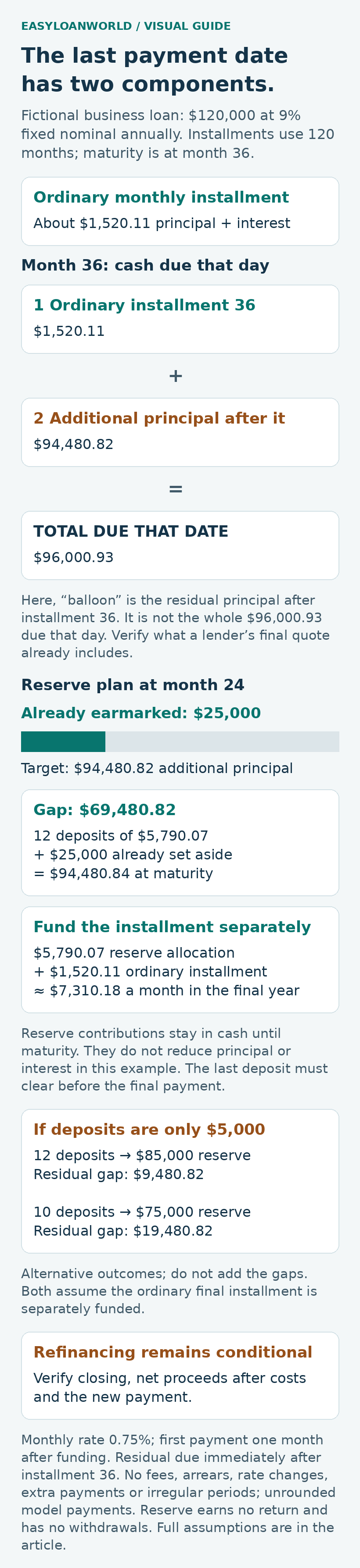
The regular principal-and-interest installment is about $1,520.11. After 36 installments, the business has repaid about $25,519.18 of principal. It still owes about $94,480.82.
Two components are due on the month-36 date
- Ordinary installment 36: about $1,520.11.
- Additional principal immediately after that installment: about $94,480.82.
- Total cash due that day: about $96,000.93.
Here, “balloon” means the additional residual principal after the last regular installment. A lender may use that word for its entire final payment, so confirm the definition. The two components above are separate only because the fictional contract explicitly makes them separate.
The residual is still-borrowed principal, not a financing fee. This borrower can’t continue making the illustrated payment for another seven years simply because the original installment calculation used 120 months.
At month 24, test a reserve for the residual
Now assume the borrower reaches the end of month 24 with $25,000 genuinely available and earmarked for the additional maturity principal. This money is separate from operations, payroll, tax remittances and cash needed for future ordinary installments.
Twelve saving opportunities remain, at the ends of months 25 through 36. The final deposit must be available before the maturity payment. Assume no investment return, withdrawals, fees or additional contributions.
- Expected additional principal at maturity: about $94,480.82.
- Already set aside: $25,000.
- Remaining reserve gap: about $69,480.82.
- Equal monthly allocation over twelve months: $5,790.07, rounded upward to cents.
Twelve allocations of $5,790.07 plus the existing $25,000 produce $94,480.84, two cents above the rounded residual target. The ordinary installment still needs its own funding. Together, the installment and reserve allocation use about $7,310.18 per month during that final year, in addition to the business’s other cash needs.
This reserve allocation is cash retained for a future obligation. It isn’t another lender charge, an accounting expense or an extra principal payment today. In this model, moving money into the reserve doesn’t reduce the debt balance or interest.
What if the business can set aside only $5,000?
With twelve $5,000 deposits, the reserve reaches $85,000. The additional residual remains short by about $9,480.82. If two of those deposits are missed, the reserve reaches $75,000 and the shortfall becomes about $19,480.82.
Those are alternative outcomes, not gaps to add together. Both assume the month-36 ordinary installment is funded separately. If it isn’t, include it in the due-date cash plan once. Add real charges only from the lender’s actual breakdown.
The reserve test doesn’t justify diverting payroll or tax cash. If operations can’t support it, the result is an early warning that the maturity plan needs another evidenced source.
Test business loan balloon payments with the correct maturity convention
Enter $120,000 principal, 9% annual interest, 120 amortization months and 36 maturity months below. The expected ordinary payment is $1,520.11, the principal remaining after payment 36 is $94,480.82, and the regular installment plus residual due on that date is $96,000.93. This reproduces the article’s stipulated convention.
Keep the two month fields distinct. Entering 36 in both would calculate a loan fully repaid over three years, rather than the ten-year installment schedule with earlier maturity. Entering 120 in both would allow all ten years of repayment and remove this modeled balloon. Neither substitution describes the original business loan balloon payments.
For an arithmetic boundary check, change only the rate to zero while retaining the 120-month amortization and 36-month maturity. The payment becomes $1,000. Thirty-six installments repay $36,000, leaving $84,000 principal. The maturity date requires the last $1,000 installment plus $84,000, or $85,000. This is a mathematical test, not an available zero-rate offer.
Restore 9% before comparing the result with the earlier reserve plan. The calculator doesn’t deduct the $25,000 already earmarked, add future reserve deposits or decide whether the business can fund them. Those belong on a separate cash timeline. Moving money to savings leaves the modeled borrowing unchanged unless an actual principal payment is made.
Compare the lender’s dated breakdown with the correct output component when testing real business loan balloon payments. If its final figure already includes the ordinary installment, don’t add that installment again. If fees, daily accrued interest, amendments or a different payoff date apply, request their separate amounts rather than forcing them into the model’s principal field. Save the inputs and unresolved difference with the supporting document. A matching model is an arithmetic cross-check, not confirmation that maturity funding or a refinancing offer exists.
Give each proposed payment source a status
The OCC describes refinance risk as being unable to replace debt on reasonable terms when needed. Borrower finances, interest rates, collateral values and market conditions can change the outcome. A good history of ordinary payments doesn’t establish that a replacement loan will be available.
For every proposed source, record an amount, ready date, supporting evidence and unresolved condition:
- Existing cash: confirm it’s unrestricted and not already assigned to operations, taxes or another maturity.
- Future retained cash: use a forecast after ordinary debts and owner needs; test weaker collections and missed reserve deposits.
- Refinancing: distinguish discussion from an offer, then record remaining conditions, closing timing, net proceeds after costs and the new payment. Replacement financing creates another debt obligation.
- Asset sale or owner contribution: record usable net proceeds and the completion date. Review restrictions and consequences before relying on a sale or contribution; expected proceeds aren’t available cash.
- Extension or changed payment arrangement: ask early and document any agreed terms. Record costs and conditions. A request or informal conversation isn’t proof the existing obligation changed.
Keep a six-field maturity record
- Exact maturity date and any contractual notice deadlines.
- Amortization period compared with the actual remaining term.
- Ordinary payment, rate type and any scheduled change.
- Dated lender breakdown of the final amount, including what is already included.
- Relevant contract conditions and unresolved questions for an adviser.
- Payment sources, ready dates and the remaining unsupported gap.
The example starts reserving twelve months ahead as a planning choice, not a legal or lender deadline. Your starting date depends on the contract and how long each funding condition takes to resolve.
If maturity is close and the payment source is unresolved, seek prompt lender and qualified financial or legal advice. Keep the due-date gap visible while exploring options; neither refinancing nor an extension is guaranteed.
Check whether the intended reserve contribution fits the business’s ongoing cash flow as well as the regular loan payment.
Featured photo: Photo by Zulfa Nazer on Unsplash. Used under the Unsplash license. Illustrative clock; no loan deadline is shown. Photo by Zulfa Nazer on Unsplash.