Daily vs. Weekly vs. Monthly Business Loan Payments
Compare business debt debit dates with cleared collections to find cash shortfalls hidden by an affordable-looking monthly total.

Three repayment schedules can leave a business with the same $6,500 at the end of a planning period and very different cash problems along the way. In the fictional comparison below, one schedule falls below zero before the first customer collection. The period-end total hides that shortfall.
To compare daily, weekly and monthly business loan payments, test the actual debit dates against cleared collections. This U.S. educational guide isolates payment timing. It does not decide which offer has the lowest total cost or whether a business should borrow.
Start with the first debit, not the frequency label
A February 2020 FTC financing discussion noted that some online products required daily or weekly repayment. That historical observation is not a measure of today’s market.
“Weekly” still leaves an important question unanswered: which day does repayment start? A first debit before a large collection can produce a different result from one after it. Obtain the proposed schedule and identify the first debit, every later debit, the final debit and any exceptions. Do not infer dates from a salesperson’s monthly equivalent.
Keep a fixed debit amount separate from an amount that changes under a contractual formula. If you cannot establish the amount or date, mark that item unresolved. A frequency comparison built on guessed terms is not ready to support a decision.
Give each money movement an actual place
Chase’s cash-flow tool instructions ask for starting cash, amounts and deposit or withdrawal dates. Those basic inputs are useful here; the experiment below is an original timing comparison.
Use cash available for the planned payments as the opening amount. Keep expected customer collections separate from sales booked but not yet paid. List operating commitments and existing debt separately so adding a proposed debit does not erase another bill.
Replace a customer’s expected payment date with the date funds are expected to be usable. Where settlement timing is uncertain, label the uncertainty. Check weekends, holidays and any calendar-day debits in the actual agreement. Do not assume every product collects only on business days.
A controlled 20-business-day experiment
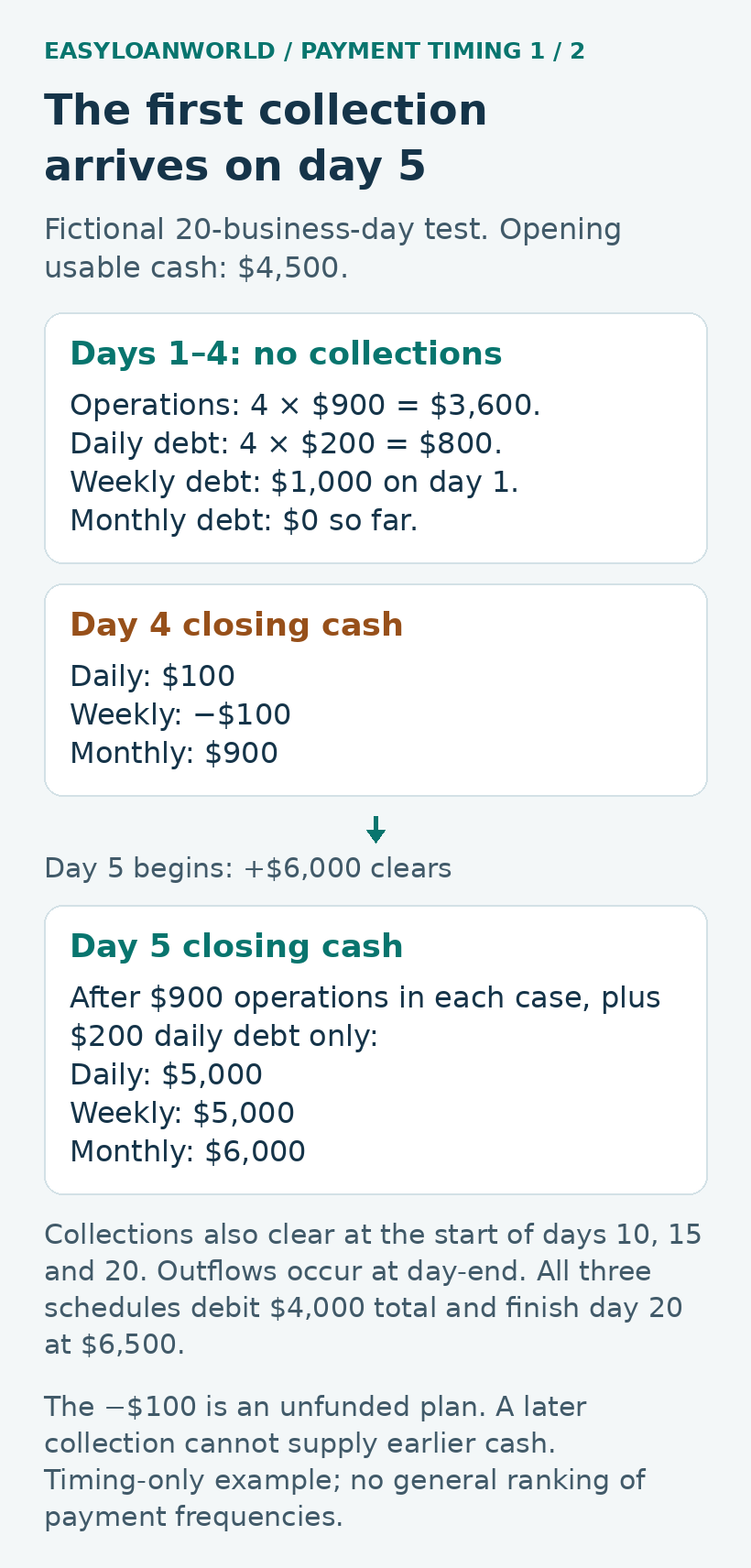
All figures and schedules in this example are invented. Twenty business days is the chosen observation period, not a guaranteed number of debit days in a normal month. Each alternative requires $4,000 during this period. Funding amounts, other term costs and later obligations are outside this timing-only comparison.
- Opening usable cash is $4,500.
- Customer collections of $6,000 clear at the start of days 5, 10, 15 and 20: $24,000 altogether.
- Operating payments of $900 occur at each day’s end: $18,000 altogether.
- Debt debits also occur at day-end. No other money moves.
Compare these three mutually exclusive schedules, keeping everything else unchanged:
- Daily: $200 on each of the 20 days.
- Weekly: $1,000 on days 1, 6, 11 and 16.
- Monthly: one $4,000 payment on day 20.
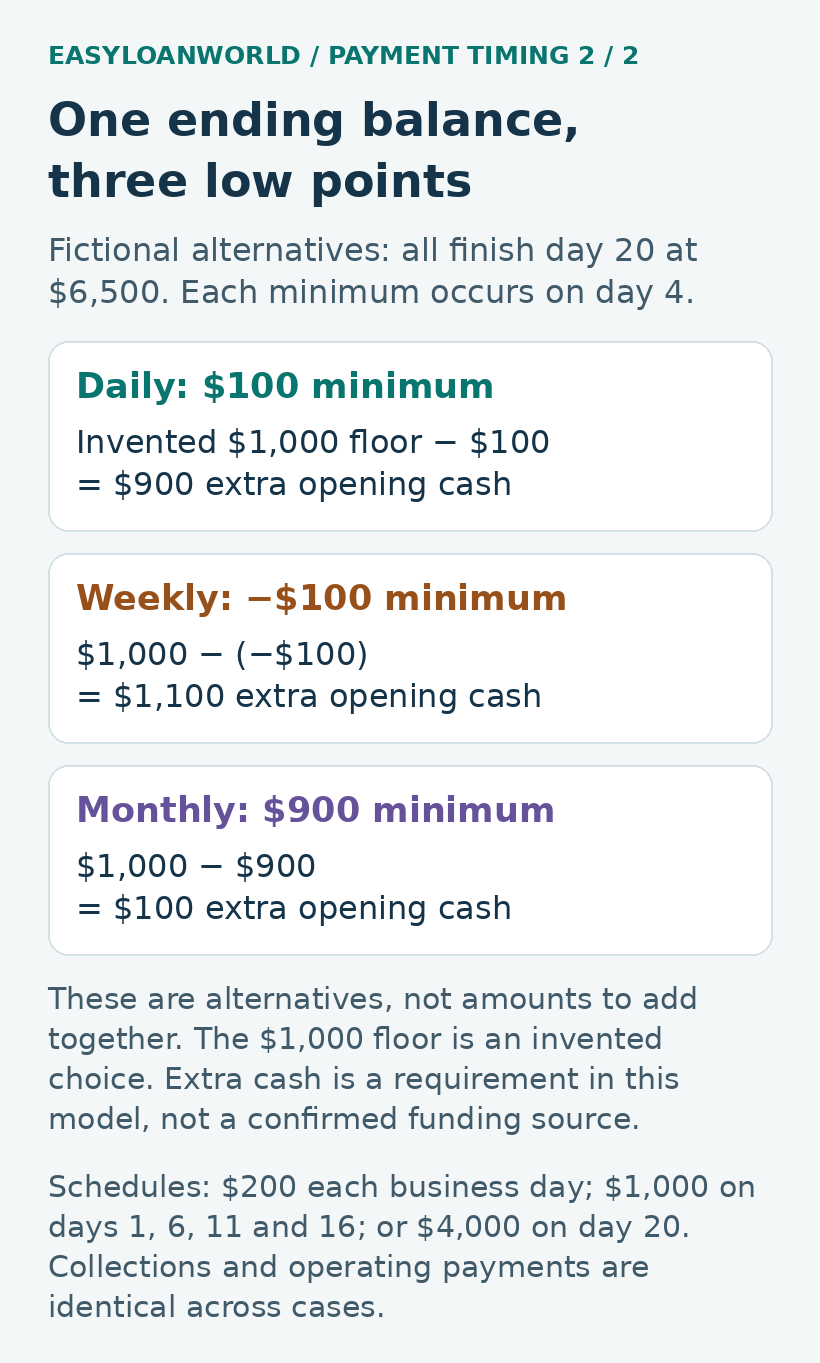
Every alternative ends at $6,500: $4,500 opening cash + $24,000 collections − $18,000 operating payments − $4,000 debt payments. That agreement at the endpoint does not mean the alternatives are equally workable.
Look at day 4, before the first collection
Under daily repayment, four days of operations cost $3,600 and four debt payments cost $800. Cash falls to $100. Under weekly repayment, the first $1,000 debit has already occurred, leaving −$100. Under the monthly schedule, no debt payment has occurred yet, leaving $900.
These day-4 closing balances are also the lowest balances over the modeled period. The weekly shortfall is an unfunded plan, not permission to overdraw the account. The later collection does not make money available earlier.
Weekly performs worse than daily here because of the assumed first debit. This is not evidence that weekly repayment is generally worse, or that monthly repayment is always preferable. A different first payment or collection pattern can change the comparison.
Add a chosen cash floor
Suppose the owner wants at least $1,000 left throughout this experiment. This is an invented management choice, not a lender requirement. The extra opening cash needed to reach that floor is:
- Daily: $1,000 − $100 = $900.
- Weekly: $1,000 − (−$100) = $1,100.
- Monthly: $1,000 − $900 = $100.
These are alternative requirements, not amounts to add together. They also do not identify where extra cash will come from. Count a proposed source only when its availability and any new obligations have been separately checked.
Check the order within the day
The example explicitly puts collections before outflows. Real records may not establish that order. If a collection and debit share a date, calculate both sequences when their timing is unknown. A positive closing balance alone does not prove the debit can clear earlier that day.
For your own test, record balances after each known event rather than only at month-end. Then move an uncertain collection to a later plausible date, leaving contractual payments unchanged. Note the first floor breach, the lowest projected balance and the supporting assumption. Do not silently move a debit to make the worksheet balance.
Finish with an exceptions record
For each problem date, keep six fields: date, collection evidence, payment obligation, projected cash, uncertainty and action needed. For example, distinguish a customer’s unconfirmed promise from cleared funds. Name who will resolve an unanswered timing question and when.
Before accepting a schedule that fails this test, seek an agreed alternative or a confirmed cash source and rerun the sequence. Changing a contractual debit date needs the provider’s agreement; a spreadsheet edit does not change the obligation. Keep cost, contractual suitability and longer-term affordability as separate decisions. Passing this short timing test settles none of them by itself.
Sources checked October 19, 2026. The figures are hypothetical and do not describe a lender’s offer.
Featured photo: A paper calendar illustrates payment timing. Photo: Behnam Norouzi / Unsplash. Used under the Unsplash license.

SBA Surety Bonds vs. Working-Capital Loans: Four Contractor Scenarios
Follow Riverton Build through four fictional alternatives at one pre-start review. Identify what remains unresolved and prepare a focused next conversation.
Export Payment Documents: A Two-Packet Review
A worked export-packet review follows an unresolved instruction proposal, an incomplete selected inventory and an unknown carrier arrangement, without inventing the missing evidence.
Profitable Business, Falling Cash: Reconcile the Difference
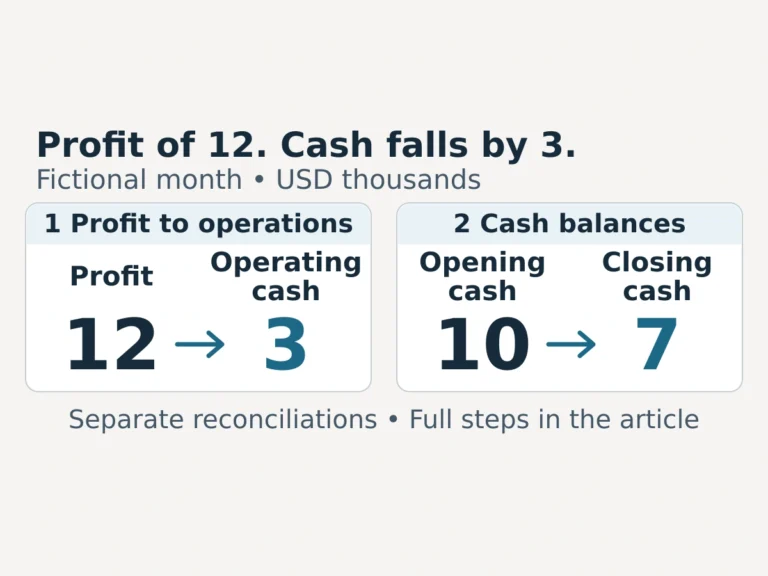
An invented one-month example reconciles net income, customer receipts, supplier payments, equipment, debt and an owner distribution to the closing cash balance.