Business Loan Personal Guarantees: Questions Before Signing
Review a business loan's personal guarantee with a clause-by-clause issue sheet covering scope, limits, demand, changes and evidence of release.

Before signing a business loan’s personal guarantee, turn each important unanswered question into a document reference and a named person who will resolve it. The useful outcome is a record of the proposed obligation, not a reassuring description of the loan.
A personal guarantee can make an individual responsible for business debt. Chase’s explanation emphasizes that terms vary by lender and loan. This U.S. checklist is educational; your own licensed lawyer can assess the documents and applicable law.
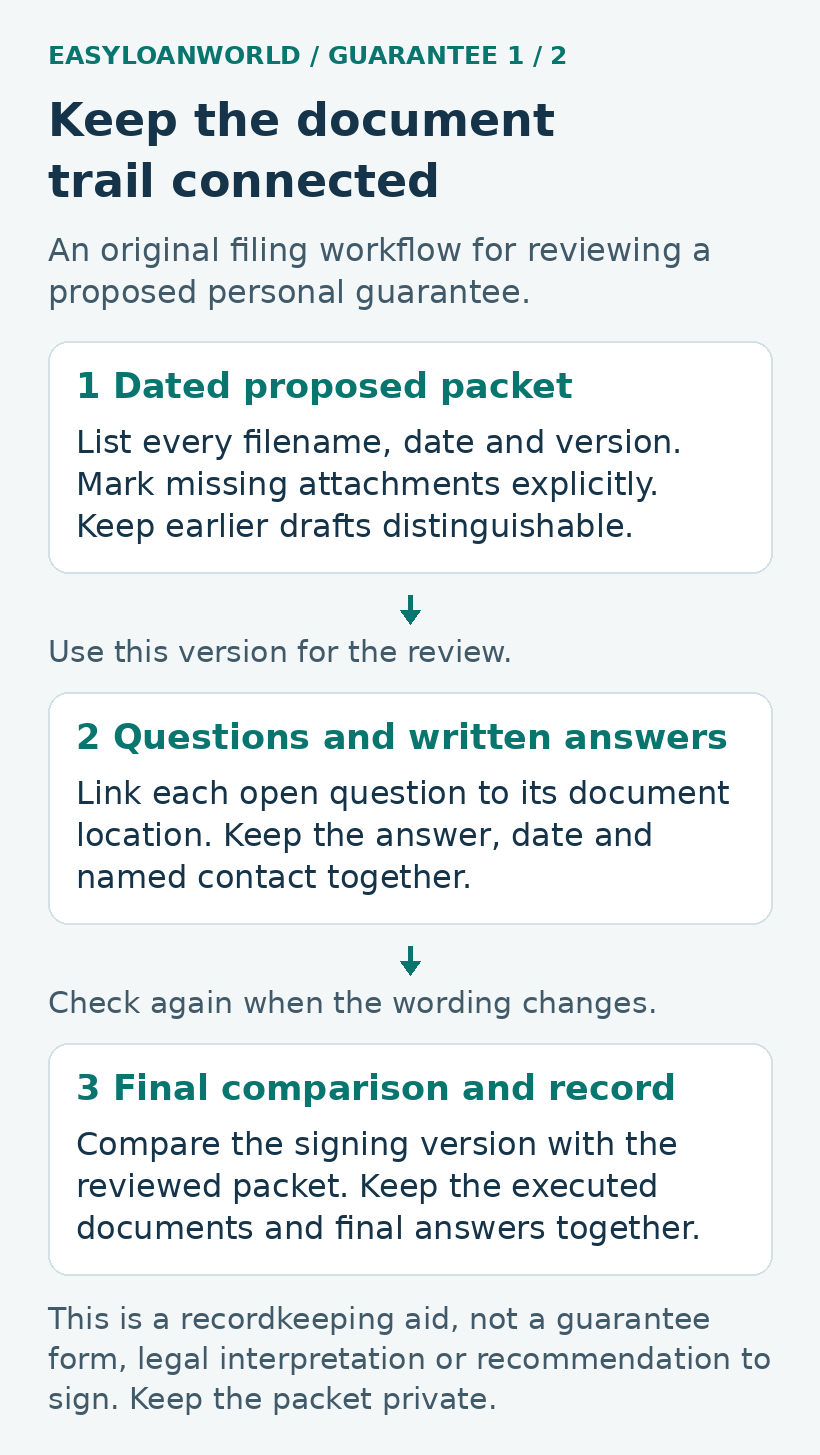
Build a complete packet before reviewing the signature
Request the proposed guarantee, note, loan agreement, referenced collateral documents, attachments and amendments. Use one dated set. If a reference points to an attachment you have not received, mark it missing rather than filling the gap from a brochure or conversation.
Make a cover sheet listing each filename, document date and version. Keep the lender’s explanations alongside the packet, with the date and person who supplied them. This prevents an answer about an earlier draft being mistaken for an answer about the version presented for signature.
On a separate signature map, list every signature requested from you and the document containing it. Ask your lawyer to distinguish signing for the business, making an individual repayment promise and pledging an identified asset. A job title beside a signature is something to review, not a conclusion this checklist can supply.
One published form shows why the wording matters
The illustrative SBA Form 148, marked 10/98, requires payment on written demand without first pursuing another source. Its definition of the note includes specified replacements and line-of-credit notes. It also makes guarantors jointly and severally liable. These are provisions of that form, not universal rules for business loans; an ownership percentage alone does not establish a contractual liability share.
Use the example to improve your questions. Do not substitute this published form for the agreement your lender actually asks you to sign, or assume a similarly named document has identical wording.
SBA Form 148L, marked 06/25, illustrates different limitation structures. Its principal-reduction option includes a no-default condition. The selected provision matters; the word limited alone does not establish the complete boundary.
Use seven short evidence cards
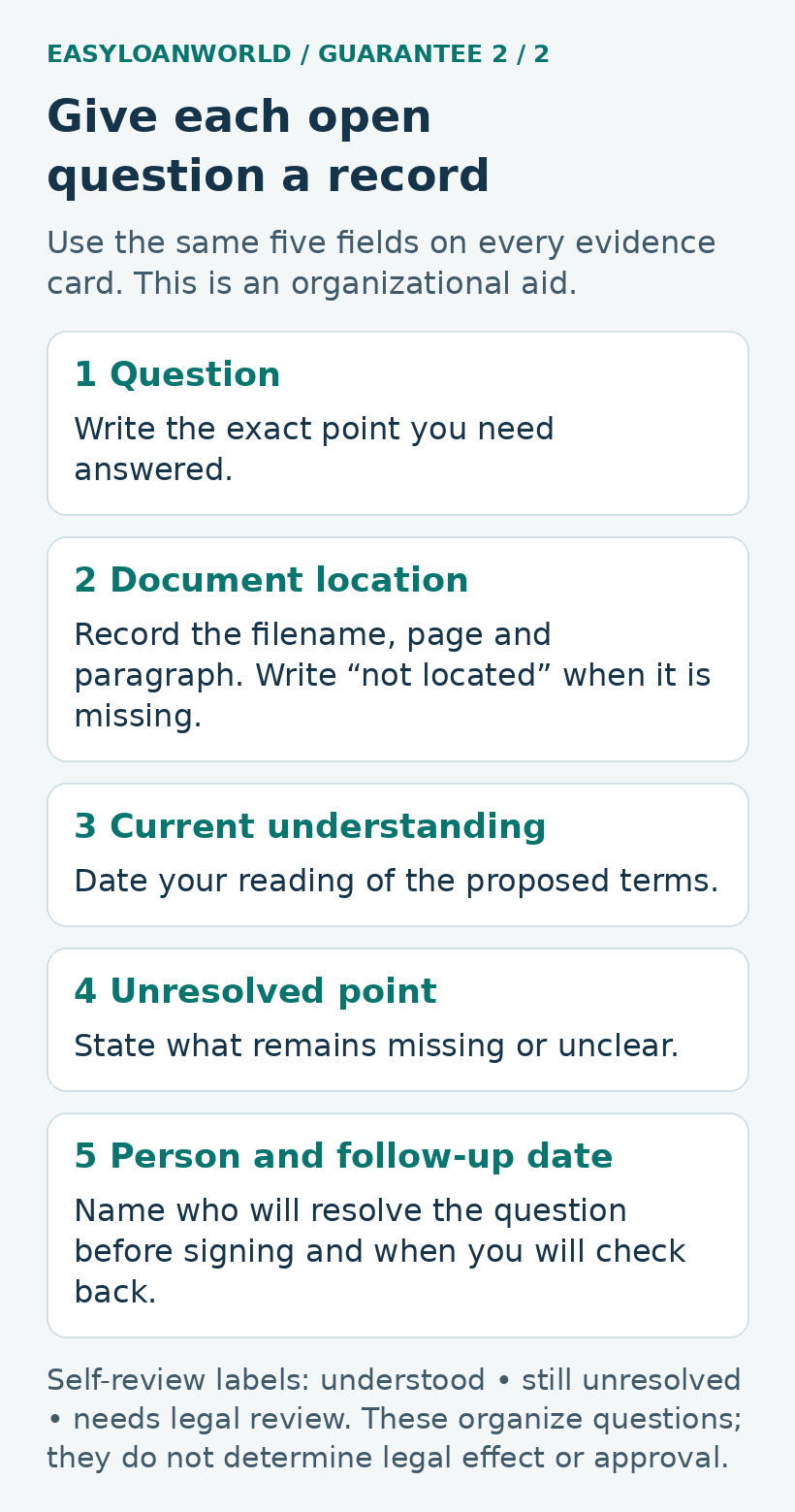
Keep this worksheet privately. You do not need to send your agreements or personal financial records to this website. Each card should contain the same five fields:
- Question: the exact point you need answered.
- Document, page and paragraph: where the answer should be checked.
- Answer in the proposed terms: your current understanding, dated.
- Unresolved point: what remains missing or unclear.
- Who will resolve it before signing: the named contact and follow-up date.
Write “not located” when you cannot find an answer. An empty space is easy to overlook; an explicit unresolved entry stays on the review list. A response from the lender can identify intended terms, while your lawyer can review what the documents mean for you.
1. Match the people and versions
Do the business, individual and lender names match throughout the packet? Record spelling differences, missing pages and inconsistent dates. Ask for a corrected or explained version, then keep the old and new copies distinguishable.
2. Identify the covered obligation
Which debt or facility is covered? Ask for the relevant definition’s location. Put your interpretation beside it for your lawyer to check, rather than summarizing the scope from the product’s name.
3. Locate the described boundary
What exactly does the proposed limit describe? Record the provision and any uncertainty about included amounts or conditions. Do not turn an informal headline number into a calculated legal maximum.
4. Record the trigger and communication
What event and communication would require your response or payment? Locate the applicable wording. Record the proposed contact details and how to keep them current; do not invent a notice period.
5. Flag planned changes
List the business or financing changes you already expect. Which ones need further review of your personal obligation? Give your lawyer the actual plan and dates, with the clauses that prompted the question.
6. Organize supporting records
Which records do the proposed terms ask you to provide or keep? Identify who will hold the final signed packet and how you will obtain a complete copy. This is a filing plan, not a universal lender checklist.
7. Specify the intended exit evidence
What would document the intended end of your obligation? Record the proposed event, required authorization, outstanding conditions and evidence your lawyer says to obtain. Leave the result unresolved while that evidence is missing.
A planned ownership sale: find the missing link
Consider a fictional owner, Maya, who expects to sell her stake next year. Her folder contains a proposed guarantee, a sale timetable and a conversation note saying the buyer is expected to take over. No release has been supplied.
The exercise is to identify what Maya has assumed, not decide her future liability. Her timetable records a business plan. The conversation note records an expectation. Neither answers the unanswered document question in this example.
She can prepare a short review note:
- State the event she assumes would end her obligation.
- Locate any supporting language in the actual proposed packet.
- Identify whose agreement is still needed.
- Ask her lawyer which written change would implement the intended outcome.
- Consider whether her plan still works if that outcome is not agreed.
This scenario does not establish what selling, resigning or replacing an owner would do under another person’s guarantee. It exposes a missing piece of evidence before Maya relies on an exit plan.
Finish with a decision record
Give each card one self-review status: understood, still unresolved or needs legal review. These labels organize questions; they are not approval recommendations or a finding that an agreement is enforceable.
Before the signing appointment, compare the final packet against the reviewed version and revisit changed passages. Preserve the executed documents and final written answers together. The checklist has done its job when an important assumption is visible and assigned for resolution, rather than hidden beneath a signature.
Sources checked October 19, 2026. Published forms are illustrative; this article does not interpret your agreement or provide individualized legal advice.
Featured photo: Photo by Diana Polekhina on Unsplash. Used under the Unsplash license. Illustrative blank stationery. Photo by Diana Polekhina on Unsplash.

SBA Surety Bonds vs. Working-Capital Loans: Four Contractor Scenarios
Follow Riverton Build through four fictional alternatives at one pre-start review. Identify what remains unresolved and prepare a focused next conversation.

Export Payment Documents: A Two-Packet Review
A worked export-packet review follows an unresolved instruction proposal, an incomplete selected inventory and an unknown carrier arrangement, without inventing the missing evidence.
Profitable Business, Falling Cash: Reconcile the Difference
An invented one-month example reconciles net income, customer receipts, supplier payments, equipment, debt and an owner distribution to the closing cash balance.