Business Loan Spouse Signature: Guaranty or Collateral Consent?
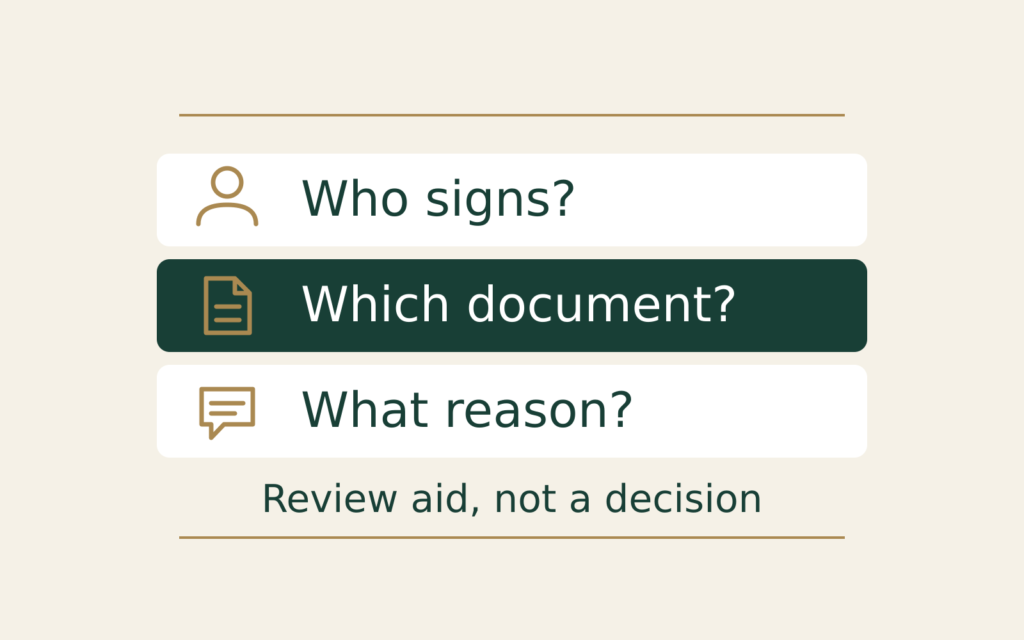
Use three fictional document requests to identify the person, signing capacity and explanation that need review.
Estimated reading time: 5 minutes
“Your spouse needs to sign” isn’t a complete explanation of a business-loan document. Before the signing appointment, ask which person is being asked to sign, in what capacity, on which instrument and for what stated reason.
A request concerning collateral is different from a request for a personal repayment promise. This U.S. guide helps organize the question; it can’t decide whether a particular signature is legally required or whether an existing agreement is enforceable. Have your own lawyer review the actual documents and applicable state law.
Separate the business owner from the owner’s spouse
Under the CFPB’s Regulation B commentary, 1002.7(d)(6), a lender may require guarantees from specified business principals based on their business relationship, even when the business is creditworthy. It may not automatically require a married guarantor’s spouse to guarantee too. An additional signature can nevertheless be justified in circumstances permitted by the rule.
Start a private role list: applicant business, owner or officer, proposed guarantor, property owner and requested signer. One person may occupy several roles. Record what the application and proposed documents actually say rather than assigning a role because someone attended a meeting or is married to an owner.
Identify which signature rule the lender is discussing
The CFPB’s July 2026 examination procedures distinguish an individually qualified applicant from a transaction requiring additional support. A person who qualifies for the requested individual credit generally need not supply another signer, subject to the rule’s exceptions. If another party’s personal liability is necessary, the lender may request a qualified additional party but can’t insist that the person be the spouse.
For secured credit, the Federal Reserve’s Regulation B explanation recognizes signatures needed under state law to make pledged property available after default. That property-related reason doesn’t automatically answer whether a separate personal repayment obligation is required. Community-property and other state-law issues need transaction-specific review.
Use three fictional requests to frame the question
These examples supply incomplete document packets deliberately. None establishes approval, discrimination or liability. Their purpose is to identify the missing explanation before someone treats a signature request as routine.
| Request | What to clarify |
|---|---|
| “All owners’ spouses sign.” | Ask for the specific basis, not just the routine. |
| “You co-own the pledged building.” | Identify the property, document and requested capacity. |
| “The application was joint.” | Locate the application-stage record of that intent. |
In the first packet, Taylor owns the applicant company and Jordan is Taylor’s spouse. The email gives only the quoted explanation, and no business role is listed for Jordan. Keep that email and ask the lender to explain Jordan’s requested role and the basis for it. Don’t silently add Jordan as an officer to make the paperwork match.
In the second packet, the email references a building, but the attachment has no property schedule. Ask for the missing schedule and a complete proposed instrument. Match its property description to the ownership records available for legal review. The task remains unresolved while the attachment is missing; the email isn’t a substitute for it.
For the third packet, Regulation B commentary requires evidence of joint application intent at the time of application. Signing a note later doesn’t establish that intent; a joint financial statement’s accuracy certification alone is insufficient.
Build the third packet’s timeline from what exists: application submitted, any joint-intent selection, financial statement supplied and later signature request. Preserve the original dates. If a field is blank, record the blank instead of recreating an earlier intention from a later conversation.
Inspect a combined document carefully
The same commentary addresses instruments combining a note and security agreement. When only a security-interest signature is needed, the combined form must make clear that the spouse doesn’t take on personal liability through that signature. This isn’t permission to assume that every “consent” form has that effect.
Mark the signature block and every section it references. Ask your lawyer to compare the stated purpose with the operative wording. Don’t write your own limiting sentence into the form and assume it changes the agreement; obtain advice and an agreed final document where appropriate.
Send a focused clarification request
Use a short question list rather than a blanket refusal or a declaration that the lender broke the law:
- Who is applying, and who is being asked to provide additional support?
- What document and exact signing capacity are requested from this person?
- What business relationship, financial reliance or property interest is the stated basis?
- If the reason concerns property, which property and state-law requirement are involved?
- Which pages or selected options would change after the clarification?
Keep the answer with the corresponding version. If the lender supplies a new packet, compare the actual changes rather than relying on a message saying it’s now corrected. Retain unanswered points for independent legal review.
If you believe discrimination occurred, seek prompt advice about the appropriate regulator or complaint route and any deadlines. This checklist doesn’t suspend a deadline, release a signer or authorize ignoring an existing obligation. Keep business financial records and personal identifiers out of public comments.


