Commercial Property Financing: When the Valuation Leaves a Cash Gap
Test how a lower lender valuation changes financing and the business cash needed for a commercial-property purchase, costs and a separate reserve.

A commercial property’s agreed price and the value accepted by a lender can differ. If the proposed financing depends on that accepted value, a lower valuation can increase the business’s required cash even when the seller’s price stays unchanged.
The useful check is a purchase-funding reconciliation: proposed debt, business contribution, cash-paid transaction costs and money deliberately retained after closing. The fictional example below isolates the valuation effect without treating a financing percentage as a promise.
Verify the sizing rule before applying a percentage
The OCC’s Commercial Real Estate Lending handbook discusses collateral value and loan-specific risk. Meeting a loan-to-value threshold alone does not establish prudent lending or approval. This is supervisory guidance for OCC-supervised institutions, not a universal borrower entitlement or a lender quote.
Ask your lender for the actual sizing basis, proposed amount and remaining conditions. Identify whether the value being discussed is preliminary or accepted, and whether it describes the property as it stands or assumes completed improvements. Keep the dated proposal with your calculation.
A marketing maximum is not enough to populate the funding line. Real proposals may use different valuation bases, eligibility definitions, other collateral, income constraints or additional limits. The arithmetic below deliberately holds those issues constant so one change can be seen clearly.
Set up one hypothetical purchase
A business considers an existing commercial property with an $800,000 agreed price. Transaction costs are assumed to be $30,000, all paid in cash and none financed. The business also chooses to retain $25,000 after closing. That reserve is its own planning choice, not a lender requirement or a fee.
A $40,000 earnest deposit has already been paid and is confirmed credited toward the purchase price. The example has no seller credits, refunds, other purchase financing, cash reimbursements, existing liens to repay or later-financed repairs. No additional cash charge is modeled.
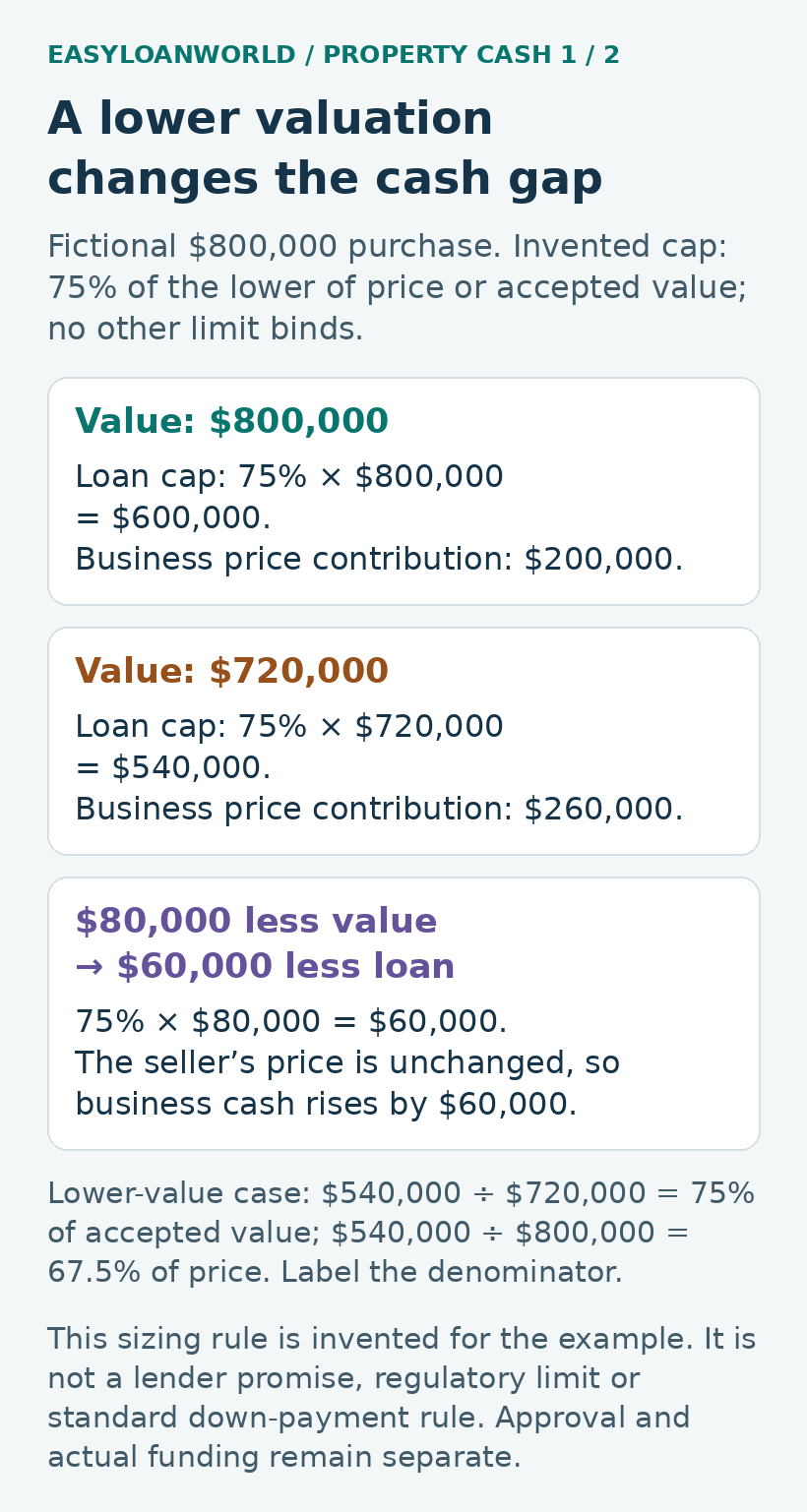
Fictional sizing rule: the loan may be no greater than 75% of the lower of the agreed price and lender-accepted valuation. This is an invented model assumption, not an OCC prescription, standard down payment or description of an SBA product. Assume no other limit binds and all other conditions would be met for this calculation only.
Approval, actual funding and whether the business should proceed remain separate questions. The loan is debt to repay; it is not income or a reduction in the seller’s price.
Base case: value matches the $800,000 price
With an $800,000 accepted value, the assumed cap is 75% × $800,000 = $600,000. The business’s contribution toward the price is $800,000 − $600,000 = $200,000.
Of that $200,000, the credited $40,000 deposit has already been paid. The additional amount due for the purchase and transaction costs is therefore:
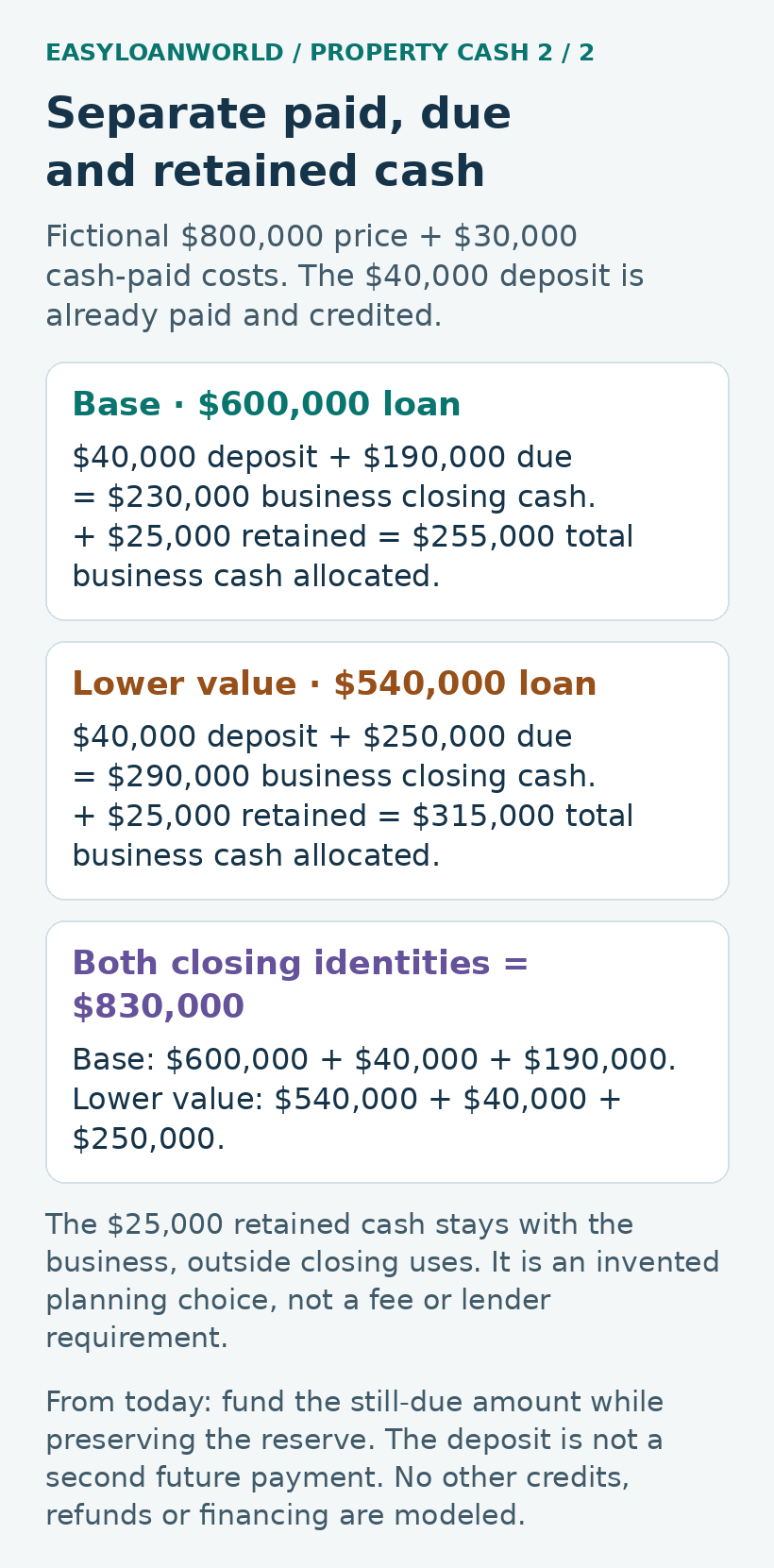
$800,000 price + $30,000 costs − $600,000 loan − $40,000 credited deposit = $190,000 additional closing cash.
As a cross-check, the $600,000 loan, $40,000 deposit and $190,000 additional cash add to $830,000: the price plus transaction costs. The retained reserve is outside that closing identity because it stays with the business.
Total business cash allocated across the plan is $40,000 already paid + $190,000 still due + $25,000 retained = $255,000. From today forward, the business needs the $190,000 closing amount while preserving its separate $25,000 reserve; the earlier deposit is not a second future payment.
Lower-value case: $720,000 value, unchanged price
Now change only the accepted valuation to $720,000. The agreed price remains $800,000, and the assumed 75% lower-of-price-or-value rule remains unchanged.
- Modeled loan cap: 75% × $720,000 = $540,000.
- Business contribution toward price: $800,000 − $540,000 = $260,000.
- Additional closing cash: $800,000 + $30,000 − $540,000 − $40,000 = $250,000.
- Total business cash allocated, including the deposit and retained reserve: $40,000 + $250,000 + $25,000 = $315,000.
The lower valuation increases required business cash by $60,000. Although value fell by $80,000, the loan fell by 75% of that amount: $60,000. Adding the entire $80,000 valuation difference to the original $200,000 price contribution would incorrectly produce $280,000 instead of $260,000.
The second closing reconciliation also balances: $540,000 loan + $40,000 credited deposit + $250,000 additional cash = $830,000. The $25,000 retained reserve is still separate, and the deposit remains part of the business contribution rather than an extra cost.
Keep the denominators visible
In the lower-value case, $540,000 divided by the $720,000 accepted value is 75%. The same loan divided by the $800,000 price is 67.5%. Both calculations are correct, but one measures debt against value and the other against price.
Label the denominator whenever a percentage appears in your worksheet. Writing only “75% financed” can conceal the distinction that created the extra cash requirement. Likewise, show costs and retained money separately instead of treating everything outside the loan as a single down-payment percentage.
Resolve the contribution gap before relying on closing
Repeat the calculation using your actual proposal and a clearly labeled lower-value possibility. Identify the source of any extra contribution. An anticipated asset sale, unapproved loan or unfinished owner contribution should remain unresolved until the funding is verified.
If the gap cannot be covered while preserving necessary business cash, discuss revised price or terms, verified additional equity, or a different feasible transaction with the appropriate parties. These are possibilities to evaluate, not guaranteed options. Do not treat a request or application as an extension of a contractual deadline or evidence of a deposit refund; seek qualified advice about the actual contract.
Keep price, financing and contribution information accurate and transparent. Do not fill the gap by silently spending cash already needed for payroll or taxes. The chosen $25,000 reserve also needs its own operating-needs assessment; this purchase example does not establish that it is adequate.
Your final record should show the accepted value, assumed or confirmed sizing rule, dated financing amount, credited deposit, additional closing cash and retained reserve. That makes the valuation-driven change visible without counting any dollar twice.
Featured photo: A modern building exterior. Photo: Ka Ho Ng / Unsplash. Used under the Unsplash license.

SBA Surety Bonds vs. Working-Capital Loans: Four Contractor Scenarios
Follow Riverton Build through four fictional alternatives at one pre-start review. Identify what remains unresolved and prepare a focused next conversation.

Export Payment Documents: A Two-Packet Review
A worked export-packet review follows an unresolved instruction proposal, an incomplete selected inventory and an unknown carrier arrangement, without inventing the missing evidence.
Profitable Business, Falling Cash: Reconcile the Difference
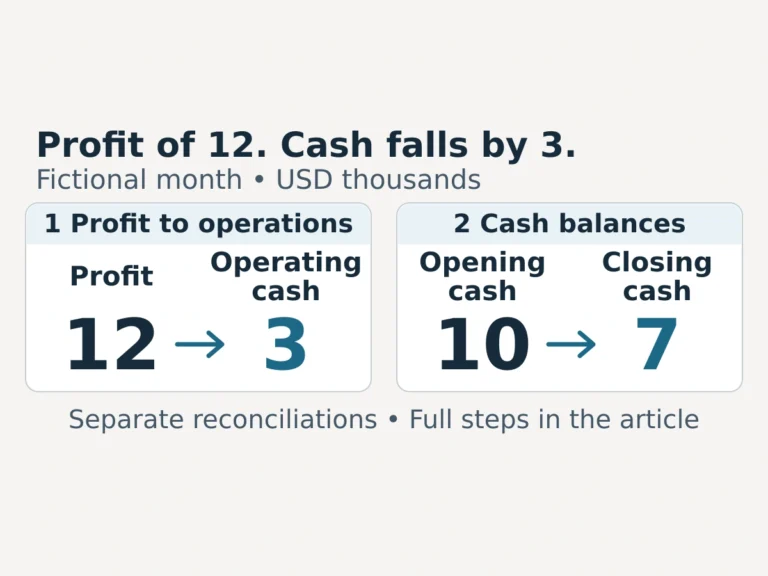
An invented one-month example reconciles net income, customer receipts, supplier payments, equipment, debt and an owner distribution to the closing cash balance.