Work backward from your monthly housing budget to an illustrative loan and home price.
The interactive form requires JavaScript. The worked example, formulas and source links below remain available.
Read the calculator result
This calculator starts with the monthly housing payment you choose and estimates the loan that fits inside it. It subtracts property taxes, insurance, mortgage insurance, and homeowners association dues, then uses the remaining amount for principal and interest. Adding your planned cash down payment produces a modeled purchase price.
The result is a budget scenario, not a borrowing approval or a complete determination of what you can afford. The tool doesn’t ask for income, debts, credit, or lender qualification criteria. Its most useful role is to connect a realistic monthly spending limit with a purchase-price range you can investigate further.
Mortgage budget: choose the budget before choosing the house
Begin with your actual household cash flow. Review take-home income, recurring bills, debt payments, savings contributions, and costs that arrive less often than monthly. A housing payment that leaves no room for ordinary variation may be difficult to sustain even if a lender would approve the loan. The CFPB’s spending assessment guidance recommends working from a realistic picture of where money goes.
The monthly budget input covers the housing charges entered in this calculator. Maintenance, repairs, utilities, moving costs, furnishings, and other ownership expenses are outside those fields. Allow for them when choosing the budget rather than assuming they are already included in the result. A property with low mortgage costs can still have substantial upkeep.
Use a budget you could maintain during an ordinary difficult month. If income is irregular, consider a conservative recurring amount and keep cash for leaner periods. The emergency fund calculator can help make that reserve discussion explicit. It doesn’t decide the housing budget for you, but it can reveal when a purchase plan consumes cash intended for emergencies.
Use comparable expense boundaries when comparing ownership with your current rent. A principal-and-interest payment alone may look similar to rent while leaving taxes, insurance, association dues, and maintenance outside the comparison. Some expenses you pay separately today may be included in rent, while ownership can shift responsibility for repairs to you. List the recurring costs on both sides before deciding that the proposed payment represents the same monthly burden. The calculator’s fixed property-cost fields help with part of that comparison, but they don’t inventory everything included in a lease or every responsibility attached to a particular home.
How the calculator works
Property taxes, homeowners insurance, mortgage insurance, and HOA dues are monthly inputs in this tool. Divide an annual estimate by 12 before entering it. For example, $3,600 of annual property tax becomes $300 per month. Entering the annual figure in a monthly field would remove far too much from the principal-and-interest budget.
Use estimates appropriate to the property being considered. An existing owner’s tax bill or insurance premium may not describe your cost after purchase. Ask for current, transaction-specific estimates and update them when better information becomes available. The calculator doesn’t look up local taxes, reassessments, insurance quotes, or association obligations.
Mortgage insurance should reflect the proposed loan if it applies. The calculator holds it constant rather than predicting cancellation. HOA dues may exclude special assessments or services you’ll pay separately. If a charge is uncertain, run a reasonable higher-cost scenario to see how sensitive the loan amount is to that assumption.
Use a rate and term from the financing scenario
The interest-rate input is the annual contractual rate used to calculate principal and interest. It isn’t a fee-inclusive APR. The CFPB’s rate and APR explanation describes why the two can differ. Enter a documented quote when available, and treat unquoted rates as illustrative planning assumptions.
The term is the number of monthly payments. A longer term generally supports a larger principal for the same principal-and-interest budget at the same rate, while extending repayment. That doesn’t establish that the larger loan is a better choice. Use the mortgage payment calculator to compare the interest cost of specific loan amounts and terms.
The down payment is cash applied to the purchase price. Closing costs and reserves are separate needs. If you have $50,000 available in total but must use part of it for closing and a reserve, entering the full $50,000 as down payment would overstate the modeled purchase price.
For example, suppose that $50,000 is your entire available cash pool, and you choose to hold $10,000 for closing expenses and $10,000 as a reserve. Only $30,000 remains for the down payment. With the example’s unchanged loan capacity, the modeled price would be $330,600.55 rather than $350,600.55. These closing and reserve amounts are simply planning choices, not estimates of what your transaction requires.
A larger down payment can also change loan pricing or mortgage-insurance terms in an actual offer. This calculator doesn’t infer those changes. If the lender supplies a different rate or insurance charge for the revised down payment, update those fields too. Otherwise the comparison intentionally holds them fixed to show only the effect of changing your cash contribution.
How the budget becomes a principal amount
First, add the monthly property charges. Subtract that sum from the chosen monthly budget to obtain the principal-and-interest allowance. If the charges exceed the budget, the inputs don’t leave room for a loan payment. If they exactly equal the budget, the modeled loan amount is zero.
For a positive monthly rate r and n payments, modeled principal equals the principal-and-interest allowance multiplied by [1 − (1 + r)−n] ÷ r. Here r is the annual contractual rate divided by 1,200. At zero interest, principal equals the allowance times the number of payments. This is the ordinary payment formula rearranged to solve for principal.
The mortgage budget calculator rounds the modeled principal down to the nearest cent so that rounding does not push its payment above the entered allowance. Modeled purchase price equals that principal plus the cash down payment. Taxes, insurance, and other costs remain fixed at the values you supplied; they do not automatically rise when the calculated price rises.
Mortgage budget calculator example: a $2,500 monthly housing limit
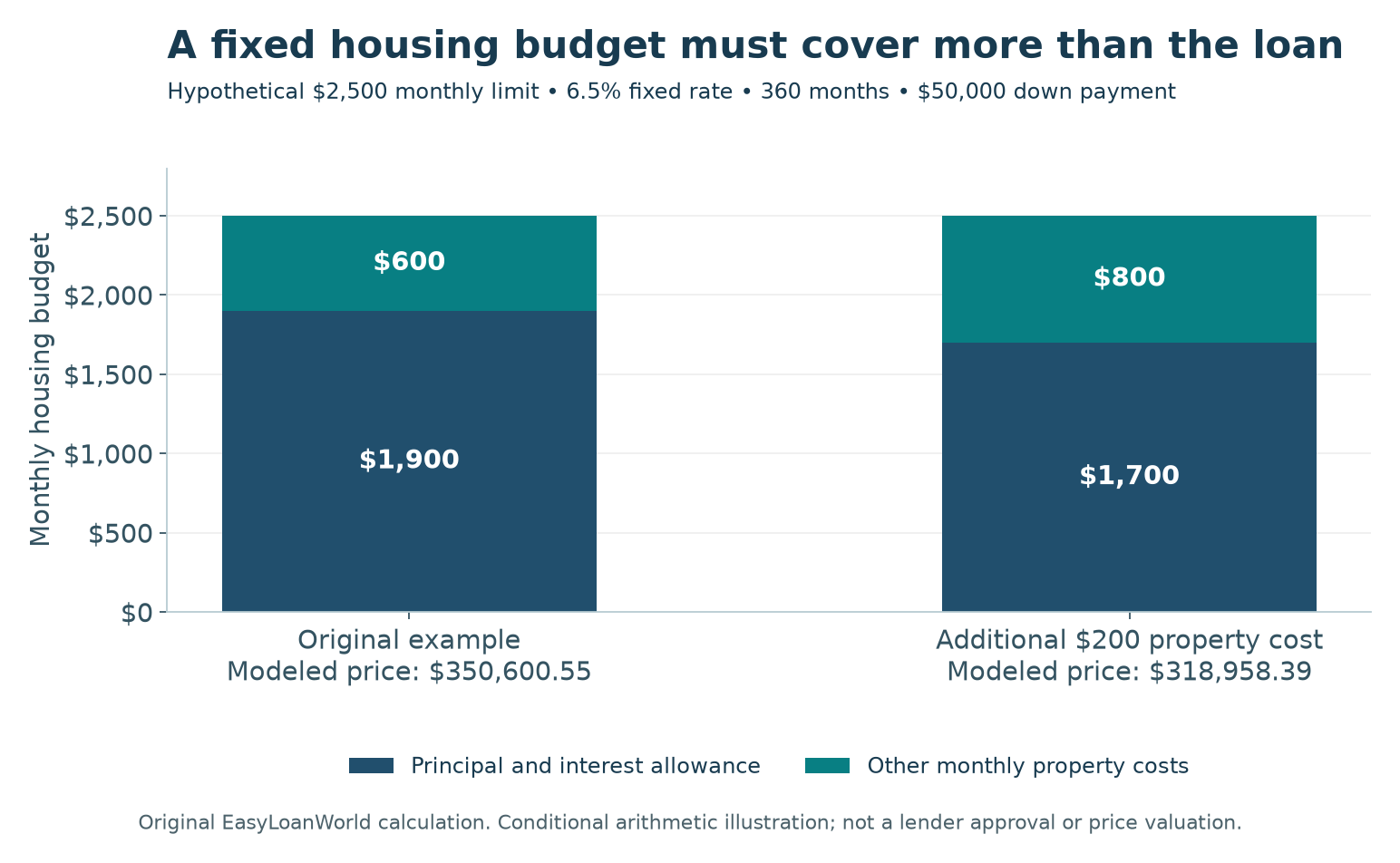
Assume a chosen monthly budget of $2,500, with $300 for property taxes, $150 for homeowners insurance, $100 for mortgage insurance, and $50 for HOA dues. Use an illustrative fixed rate of 6.5%, a 360-month term, and $50,000 of cash reserved specifically for the down payment.
| Measure | Amount |
|---|---|
| Chosen monthly housing budget | $2,500.00 |
| Entered monthly property charges | $600.00 |
| Principal-and-interest allowance | $1,900.00 |
| Modeled loan principal | $300,600.55 |
| Cash down payment | $50,000.00 |
| Modeled purchase price | $350,600.55 |
The $350,600.55 figure is conditional on every assumption in the table. It isn’t a home valuation, lender maximum, or assurance that a property at that price has the entered taxes and insurance. Use it as a starting point for gathering property-specific costs and financing terms, then recalculate.
A modest cost change can move the price meaningfully
Suppose the same household discovers an additional $200 per month of property costs. Its principal-and-interest allowance falls from $1,900 to $1,700. With the same illustrative 6.5% rate, 360-month term, and $50,000 down payment, the modeled price falls to about $318,958.39. The difference is about $31,642.16.
This is why early estimates of taxes, insurance, and association dues matter. A price target based only on principal and interest can be too high once the other bills are included. Conversely, comparing two properties with similar prices but different recurring costs may reveal a substantial difference in monthly comfort.
Change one input at a time when learning what drives the result. Test a higher rate, a larger insurance estimate, a shorter term, and a smaller down payment after reserves. Then create one combined cautious scenario. This process shows which assumptions deserve better evidence before you make an offer.
Budget fit and loan qualification are separate checks
A lender may review income, debts, credit, assets, property value, and program requirements. This calculator reviews none of those. The debt-to-income calculator can help organize one part of the discussion, but it also can’t promise approval. A lender’s qualification analysis and your household’s comfortable spending level can produce different numbers.
The CFPB’s home-spending guidance emphasizes considering both monthly payments and available cash. Use the cash-to-close calculator to organize the down payment, closing charges, credits, and money already paid. A monthly payment can fit while the transaction still requires more cash than you have reserved.
After obtaining a Loan Estimate and property-specific information, compare the documented figures with your planning inputs. Reconcile large differences before relying on the purchase-price estimate. Don’t let a more generous qualification amount automatically replace the budget you selected from your actual expenses.
Mortgage budget calculator questions
Why does the tool not ask for my salary?
It starts with a housing budget you choose. It calculates the loan supported by that payment under the entered assumptions. It doesn’t derive a lender qualification limit from income.
Are taxes and insurance calculated from the home price?
No. They remain the fixed monthly amounts you enter. Update them for the property and transaction rather than assuming the calculated price includes an automatic local-cost estimate.
Does the purchase price include closing costs?
No. It’s modeled loan principal plus cash down payment. Closing costs, prepaid items, initial escrow funding, moving expenses, and reserves require separate cash planning.
Can I use the result as my offer limit?
Use it as one input to that decision. Verify financing, property costs, repairs, available cash, and your comfort with the recurring payment. The result doesn’t assess the property’s market value or your approval prospects.
Questions or corrections?
Send a question or report an issue with a published page.