California Private-Party Car Financing
Quick answer: Confirm that the lender accepts this private-party purchase and this vehicle, then reconcile the title, existing lien and required transfer…
Estimated reading time: 6 minutes
Quick answer: Confirm that the lender accepts this private-party purchase and this vehicle, then reconcile the title, existing lien and required transfer documents. Build the budget from the full purchase price plus applicable taxes and fees. A small payment to the seller isn’t necessarily the whole price.
Does the loan cover this seller?
An auto-loan label doesn’t establish that the lender finances purchases from individuals. Bank of America, for example, explicitly excludes private-party purchases. Its prequalification is for new or used dealer purchases and isn’t a commitment to lend or loan approval.
That provider example is a reason to identify the transaction type before comparing offers, not a recommendation for or against a bank. A favorable estimate for a different purchasing channel doesn’t answer the private-seller question. Ask the lender whether its product covers the actual seller and vehicle, and which conditions remain unresolved.
The same FAQ notes that changing the loan amount or collateral can change approval and terms. Keep a new vehicle selection attached to the lender’s current response, not an earlier estimate.
Read the accepting lender’s instructions
Navy Federal describes private-seller purchases, but requires membership before applying. Its FAQ asks for the selected vehicle’s VIN, registration state, exact mileage and seller’s name. Membership doesn’t guarantee approval.
It also directs private-party borrowers to confirm state documentation and record Navy Federal as first lienholder. This is that lender’s process, not proof that another institution accepts the same transaction or paperwork.
Find the first payment date in the promissory note, as its FAQ directs.
Title releases
For California-registered vehicles, DMV distinguishes registered-owner and lienholder releases, with an exception when the same lienholder remains.
Purchase price isn’t just cash handed to the seller
CDTFA says private-party vehicle purchases generally incur use tax unless an exemption or exclusion applies. The rate depends on registration address.
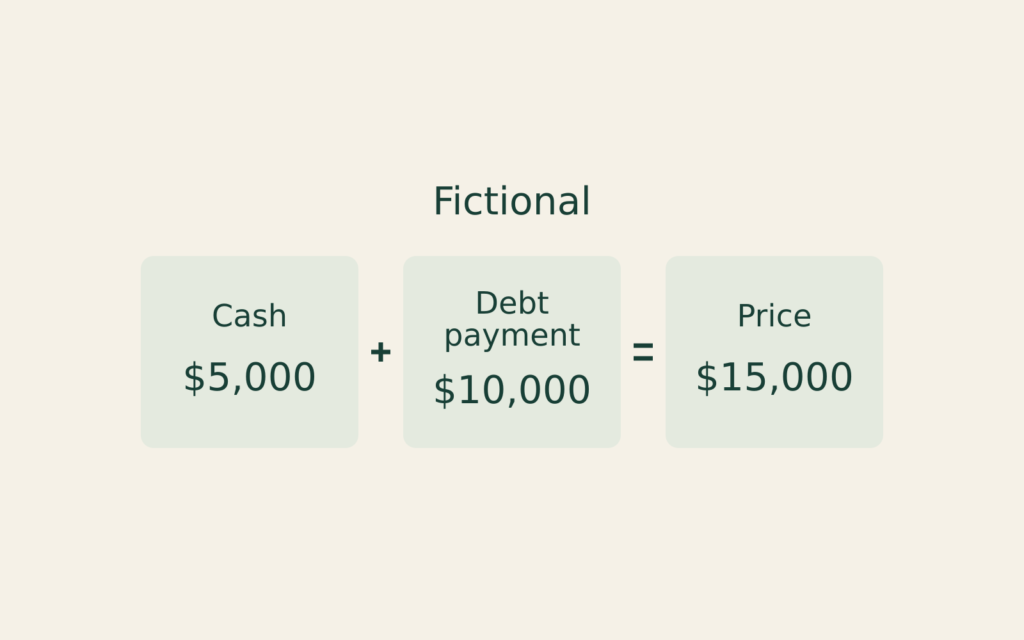
The taxable purchase price can include payment or assumption of debt, as well as cash. Fictional transaction: the agreed vehicle price consists solely of $5,000 paid to the seller and $10,000 paid toward the seller’s vehicle debt. That’s a $15,000 purchase price, not $5,000. No tax amount is calculated.
CDTFA identifies a claim for refund or credit for tax paid to DMV, with an online route and Form CDTFA-101-DMV. This concerns tax previously paid, not financing approval. Consult the agency about the applicable process and supporting evidence.
Use the current odometer rule
NHTSA’s current guidance describes the twenty-year disclosure exemption and the separate exemption for model-year 2010 and older vehicles. Don’t rely on a blanket ten-year shortcut for newer models.
California’s 2021-10 bulletin confirms the twenty-model-year framework beginning with 2011 models. Other exemptions remain; the vehicle’s actual circumstances still matter.
NHTSA also says that when the displayed mileage is incorrect, the title must carry a statement to that effect.
NHTSA distinguishes individual cases, directed to a state enforcement agency, from reporting large-scale schemes to its Vehicle Safety Hotline. Its office says it can’t pursue individual consumers’ claims. Preserve the disputed record and seek appropriate advice rather than treating an online report as a decision on ownership or compensation.
Check the right smog event
California’s Bureau of Automotive Repair distinguishes registration renewal from a change of ownership. For gasoline, hybrid and alternative-fuel vehicles, the newer-model exception is eight model years for renewal but four for ownership changes. Other vehicle-type exemptions apply, including electric vehicles.
For a private-party purchase requiring a Smog Check, BAR says the vehicle must have passed within the preceding 90 days. Ask for the vehicle inspection report. A renewal exception doesn’t automatically establish an ownership-transfer exception.
Keep the applicable vehicle category and event together when asking BAR or DMV about an uncertain requirement. This isn’t a mechanical condition assessment.
Three 90-day references, different clocks
These named-provider and California rules aren’t interchangeable:
| Record | Reference point |
|---|---|
| Navy Federal preapproval: 90 calendar days | Check date |
| Navy Federal title receipt: within 90 days | Purchase |
| Required private-sale Smog Check: preceding 90 days | Purchase |
Identify what the listing platform actually does
Autotrader’s own fraud guidance distinguishes its classifieds from its separate Private Seller Exchange, or PSX. For classifieds, it’s an advertising publisher, not an endorsement of buyers, sellers or transactions. It says it doesn’t warehouse listed vehicles. It also says it doesn’t endorse third-party escrow services.
The separate PSX platform has different transaction services, including an escrow option. Therefore, “Autotrader never handles payments” would be an inaccurate blanket statement. Equally, a classified listing doesn’t by itself establish that the purchase is being completed through PSX.
Identify the exact service and confirm its actual process through the platform’s own independently accessed support. Autotrader says PSX won’t direct buyers to pay sellers directly or sellers to send titles directly to buyers. A conflicting message needs clarification; a familiar logo alone doesn’t verify its origin or authorize a payment.
Keep unresolved questions open until the responsible party answers them in writing. This article doesn’t select a lender, certify title or direct a payment.

Parent Pays Student Loan Interest: Who Deducts?
Separate payment and obligation.

Returned Loan Debit: Two Fees?
Trace the payment and fees.

Rehabilitation Payment Too High?
Check an alternative request.