Capacity Choices
Choosing advance capacity by average demand can miss the cost of the next unit. This fictional example derives a quantity rule and its exact ties.
Estimated reading time: 5 minutes
Choosing advance capacity by average demand can miss the cost of the next unit. This fictional example derives a quantity rule and its exact ties.
Specify which units are charged
A one-period service requirement D is zero units with probability 0.2, four units with probability 0.5 and ten units with probability 0.3. These probabilities are stipulated, not estimated from customer records. Select a nonnegative integer quantity q before demand becomes known.
Every reserved unit costs c, whether used or not. Unused units receive no refund and have no resale or later use. Reserved capacity covers up to q units without another usage charge. Any excess demand is fulfilled through an unlimited alternative costing six per unit, with identical service. There are no other costs, delays, taxes or financing flows.
Thus the realized cost is cq + 6 max(D − q, 0). The reservation charge applies to every unit, not just unused units. The alternative’s charge is an actual stipulated payment, not lost revenue or a penalty assigned to unfulfilled service.
Compare adjacent quantities
Increasing q by one always adds c. It avoids one alternative-service charge only when demand exceeds q. Therefore the change in expected cost is c − 6 Pr(D > q). This is next-unit reasoning of the kind developed in MIT OpenCourseWare’s Newsvendor Inventory Problem notes; the payment structure and numerical cases here are stipulated separately.
For q from zero through three, either positive demand value requires the extra unit. The probability is 0.5 + 0.3 = 0.8. For q from four through nine, only demand of ten requires it, giving probability 0.3. Once q reaches ten, the probability is zero.
The inequality is strict. At q = 4 and D = 4, existing reserved capacity already covers all four units. A fifth reserved unit replaces no alternative-service payment. Counting Pr(D ≥ q) would incorrectly include that half-probability event.
Show why the local comparison finds a global minimum
As q increases, the probability that demand exceeds it cannot rise. The expected-cost increments therefore cannot decrease. Negative increments reduce total expected cost; positive increments increase it. Once increments become positive, buying still more units cannot make them negative again. Zero increments create tied quantities rather than a unique answer.
Apply the rule at a reservation price of two
Set c = 2. The first four increments each equal 2 − 6(0.8) = −2.8. The next six each equal 2 − 6(0.3) = +0.2. Expected cost falls until q reaches four and then rises. Four is the unique minimizing integer quantity.
At q = 4, the reservation payment is eight. Only demand of ten needs alternative service: six units costing 36, occurring with probability 0.3. Expected cost is 8 + 0.3(36) = 18.8.
Mean demand is 0(0.2) + 4(0.5) + 10(0.3) = 5. Reserving that mean quantity costs ten upfront and leaves five alternative units in the high-demand case. Its expected cost is 10 + 0.3(30) = 19. The mean is feasible but not minimizing in this example.
Change the price without changing demand
Now lower c to 1.5 while keeping all demand values, probabilities and alternative-service charges unchanged. The first four increments become 1.5 − 4.8 = −3.3. The next six become 1.5 − 1.8 = −0.3. Every increment through the tenth unit reduces expected cost, so q = 10 uniquely minimizes it.
Ten reserved units now cost 15 and cover every listed demand outcome. Four reserved units instead have expected cost 6 + 0.3(36) = 16.8. The demand mean is still five; the distribution did not change, but the cost comparison did.
Retain every minimizer at the boundary prices
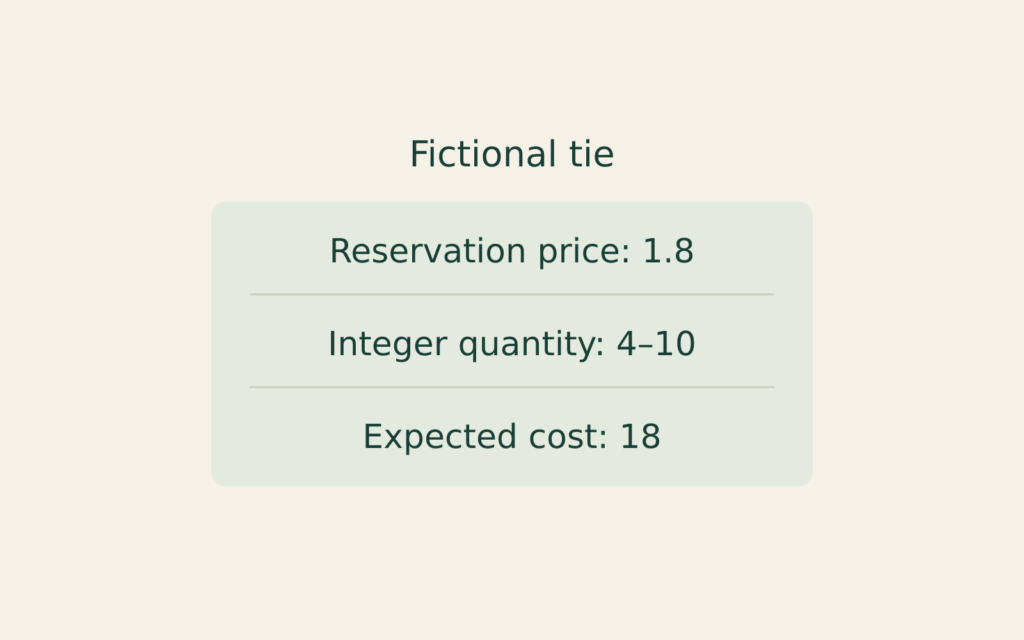
At c = 1.8, the first four increments are −3 and the next six are zero. Expected cost falls from 30 at q = 0 to 18 at q = 4, then stays at 18 through q = 10. Every integer quantity from four through ten minimizes it.
At c = 4.8, the first four increments are zero and the next six increments are +3. Every integer quantity from zero through four has expected cost 30. Quantities above four cost more. Selecting only one boundary quantity would omit other equally good answers under the stated criterion.
The complete positive-price comparison follows from those same two increment values. Below 1.8, ten uniquely minimizes expected cost. Strictly between 1.8 and 4.8, four minimizes it. Above 4.8, zero minimizes it. At either boundary, retain the full tie set just calculated.
For any positive c, reserving more than ten units cannot reduce alternative-service spending because demand never exceeds ten; each additional reservation only adds c.
Do not read an expected cost as a bill limit
With c = 2 and q = 4, expected cost is 18.8, but demand of ten produces an actual cost of 8 + 36 = 44. The minimizing quantity does not cap the payment at its average. This exercise supplies neither real forecasts nor financing-affordability conclusions.
Roth Conversion and Account Clocks
Separate five-year tests.
ABLE Distributions Across Month-End
Separate retained purposes.