Check Funds Available? Do Not Refund an Overpayment
Do not send back an apparent check overpayment just because funds show as available. Follow the immediate steps for your situation and trace any money already sent.
Estimated reading time: 9 minutes
U.S. consumer education. This guide explains the scam pattern and practical reporting steps; it doesn’t decide liability, guarantee reimbursement or replace advice about a specific dispute.
A seller sees money in an account, sends back an overpayment and later discovers the original check was fraudulent. The outgoing transfer was real even though the incoming credit was temporary. Understanding that sequence is more useful than trying to judge whether a check looks professional.
What to do now, based on your stage
| Your situation | First action | Information to keep |
|---|---|---|
| You received the check but have not deposited it | Do not send money or release goods because of the overpayment. Ask your bank how to handle the suspicious check. | Buyer messages, listing, envelope and check details. |
| You deposited it, but sent nothing back | Contact the bank’s fraud team promptly. Explain that the deposit may be fraudulent and leave the funds alone while the bank advises you. | Deposit receipt, date, amount and any hold notice. |
| You sent a refund or paid a third party | Contact your bank and the company that processed the outgoing payment immediately. | Transaction number, destination, amount and time. |
| The deposit was reversed | Request the reversal details and discuss the account balance, pending payments and dispute process with the bank. | Statements, bank notices and case-reference numbers. |
Use the phone number on your bank card, the bank’s official app or a website address you already know. A number or link supplied by the buyer may not reach the real institution. The OCC’s guidance for check-fraud victims recommends contacting the bank immediately and filing a police report. Don’t delay that contact while you investigate the buyer yourself.
Check overpayment scam: what available funds actually mean
Funds availability concerns when a bank permits you to use a deposited amount. It doesn’t answer every question about whether the check is authentic or will remain paid. The OCC’s funds-availability explanation describes general timing rules and exceptions that can extend a hold. Your account agreement and deposit circumstances matter.
The FTC’s fake-check guidance warns that convincing checks can take weeks to be identified as fake. It specifically identifies overpayments followed by a request to return money as a scam pattern. A visible account credit, a cashier’s-check label or the end of a hold isn’t a sensible basis for paying an unfamiliar person’s third party.
A hold is also not proof of fraud by itself. Banks may extend holds for several reasons. The warning sign here’s the transaction: someone has sent more than the agreed price and wants you to move money on their behalf.
Worked example: how a $1,200 “refund” becomes your loss
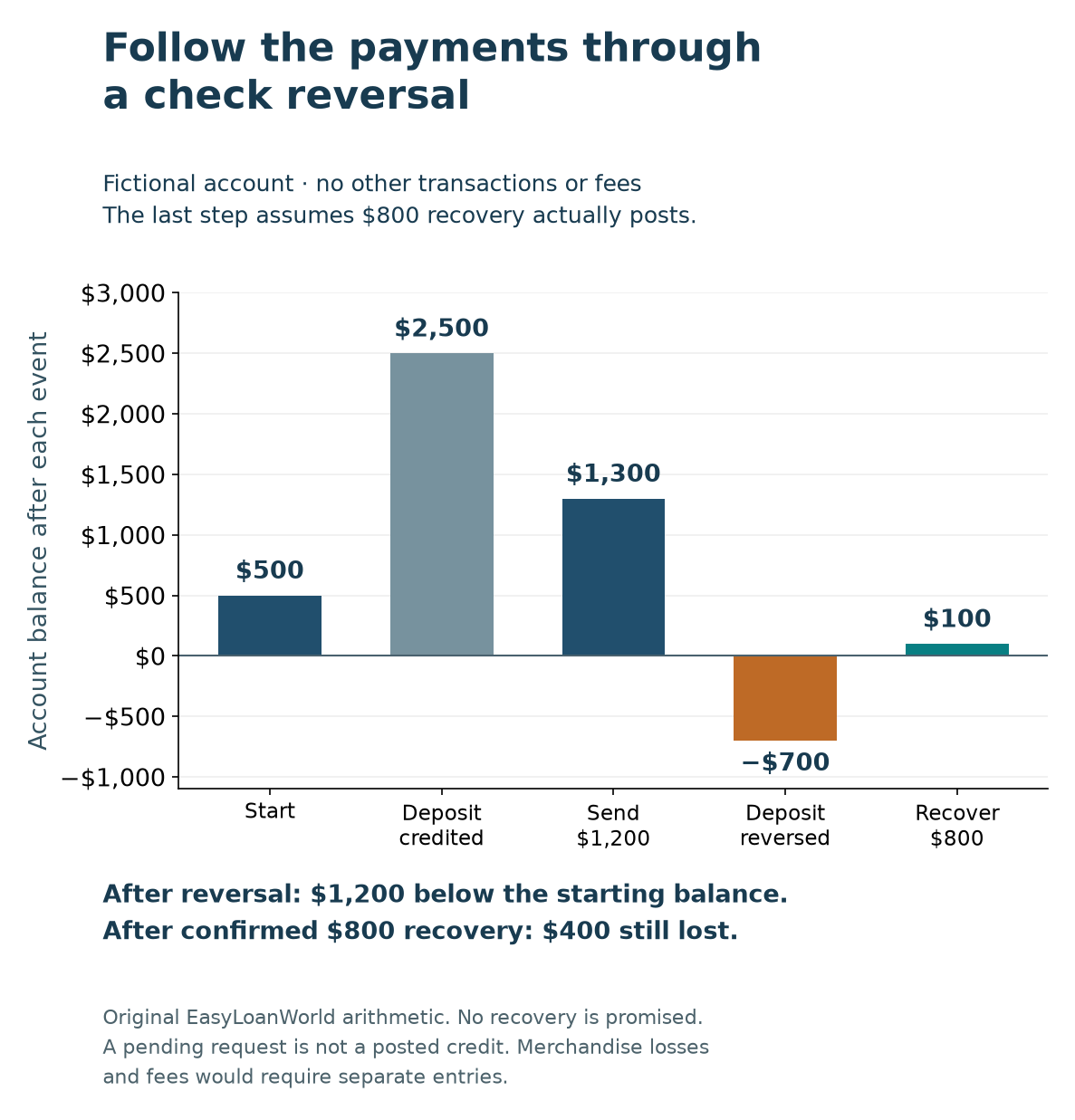
Imagine a fictional seller with $500 in the bank. A buyer sends a fraudulent $2,000 check for an $800 item, then asks for $1,200 back. For clarity, assume the seller sends the money, the bank later reverses the entire check credit, and there are no other transactions or fees.
| Event | Change | Balance |
|---|---|---|
| Starting balance | — | $500 |
| Check temporarily credited | +$2,000 | $2,500 |
| Separate payment sent to buyer | −$1,200 | $1,300 |
| Fraudulent check credit removed | −$2,000 | −$700 |
The calculation is $500 + $2,000 − $1,200 − $2,000 = −$700. The seller is $1,200 worse off than at the start. If the item was also shipped, its loss is additional; fees or other transactions would change the final account balance.
Two figures should therefore be kept separate when reporting the incident: the suspicious deposit amount and the amount of genuine money sent out. Saying only “I lost a $2,000 check” can hide the sequence the bank or payment provider needs to understand.
Check overpayment scam: track partial recovery separately
Suppose the fictional $1,200 outgoing payment was split into $800 through one provider and $400 through another. Keep a transaction reference and recovery request for each. The $2,000 suspicious deposit is a third, separate entry. A check overpayment scam report is easier to follow when the incoming credit, outgoing payments and later recoveries stay distinct.
Now assume, solely to illustrate the ledger, that the first provider successfully returns $800 and the credit actually posts after the check reversal. No other transaction or fee occurs. The account moves from negative $700 to positive $100. Compared with the original $500, the remaining cash loss is $400.
| Item | Amount |
|---|---|
| Balance after reversal in the original example | −$700 |
| Confirmed recovery actually credited | +$800 |
| New balance, with no other activity | $100 |
| Original $500 minus new $100 | $400 still lost |
A case number, recall request or statement that a provider will investigate isn’t an $800 bank credit. Keep a requested recovery marked as pending until the actual status and amount are confirmed. Tell each provider about relevant recoveries so the same outgoing payment isn’t mistakenly described as still wholly unrecovered.
For a check overpayment scam, the amount needed to bring an account back above zero is also different from the total money lost. In the original example, the negative balance is $700 but $1,200 left the seller’s funds. Preserve both figures, identify any merchandise loss separately and ask the bank how the reversal affects real pending bills. Don’t fund another “recovery fee” demanded by the sender.
Recognize a check overpayment scam by the request
Watch for a story that turns you into an intermediary. The sender may say the surplus is for a shipping company, assistant, equipment supplier or an accidental payment. The explanation changes; the requested action remains the same: use your account to pass money to someone else.
Pressure makes the mistake easier. A deadline to secure a sale or begin a job can make it feel unreasonable to pause. Separate the original transaction from the new request. Selling an $800 item doesn’t require you to provide a $1,200 money-transfer service.
The OCC’s scam-prevention guidance also advises declining requests to cash another person’s check for a fee. It warns that fraudulent credits can be removed and cautions against sharing account details or authentication codes with unverified contacts.
Don’t send a small “test” refund to prove cooperation. That creates another real payment without resolving the authenticity of the incoming check. Don’t buy gift cards, send cryptocurrency or pay a supposedly independent delivery agent to solve an unexplained overpayment.
If you already paid, follow the outgoing payment
The next call depends on how your money left. The FTC’s guidance identifies payment-specific attempts at recovery, including contacting a wire-transfer company or gift-card issuer promptly. Recovery isn’t assured; fast reporting gives the provider the opportunity to explain any available steps.
| Payment route | Contact | Ask and document |
|---|---|---|
| Bank transfer or payment app | Your bank and the service that sent the payment | Report the scam, ask about stopping or recalling it, and obtain a case number. |
| Wire-transfer company | The company’s official fraud or customer-support channel | Ask whether the transfer can be reversed; supply the receipt and reference number. |
| Gift card | The issuing company and the store that sold it | Report the scam and ask whether remaining value can be protected or refunded. Keep the card and purchase receipt. |
| Money order or mailed payment | The issuer and, where relevant, the delivery service | Ask about stopping payment or delivery before the item is received or redeemed. |
Give an accurate account of what happened. Distinguish a payment you personally sent after deception from a transaction you did not authorize. The provider needs the actual circumstances to assess its process; don’t change the description to fit a hoped-for outcome.
If the outgoing payment used Zelle, see our separate Zelle scam response guide. If the request arrived as changed invoice instructions, the invoice-payment fraud checklist helps organize that evidence.
Build a clear incident record
- Write a timeline. Record when the buyer contacted you, when the check arrived, when you deposited it and when each outgoing payment was made.
- Preserve the original messages. Include usernames, email addresses, phone numbers and the instructions to return or forward money. Keep receipts and check images securely.
- Record bank contacts. Note the department, date, case number, requested documents and next step. Ask for written confirmation where available.
- Identify pending obligations. Tell the bank if a reversal may affect scheduled rent, utility or other essential payments. Ask what options apply rather than assuming a pending deposit can cover them.
- Report through official channels. The FTC lists ReportFraud.ftc.gov, the U.S. Postal Inspection Service and state attorneys general among reporting routes. Reporting is separate from requesting recovery from the payment provider.
If you disclosed sensitive information or access credentials, explain exactly what was shared to the bank. Don’t publish unredacted check images, account numbers or identification documents in a social-media warning.
Frequently asked questions
How many days should I wait before refunding the surplus?
There’s no waiting period this guide can give that makes an unexplained overpayment from an unfamiliar buyer safe. Ask the bank about the suspicious deposit and avoid sending a separate payment based on account availability.
What if the check looks like a cashier’s check?
Appearance doesn’t resolve authenticity. The FTC includes cashier’s checks among the forms fake checks can take. Focus on the overpayment request and contact the institution through an independently verified channel.
Should I return the money directly if the buyer threatens me?
Don’t let pressure replace the verification process. Preserve the messages, stop discussing payment instructions with the sender and tell the bank what happened. Report threats to the appropriate authorities.
Will the bank automatically cover my loss?
No reimbursement is promised here. Outcomes depend on the facts, payment method, account terms and applicable rules. Ask the bank to explain the reversal and dispute options, and retain the response.
Next step: If this is happening now, contact your bank before sending anything else. Use the timeline above to explain the incoming check and outgoing payment separately.
Sources checked October 25, 2026. Examples are fictional and exclude merchandise, fees and unrelated transactions.


Roth Conversion and Account Clocks
Separate five-year tests.

ABLE Distributions Across Month-End
Separate retained purposes.