Child Care Before Borrowing
Separate the child-care provider’s bill, available benefits and possible tax treatment before considering borrowing.
Estimated reading time: 5 minutes
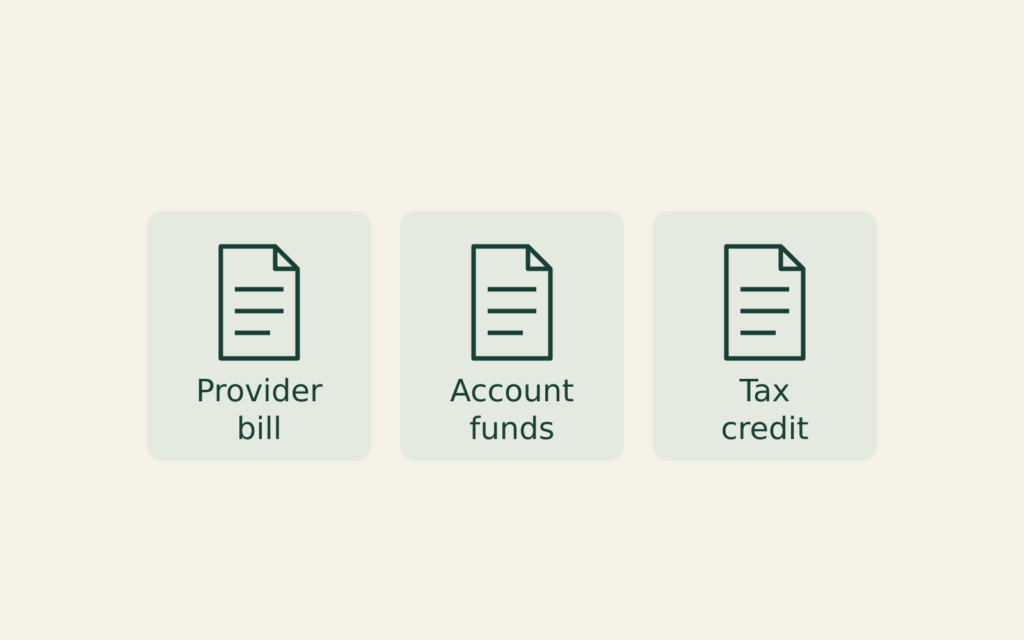
Start with the child-care provider’s bill, then look separately at available benefits and possible tax treatment before borrowing. The examples below explain different documents; they aren’t a combined funding offer.
Start with the actual care agreement
ChildCare.gov’s contract guidance identifies the child’s schedule, rates and fees, vacation and absence treatment, and the process for stopping care as subjects the agreement should address.
Ask specifically how an absence or vacation affects charges rather than assuming that not attending automatically removes a payment.
This is a document-reading question, not a finding that a particular charge is enforceable. Resolve unclear terms with appropriate help.
Distinguish the election from the funded account
FSAFEDS describes its dependent-care FSA as a payroll-funded, pre-tax account for eligible care expenses. Its rules permit use of the available account funds, not the entire annual election.
For an enrolled participant, that means an election confirmation and the current funded balance answer different questions. Don’t enter the annual election as a bank receipt in a borrowing plan. This program example doesn’t establish another employer’s reimbursement procedures. FSAFEDS offers reimbursement by check or direct deposit, with account alerts available by email or text. Delivery method and claim status are separate records.
The program also warns that unused money remaining after its benefit period is lost. Ask the administrator about the applicable period before treating an account balance as indefinitely available.
A tax credit isn’t the provider’s discount
The IRS’s current child-and-dependent-care credit page identifies changes for tax year 2026, generally reported on returns filed in 2027. It describes a credit percentage tied to adjusted gross income and qualifying expenses, not a universal percentage of every child-care bill.
The credit is nonrefundable: it can reduce federal income tax owed, but excess credit doesn’t become a refund. Excluded employer-provided dependent-care benefits generally reduce the expenses available for calculating the credit; the same expenses can’t support both benefits.
This guide doesn’t calculate a credit, determine eligibility or treat a possible tax reduction as money already received.
Head Start eligibility and a vacant place differ
Head Start describes free learning and development services for eligible families with children from birth to age five. Its eligibility routes include income at or below the poverty level, specified public assistance, foster care and homelessness. Local programs help determine qualification and required documentation. The listed public-assistance routes are TANF, SSI and SNAP; those routes don’t depend on income.
The same guidance says a family can request a waiting-list place when no space is available.
Head Start also welcomes children with disabilities, and some Early Head Start programs provide prenatal services. The local program supplies its own forms and identifies the needed supporting documents. This guide doesn’t make an enrollment decision.
Read the employer’s backup-care conditions
Johns Hopkins’ public benefits page gives a specific employer example, not a nationwide Bright Horizons price. Its listed full-time, benefits-eligible groups can access the program; the page says benefits can’t be used during an inactive employment status or leave of absence.
Hopkins describes partial payment for up to ten backup-care days per calendar year when regular arrangements are unavailable. The page separately describes enhanced family-support services, such as caregiver-marketplace access; those aren’t the same benefit as paying for a care session.
For its backup-care bookings, a copay hold is placed on the credit card, with the charge occurring after care is provided. Check the actual employer’s conditions rather than borrowing another employer’s allowance.
Military assistance has provider and payment requirements
Army MCCYN fee assistance supports eligible Army families lacking military-based care because of distance or a waitlist. Family and provider documentation requires review.
Its Provider Cost Verification Form records discounts, effective dates, rate changes, payment frequency and care schedule. The provider’s eligibility is confirmed before that form is submitted with the family application.
The administrator pays the provider at month-end after completed attendance sheets are received and processed. The program isn’t an entitlement; funding availability governs.
For in-home employees, wages may not be the full cost
IRS Topic 756 explains that household workers can be employees when the household controls both the work and how it’s performed. Babysitters are among its examples.
When the applicable conditions are met, household employment can involve employer Social Security and Medicare taxes, federal unemployment tax and reporting duties. The IRS identifies exceptions, including specified family-member and younger-worker situations; the wage amount alone doesn’t resolve every case. Its guidance identifies Form W-2 and Schedule H for specified reporting circumstances.
Federal income-tax withholding has a separate rule: it’s generally not required for a household employee, although the parties can agree to it. Obtain qualified guidance on the actual relationship and tax year before treating an hourly wage quote as the complete household-employer cost.


Roth Conversion and Account Clocks
Separate five-year tests.

ABLE Distributions Across Month-End
Separate retained purposes.