Compare Private Student Loan Offers and Total Cost
Match private student loan offers to one school year and funding calendar, then compare enrollment payments, later installments and total scheduled repayment.

Compare private student loan offers only after they cover the same school period, funding amounts and payment calendar. A smaller monthly payment is not a complete answer if the quote funds less tuition or leaves out payments made while you are studying.
Start with your school’s financial aid office to check available resources before deciding how much private borrowing remains necessary. Federal Student Aid recommends that conversation; its article currently carries a federal-program update warning.
This guide organizes a comparison for one academic year. It does not predict approval, future-year financing or the terms you will receive.
Label the evidence before comparing it
Private education loan disclosure rules distinguish application-stage illustrations from approval disclosures for the offered loan. An early cost example may use standardized assumptions. Approval paperwork addresses enrollment payments, deferred interest and repayment estimates. Label each document’s stage and date rather than treating every advertised example as your personal offer.
For a provider-specific illustration, Sallie Mae says prequalification is not firm credit approval. Its process also separates approval, school certification and disbursement, and funding may be split by semester. That does not establish another lender’s process or guarantee when your school will receive money.
Keep an unresolved condition visible beside the figure it affects. “Expected in August” and “received by the school” belong in different fields. Do not turn an estimated date into confirmed funding simply because the amount looks affordable.
Make four short comparison cards
Use one set for each offer. Keep private documents in your own secure files, with document and page references. Do not send financial records to EasyLoanWorld; these cards are an organizing tool, not an application.
1. Need
Write the school, program and academic period, the remaining fall and spring amounts, and the school confirmation reference. Keep the underlying need identical across comparisons. A whole-year offer and a one-semester offer answer different questions.
2. Quote
Identify who would owe the debt, including the borrower and any co-signer. A parent borrowing personally and a student borrowing with a co-signer are different arrangements. Record the document stage, requested amount, date and unresolved conditions. If an amount or calendar differs, request a matching version; the revised terms or approval may differ too.
3. Timeline
Place each funding event and payment phase on one calendar. Mark the first and last scheduled payment dates. Record the disclosed APR, contract interest rate and type, required fees, enrollment payments, expected capitalization, later installments and disclosed repayment total. List which payments each total includes, so nothing is omitted or counted twice.
4. Contract questions
Record rate-change and discount conditions, and preserve the applicable acceptance and cancellation dates and instructions from your disclosures.
Keep separate questions about co-signer release or payment help for loan-specific review. An unanswered question stays open; it is not a benefit you can assume will be available.
First fix an incomplete funding comparison
Suppose the remaining need is $12,000: $6,000 for fall and $6,000 for spring. An initial $10,000 quote leaves $2,000 unfunded. Its payment cannot establish the cost of financing the full year. Identify that gap before ranking the quote against a $12,000 offer.
For the example below, assume two new, fully matched fictional offers have been obtained. Their rates are invented; neither predicts how the incomplete quote would be repriced.
Worked example: two funding dates, one complete schedule
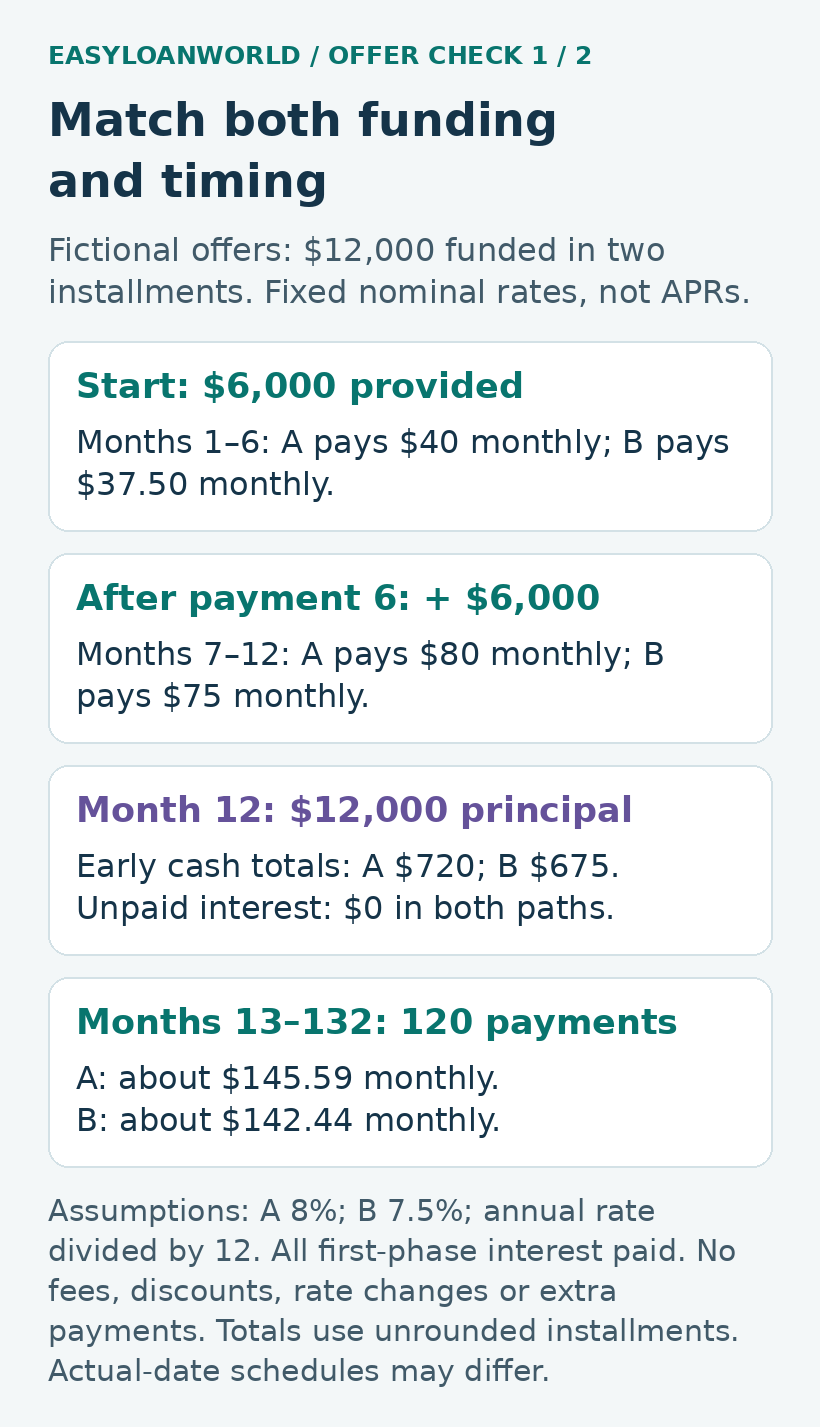
Both offers provide $6,000 at the outset and another $6,000 immediately after the month-six interest payment. The borrower pays all modeled interest at each month-end for 12 months, without reducing principal. At month 12, principal is $12,000 and no interest remains unpaid.
Then 120 equal principal-and-interest installments begin in month 13. The elapsed schedule spans 132 monthly periods from first funding, although principal-and-interest repayment lasts 120 periods. This is an invented payment calendar, not a lender’s grace-period policy.
Assume equal monthly periods, annual nominal interest divided by 12, and no fees, discounts, rate changes, missed payments or extra payments. The rates below are not disclosed APRs.
Offer A: fixed 8%
- Months 1–6: six interest payments of $40
- Months 7–12: six interest payments of $80
- First-phase payments: $720
- Later installment: approximately $145.59; later installments total $17,471.17
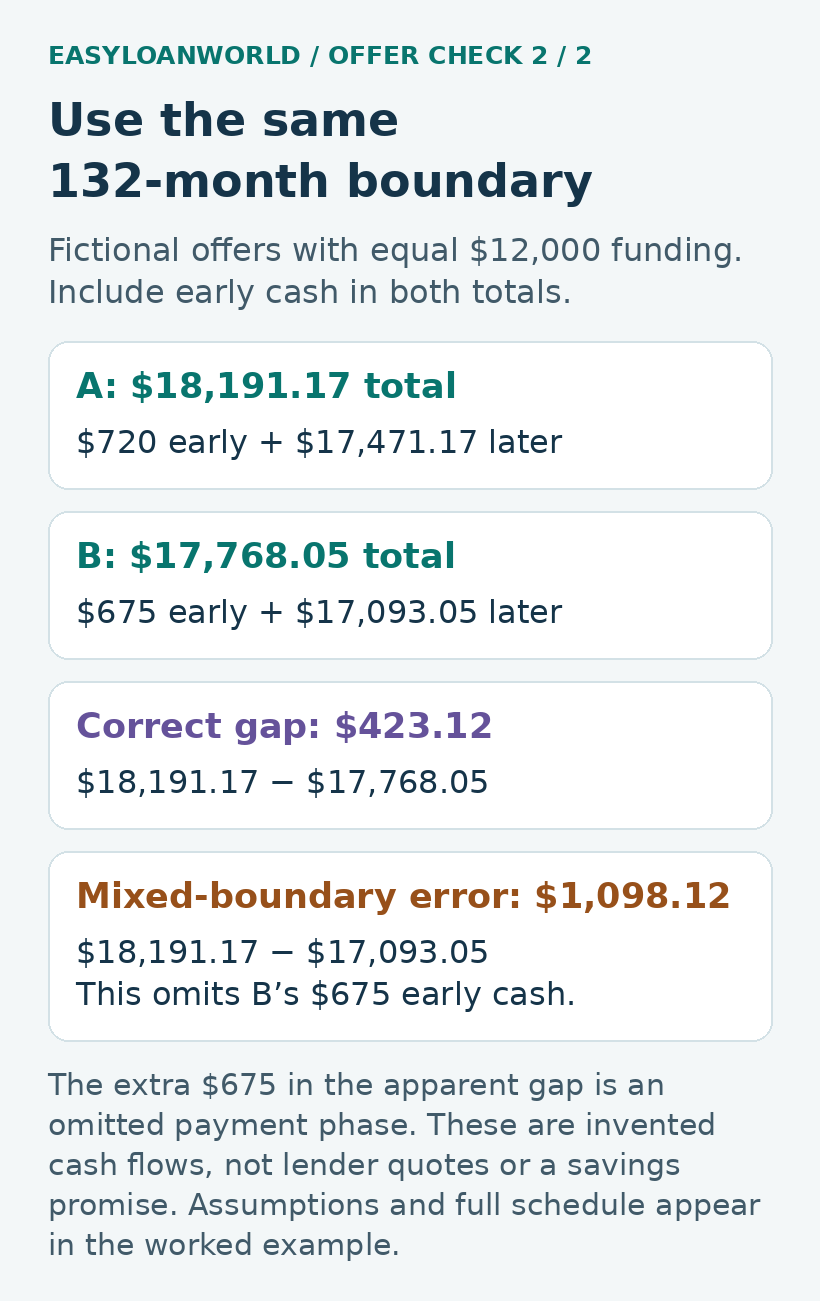
- All scheduled payments: $18,191.17
- Cost above the $12,000 funded: $6,191.17
Offer B: fixed 7.5%
- Months 1–6: six interest payments of $37.50
- Months 7–12: six interest payments of $75
- First-phase payments: $675
- Later installment: approximately $142.44; later installments total $17,093.05
- All scheduled payments: $17,768.05
- Cost above the $12,000 funded: $5,768.05
Totals use unrounded installments; multiplying the displayed payment cents may differ slightly. Actual dates, daily-interest methods and lender rounding can change results.
Compare totals with the same boundaries
Offer B’s modeled all-period total is $423.12 lower. That is a difference between these fictional schedules, not available or guaranteed savings.
The wrong comparison is A’s $18,191.17 all-period total against B’s $17,093.05 later-only total. That appears to create a $1,098.12 gap because B’s $675 of earlier payments is missing. Add B’s earlier phase before comparing. Do not add the $12,000 principal again: the repayment totals already include it.
Check affordability in both phases. If you cannot make the example’s early interest payments, you cannot simply replace them with deferral and keep these totals or assume the same rate.
Keep the lender’s disclosed total alongside your reconciliation. If they disagree, ask what each includes rather than relabeling your own calculation as a disclosure.
Resolve the remaining uncertainty
A variable-rate repayment estimate does not fix future borrowing costs.
Likewise, hoped-for future income or another loan next year is not confirmed funding. Keep those assumptions outside the verified comparison.
Before choosing, obtain matching paperwork, reconcile every payment phase and get written answers to the questions still open. A useful comparison shows both what is known and what could change, with an affordable calendar for the person actually responsible for repayment.
Featured photo: Campus buildings in Eugene, Oregon. Photo: Casey Olsen / Unsplash. Used under the Unsplash license.
College Withdrawal Bill: Reconcile the School Account
Use three school records and a fictional $1,340 example to trace each adjustment, check a changed balance and organize questions for the right office.

Student Aid Credit Balance: Separate the School Ledger From Spendable Cash
Use two fictional aid snapshots and a private payment record to organize the amounts, permissions and dates behind a college-account credit.

Solar Loan Quotes: Compare the Cash Price Before the Low Rate
Match the installation scope, reconcile a fictional $6,000 financed-price uplift, and test the later payment if a planned savings payment never arrives.