Debt Snowball vs Debt Avalanche: Compare the Cost
Compare the cost and account milestones of snowball and avalanche using the same payment budget, then check the terms that could change your plan.
Estimated reading time: 7 minutes
Debt snowball vs debt avalanche is a choice about where extra payments go after you cover every required minimum. Snowball targets the smallest balance, while avalanche targets the highest annual percentage rate (APR); the CFPB’s debt-reduction worksheet describes both orders and their tradeoffs.
For ordinary unsecured debts with stable rates, avalanche generally prioritizes interest savings. Snowball can provide an earlier account payoff, which some people find motivating.
Start with an affordable total, then compare the interest cost alongside the account milestones. The worked example below finishes in the same modeled month under both methods, yet the interest totals differ.
First, work out the payment budget
After allowing for essential expenses and irregular costs, list the amount available for debt payments and subtract every required minimum to find the extra you can direct toward a target account. Keep the two amounts distinct.
If the result is zero, there’s no extra payment to allocate this month. If it’s negative, address the shortfall before choosing an acceleration method.
This comparison concerns ordinary unsecured debt, such as credit cards. Housing and obligations that protect your ability to work need separate attention. The CFPB’s bill-prioritization tool asks readers to consider the consequences of missing different bills, including housing costs and required insurance. Don’t miss a car payment needed to keep working just to accelerate a card.
In a private worksheet, give each account a nickname and record its current balance, APR and minimum, with the due date beside it so you can schedule every required payment. Flag special deadlines separately. Account numbers aren’t needed for this planning sheet.
Debt snowball vs debt avalanche with the same $220
Consider three hypothetical debts. Every balance and rate below is invented for the comparison, and the minimums are assumed fixed dollar amounts. They don’t reproduce an issuer’s formula.
| Debt | Opening balance | APR | Assumed minimum | Snowball allocation | Avalanche allocation |
|---|---|---|---|---|---|
| A | $500 | 12% | $25 | $125 | $25 |
| B | $2,000 | 28% | $60 | $60 | $160 |
| C | $1,000 | 20% | $35 | $35 | $35 |
The balances total $3,500. The minimums add up to $120, leaving $100 extra from the $220 payment budget. Both allocations use the same total.
Snowball sends the extra $100 to A because it has the smallest balance. Avalanche sends it to B because it has the highest APR. C receives its assumed minimum under either order. One account’s extra payment doesn’t replace another’s required payment.
For the full projection, assume constant rates and minimum dollar amounts. Each month adds interest at APR divided by 12, then applies payments at month-end. There are no purchases, fees or missed payments. Keep unrounded balances, cap each payment at the amount owed and move unused target money to the next debt within that same month.
A model that waits until the following month to redirect unused money can produce different totals, even when it begins with identical balances and uses the same interest rates throughout.
- Snowball
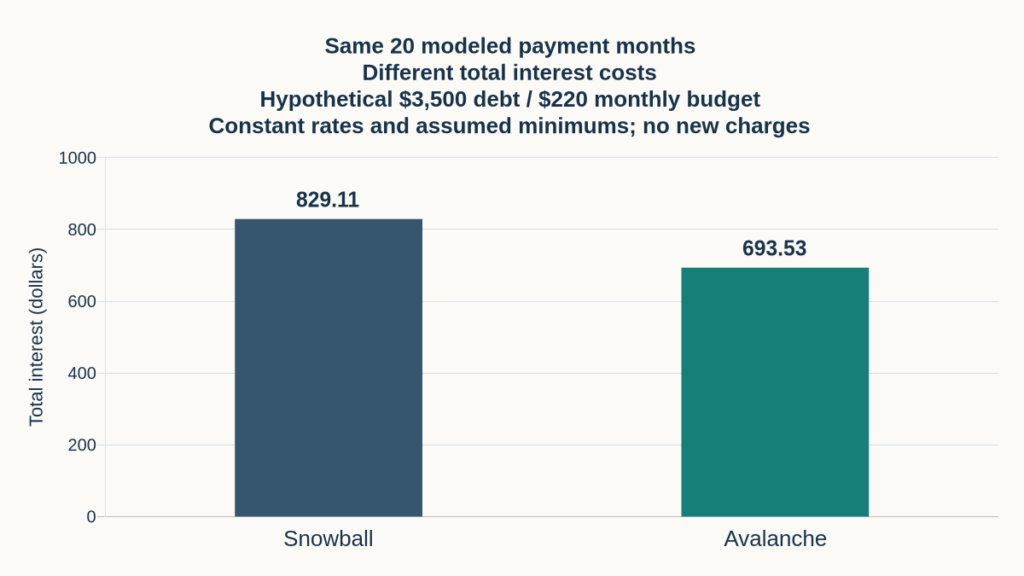
- 20 payment months. Interest: $829.11. Total paid: $4,329.11. First account clears in month 5.
- Avalanche
- 20 payment months. Interest: $693.53. Total paid: $4,193.53. First account clears in month 15.
The avalanche model costs $135.58 less interest. Both finish in month 20, but their final payments differ: about $13.53 for avalanche and $149.11 for snowball.
Snowball clears A in month five and C in month 11. Avalanche first clears B in month 15. Those are account milestones within this calculation, not evidence that either approach will motivate a particular person or produce a particular credit score.
The budget remains $220 until the smaller final payment clears everything. Letting total payments fall whenever an account disappears changes the comparison.
Enter the total budget in the calculator
To reproduce the model, enter A as $500 at 12% with a $25 minimum, B as $2,000 at 28% with a $60 minimum, and C as $1,000 at 20% with a $35 minimum. Use $220 for the total monthly budget. The initial extra is $100 after the assumed minimums.
For your own scenario, use the same starting information and total budget for both strategies. Otherwise, a larger payment can make one plan appear better even when the repayment order explains little of the difference.
Actual cards can use daily interest calculations, changing minimums and multiple APR categories. The CFPB explains the daily-interest approach used by many issuers. A simplified monthly projection won’t reproduce every statement.
Keep lender payoff information separate from the estimate. Our single-account payoff calculator can test a fixed payment for one balance, but that separate tool doesn’t roll money across this three-account plan.
When an account clears, keep the total visible
Suppose A is now paid off and you can still afford $220. If B and C still require $60 and $35, their minimums total $95. That leaves $125 above the remaining minimums.
In this separate snapshot, targeting C would give it $160 while B receives $60. Targeting B would give it $185 while C receives $35. The total remains $220 in either case.
Before redirecting the retired payment, confirm that the account has no remaining balance or residual interest and review any automatic debit. Then change the next target’s payment instruction. A worksheet entry saying “paid” doesn’t cancel a scheduled withdrawal.
Rates and deadlines can change the ranking
A simple APR order assumes the rate comparison still describes the period you’re planning for. If a known rate change is approaching, record its effective date and compare the resulting payment path before treating the account with the lowest rate today as the cheapest throughout repayment.
That doesn’t establish a blanket rule to pay a 0% account first. The future rate and the length of the comparison both matter, alongside the payments you can actually make. Don’t infer lifetime savings from a short projection that leaves both debts outstanding.
Deferred interest needs particular attention. The CFPB’s deferred-interest explanation warns that missing the full-payment deadline can lead to interest back to the original purchase date. Minimum payments generally won’t clear that promotional balance in time. Check the deadline and allocation terms before placing it in an ordinary stable-APR ranking.
If your circumstances change, you can reassess the target using current statements. When the smallest debt also has the highest APR, the two methods point to the same account anyway.
Choosing an account doesn’t control every allocation
Sending extra money to Card B is a choice among accounts. How the issuer allocates that money among balances within Card B is a separate issue.
For a card with several APR categories, amounts above the minimum generally go toward the highest-rate balance first; the issuer generally chooses where the minimum portion goes. Exceptions can apply, including special deferred-interest rules. Ask about the actual allocation when a single card contains different kinds of debt.
When there isn’t enough for every minimum
Contact the issuer promptly with the reason for difficulty and the amount you can afford. Explain when normal payments might resume and the temporary arrangement you’re requesting. The CFPB’s guidance for unaffordable card bills outlines these steps and suggests asking credit counselors about their services and fees before signing up.
Assistance depends on the issuer and your circumstances. Keep the proposed terms and check what any arrangement changes before building it into the payment plan. Moving an extra-payment target can’t solve a budget that fails to cover the required amounts.
For planning beyond this month, the emergency-fund calculator can illustrate a chosen reserve target. Don’t count cash needed for imminent essentials as available for both a reserve and extra debt payments.
When the next statements arrive, update the required amounts before scheduling the extra payment. Record the total you can fund and the account that will receive the remainder. If a payoff frees $25, show where that $25 goes in the next month’s budget.
Sources
Checked November 3, 2026. Dollar examples and calculator outputs use hypothetical terms; they aren’t payment instructions for a real account.