Missed Depreciation and Adjusted Building Basis
Compare depreciation actually deducted with the verified allowable amount, then reconcile the building's adjusted basis without treating the result as a new deduction.
Estimated reading time: 3 minutes
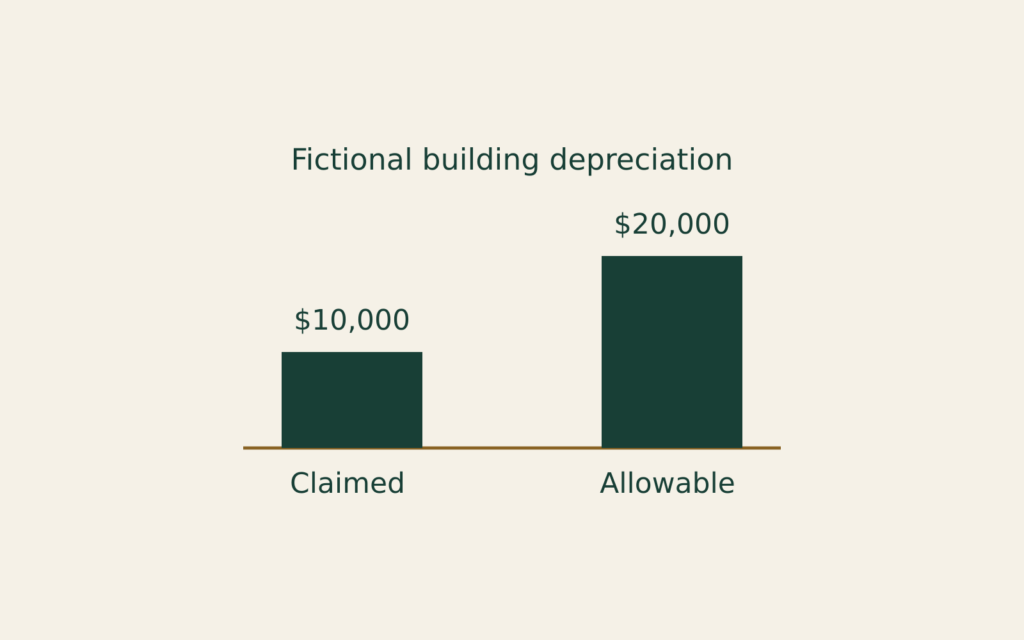
Claiming too little depreciation does not necessarily preserve that amount in a rental building’s basis. In the scoped example below, the basis reduction is $20,000 of allowable depreciation even though only $10,000 was deducted.
The key comparison is between the deduction history and the amount that could have been deducted under the chosen method. Adding up the amounts shown on past returns answers only one side of that comparison.
The rule behind the adjustment
Under “Depreciation,” IRS Publication 551, revised December 2025, says to reduce basis for depreciation deducted or that could have been deducted under the chosen method. When less was taken than could have been taken under that method, the publication calls for the full allowable reduction.
This guide addresses that underclaimed-depreciation situation. It does not establish a depreciation method, work out an allowable deduction or decide how an earlier return should be corrected.
Worked example: deductions are not the same as the required reduction
Assume an individually owned rental building has an established $100,000 cost basis, excluding land. For the relevant ownership period, allowable depreciation under the chosen method is independently verified as $20,000. The owner deducted only $10,000.
There are no improvements, credits, special depreciation allowances, capitalized depreciation or other adjustments. Those exclusions make the comparison visible; do not assume they hold for a real property’s history.
| Item | Amount | What it tells you |
|---|---|---|
| Established starting basis | $100,000 | The example’s building cost basis |
| Depreciation actually deducted | $10,000 | The deduction history |
| Verified allowable depreciation | $20,000 | The required reduction in these facts |
| Adjusted basis | $80,000 | $100,000 − $20,000 |
Subtracting only the $10,000 claimed would produce $90,000. That leaves $10,000 in basis that the stated rule requires this example to remove. The correct $80,000 result is a basis calculation, not an extra depreciation deduction or a tax payment.
A practical way to investigate a mismatch
- Identify the asset and starting basis. Keep building and land figures distinct.
- Collect the depreciation schedule and filed-return history. Record what was actually deducted for the relevant period.
- Establish the allowable amount separately. The $20,000 here is an assumption already verified for the example; it is not a rate to apply to other buildings.
- Reconcile other adjustments. Improvements, credits and other changes can make the real calculation more involved.
- Keep correction questions separate. A basis adjustment by itself does not file a claim for a missed deduction or amend an earlier return.
If the property was formerly a personal home
There may be another distinction to resolve before this adjustment: the depreciation starting basis after a rental conversion can differ from the basis later used for a gain. Our rental conversion basis guide shows those figures side by side.
No sale price is supplied in this example. It therefore does not determine sale gain, recapture, tax owed or a procedure for correcting past returns. Use the verified depreciation history and the applicable IRS guidance for those separate questions.


Roth Conversion and Account Clocks
Separate five-year tests.

ABLE Distributions Across Month-End
Separate retained purposes.