Equipment Financing: Cash Needed Before the Machine Is Ready
Reconcile the equipment invoice, financing and cash still needed, then check delivery, installation and acceptance before relying on productive use.
Estimated reading time: 8 minutes
Equipment financing needs a cash and readiness check before the machine starts earning. Reconcile deposits and invoices, then keep delivery, installation, acceptance and early payments on their own dated lines.
A financed machine can arrive before it’s installed, tested or producing anything. Before relying on it, reconcile the acquisition cash still due and the facts any acceptance document asks you to confirm.
These are related checks, but they answer different questions. Funding tells you who pays which invoice items. Readiness tells you whether the equipment can do its intended job. The fictional example below keeps them separate.
Equipment financing: list the actual uses of money
U.S. Bank describes direct vendor funding and possible inclusion of installation, tax and freight within product limits. That named example is a reason to confirm eligible invoice lines and the payment destination; an approved amount isn’t necessarily unrestricted cash sent to your business.
For your purchase, list the exact machine, accessories and services in the quote. Beside each item, identify the payee, total cost, amount financed, cash already paid and amount still due. Keep a deposit credit connected to the invoice it reduces.
Consider this invented acquisition, not a lender quote or tax calculation:
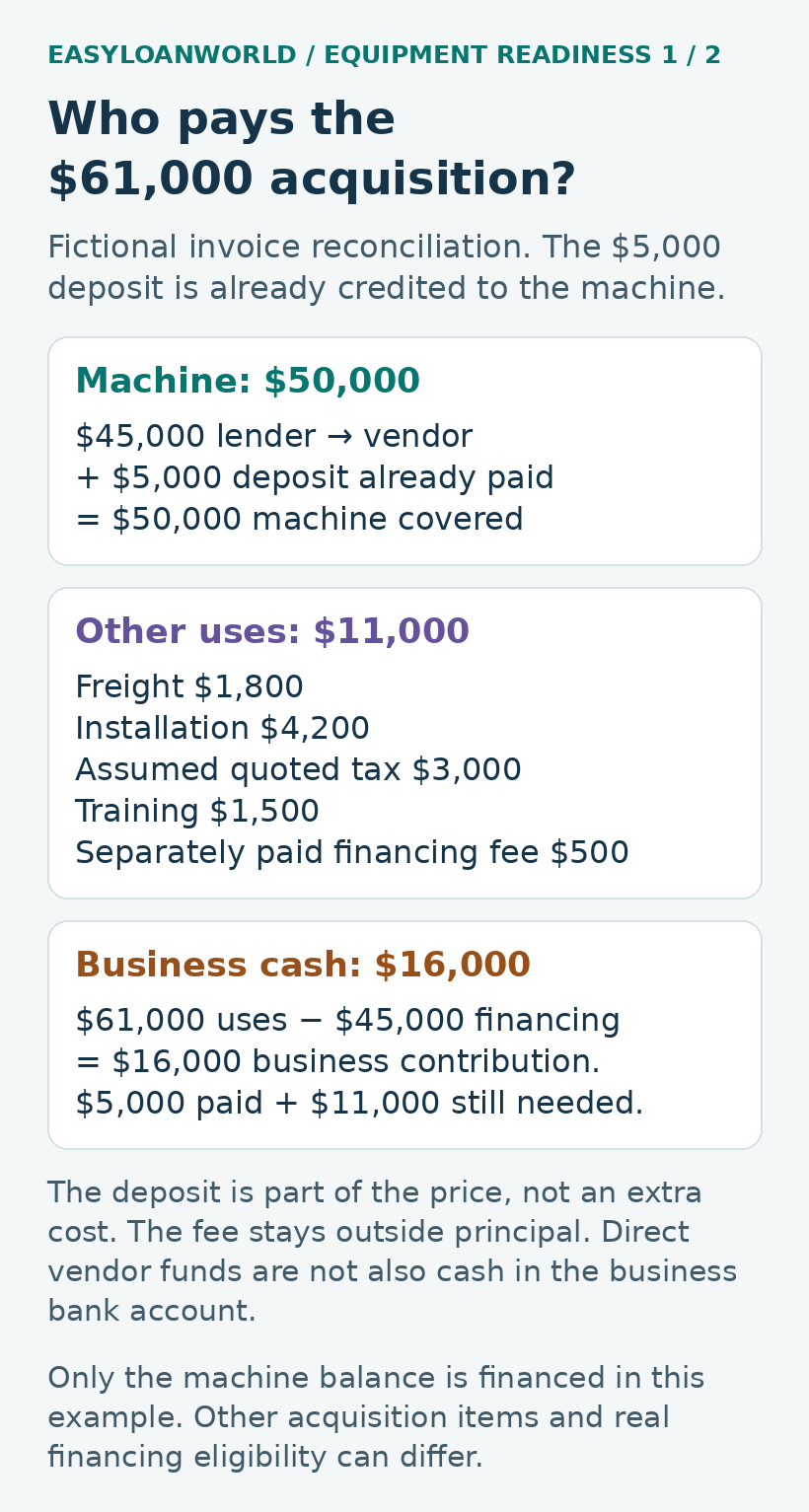
- Machine: $50,000.
- Freight: $1,800.
- Installation: $4,200.
- Assumed quoted tax: $3,000.
- Training: $1,500.
- Separately paid financing fee: $500.
Total acquisition-related uses are $61,000. The $3,000 tax is simply a stipulated invoice item; it doesn’t establish any jurisdiction’s tax rate, exemption or credit. In an actual project, add missing quote items and applicable connection, permit, insurance or service costs. These six lines aren’t an exhaustive checklist for every machine.
Equipment financing: credit the deposit exactly once
In this arrangement, the lender commits $45,000 directly to the vendor against the machine balance only. Every other item is excluded from financing. Funding conditions are assumed satisfied solely for the arithmetic.
The business already paid that vendor a $5,000 deposit, with evidence that it’s credited toward the $50,000 machine price. There’s no reimbursement or refund in this example.
The machine is therefore covered by $45,000 of lender funds plus the $5,000 credited deposit. Freight, installation, tax, training and the financing fee total $11,000, which the business still needs to pay.
- Total business acquisition cash: $61,000 − $45,000 = $16,000.
- Cash already paid toward that amount: $5,000.
- Acquisition cash still needed: $16,000 − $5,000 = $11,000.
Adding the deposit to the $61,000 again would count part of the machine price twice. Deducting it twice would conceal a cash shortage. The $500 financing fee remains outside the loan principal, and money paid by the lender to the vendor isn’t also available in the business’s bank account.
Before relying on this reconciliation, obtain matching invoice and deposit records. If financing eligibility or reimbursement is only proposed, label it unresolved rather than subtracting it as if the money had arrived.
Check insurance evidence against the invoice
As a provider-specific example, First Western Equipment Finance’s checklist asks for actual equipment cost, not the loan amount, plus the agreement number, policy dates, carrier and policy number. The lender’s designation depends on your contract. In the fictional purchase above, the machine costs $50,000; financing is $45,000. Ask your insurance agent which invoice items belong in the certificate. These figures don’t establish the required insurance coverage limit.
First Western reference checked October 25, 2026 (UTC).
Give arrival, installation and acceptance separate entries
Record what happened and when, rather than using one “delivered” box for the whole acquisition. Arrival could be evidenced by a delivery record; completed installation and technical testing need their own appropriate evidence. Assign responsibility for site preparation, setup and testing before scheduling productive use.
As a provider-specific documentation example, DLL’s Retail Finance best-practices resource emphasizes matching equipment serial numbers to the contract. Record each delivered asset’s identifier so discrepancies can be resolved against the actual order.
A 2017 Wells Fargo/Plug Power master lease filed with the SEC provides a historical illustration. Its acceptance certificate covers delivery, inspection, installation and operational readiness, and section 24 connects acceptance with noncancelability under that agreement. This isn’t a current standard form or a rule for every equipment transaction.
Before signing your document, read each factual statement and check whether it’s true. Note missing accessories, damage or unfinished installation and testing. Seek corrected documentation or advice about unresolved statements instead of certifying something inaccurate. Qualified technical personnel should assess mechanical readiness; contractual questions belong with the parties and a qualified legal adviser.
Keep signed records and confidential identifiers private. This guide isn’t a substitute acceptance form and doesn’t determine the legal effect of a signature.
Test payments before productive use
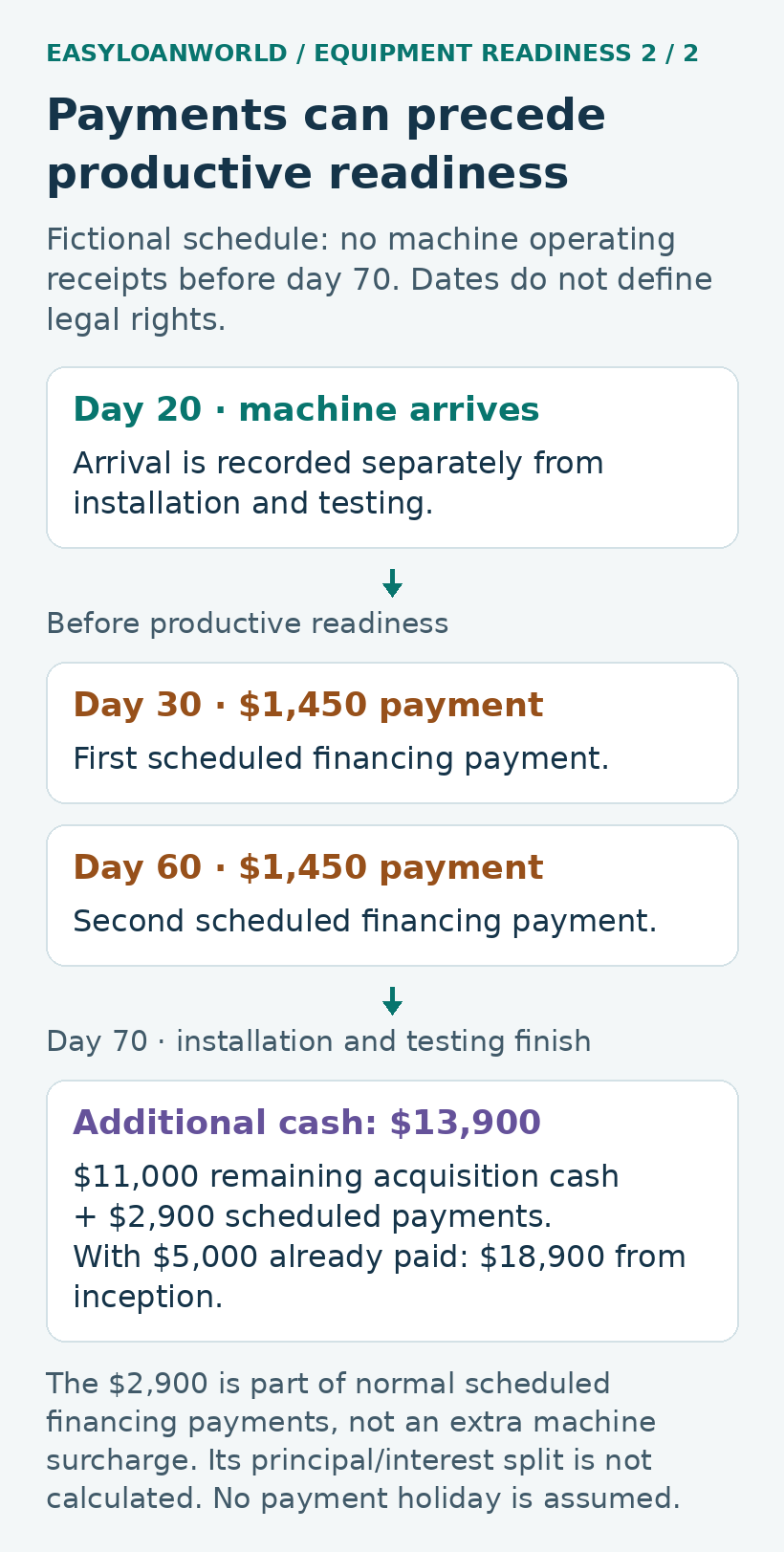
Now add a separate timing assumption to the $11,000 still needed. In the fictional project, the machine arrives on day 20, but installation and testing finish on day 70. The agreed financing schedule requires $1,450 on day 30 and another $1,450 on day 60. No operating receipts from the machine arrive before day 70.
Those dates and installments are supplied assumptions, not a calculation of the $45,000 financing rate or term. They are also independent of the historical SEC agreement.
- Two scheduled payments before readiness: 2 × $1,450 = $2,900.
- Additional cash through readiness: $11,000 remaining acquisition cash + $2,900 = $13,900.
- Total business cash from inception through readiness: $5,000 already paid + $13,900 = $18,900.
The $2,900 is part of the normal financing payment schedule, not an extra surcharge added to the machine’s price. Its principal and interest components aren’t calculated here. Once spent, it can’t also be counted as an operating reserve available after installation.
For the real transaction, ask which dated event triggers vendor funding, any financing charges and the first payment, and how an installation delay affects the agreed schedule. Don’t assume those events share a trigger. The example creates no payment holiday or right to cancel payments.
Equipment financing: extend the readiness delay
Use a separate stress test of the original project. Assume readiness moves from day 70 to day 100, and a third $1,450 scheduled financing payment is due on day 90. Keep the $11,000 remaining acquisition uses and all other original inputs unchanged. No operating receipts from the machine arrive before day 100.
There are now three payments before readiness, totaling $4,350. Additional cash from the original checkpoint through readiness becomes $15,350: $11,000 plus $4,350. Including the $5,000 deposit already paid, total business cash from inception through readiness is $20,350.
The extra $1,450 is a payment falling inside the longer observation window. It isn’t evidence that the delay increased the contractual loan price by that amount. The exercise doesn’t split the payment into principal and interest or estimate lost production, storage or other delay costs.
Compare the revised $15,350 still-to-fund requirement with the original $13,900 using the same starting boundary. Comparing the revised inception total with the original remaining-cash figure would mix two different measures and overstate the change by the already-paid deposit.
Equipment financing: separate committed cash from an operating reserve
Suppose the business has an invented $16,000 of available acquisition-and-payment cash at that original checkpoint, after paying the deposit. Under the base readiness case, $13,900 is committed through day 70, leaving $2,100. Under the delayed case, $15,350 is committed through day 100, leaving $650.
Those remainders assume every listed use occurs as modeled and no other business expense draws from this pot. They aren’t a conclusion that either amount is an adequate operating reserve. Payroll, rent, consumables, repairs and customer-collection timing would require their own dated forecast.
A projected margin of $650 is also not evidence that all commitments can be paid on time. List when the $11,000 acquisition items and each installment actually fall due. A final positive amount can coexist with an earlier shortage if the available funds arrive after a required payment.
Record unresolved readiness evidence separately from the cash forecast. A technician’s completed test may close an operational question without changing the agreed debit date. A lender’s funding confirmation may answer an invoice question while installation remains incomplete. Keep the two records connected by the asset reference, without treating either as proof of the other.
Close the unresolved-items list
Before depending on production, reconcile the vendor’s receipt, the credited deposit, your remaining payments, the first financing debit and the actual readiness date. Give each unresolved item an owner and the evidence needed to close it: a corrected invoice, funding confirmation, missing-part delivery or completed technical test.
A balanced invoice alone doesn’t prove readiness, and a ready machine doesn’t prove every cash obligation is covered. Keeping both records makes the remaining work visible before the business relies on the equipment.
If both structures are offered, compare an equipment loan and lease using cash paid and the ownership outcome at the same date.
Featured photo: Workshop tools illustrate equipment setup and maintenance. Photo: Markus Spiske / Unsplash. Used under the Unsplash license.