Equipment Loan vs. Lease: Compare Cash Paid and What You Own
Compare equipment financing over the same use period, including upfront cash, service costs and the price of keeping or returning the equipment.
An equipment loan and a lease can end with different things in your business: a paid-for machine, a machine you must return, or a purchase option that still requires cash. Compare those endpoints alongside total payments before choosing between offers.
The worked example below follows the same equipment through 36 months. It separates cash spent from ownership, so a smaller upfront payment cannot quietly become a claim of lower overall cost.
Define the equipment and the ending first
Use the same machine specification, service capacity, use period and assumed ending condition. If one proposal includes different accessories or maintenance, record the difference before comparing totals. Decide whether your business wants to keep using the machine after the comparison date.
U.S. Bank’s equipment-financing page describes an Equipment Finance Agreement in which the borrower holds title while granting a lender security interest. That specific structure illustrates why ownership should be checked in the documents rather than inferred from the financing label.
Our example is a fictional amortizing loan, not that bank’s agreement or quote. All amounts are nominal, before tax and undiscounted. Inflation, insurance, lost production and other unlisted costs are excluded; real comparisons need relevant costs added consistently. The same machine has a $60,000 cash price in both alternatives.
Loan purchase: count the full acquisition and use cash
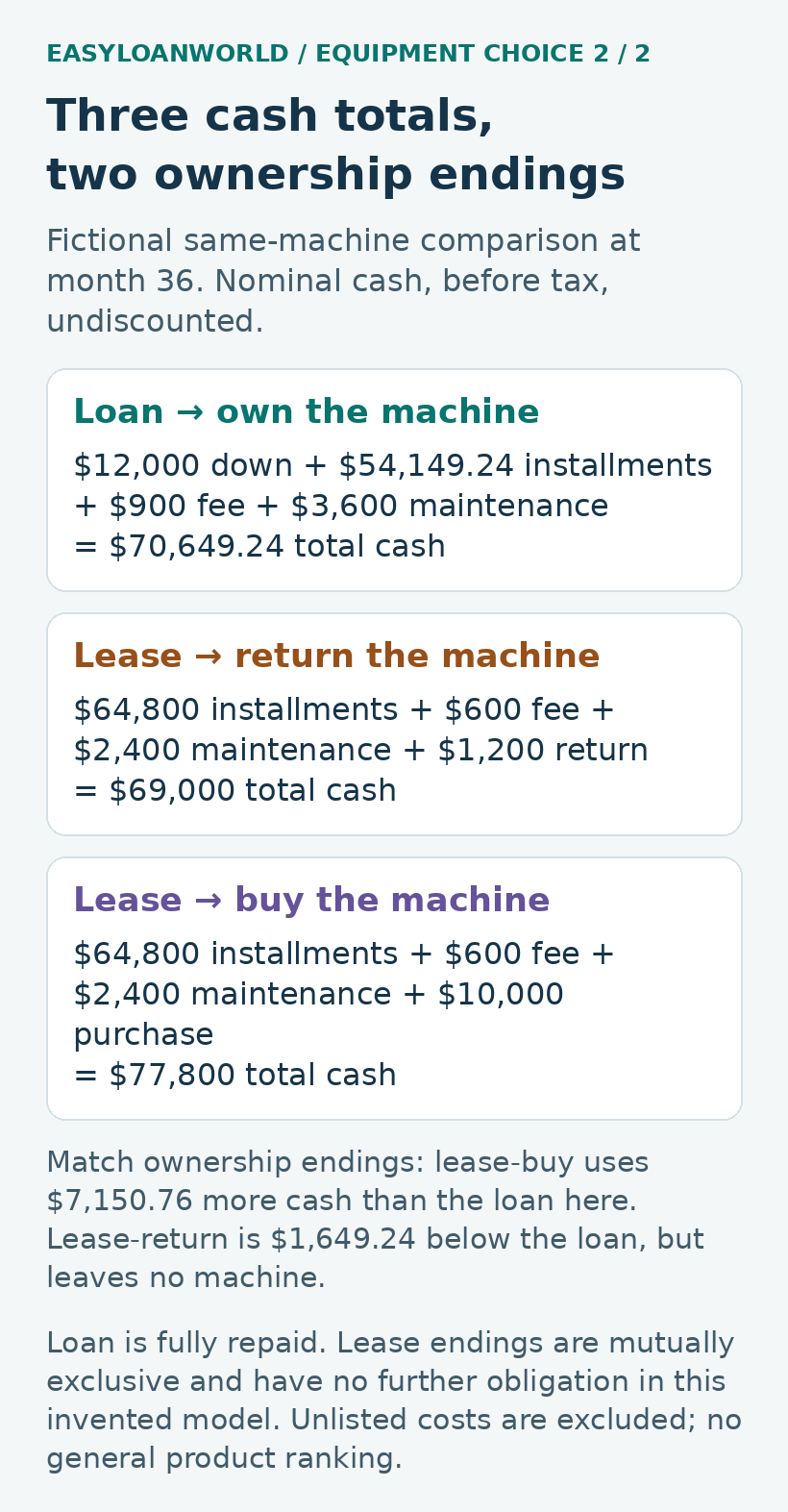
The business puts down $12,000 and borrows $48,000. The assumed loan has a fixed nominal annual rate of 8%, a monthly rate of 8% divided by 12, and 36 monthly installments beginning one month after funding. A separate $900 financing fee is paid upfront, outside principal. Maintenance totals $3,600 over the three years.
Under this invented contract, the business owns the equipment subject to the lender’s security interest during repayment. There are no extra principal payments or penalties, and the debt is fully repaid at month 36.
- Down payment: $12,000.
- Modeled installments: approximately $1,504.15 monthly; $54,149.24 in total.
- Separately paid financing fee: $900.
- Maintenance paid during use: $3,600.
- Total acquisition and use cash: $70,649.24.
The installments include repayment of the $48,000 borrowed plus $6,149.24 of interest. Do not add the entire $60,000 purchase price again: the down payment and principal repayment already cover it. This is a full cash-outlay comparison, not a comparison of interest alone.
Initial cash is $12,900 because maintenance is paid later in this example. Calculations retain the unrounded installment internally; multiplying the displayed $1,504.15 by 36 produces a small rounding difference. An actual lender schedule can adjust the final payment. Confirm any required lien-release documentation after repayment rather than treating this model as evidence of release.
Lease: calculate return and purchase as separate paths
The fictional lease requires 36 payments of $1,800. The first payment is due at signing and counts as one of the 36, leaving 35 afterward. There is also a $600 nonrefundable inception fee, and the business pays $2,400 for maintenance over the period.
For this example only, the agreement offers two mutually exclusive endings: return the equipment for an agreed all-in $1,200 charge with no further obligation, or pay a fixed $10,000 purchase-option price and keep it without a return charge. There is no refundable deposit, automatic extension, residual guarantee or other charge in this model.
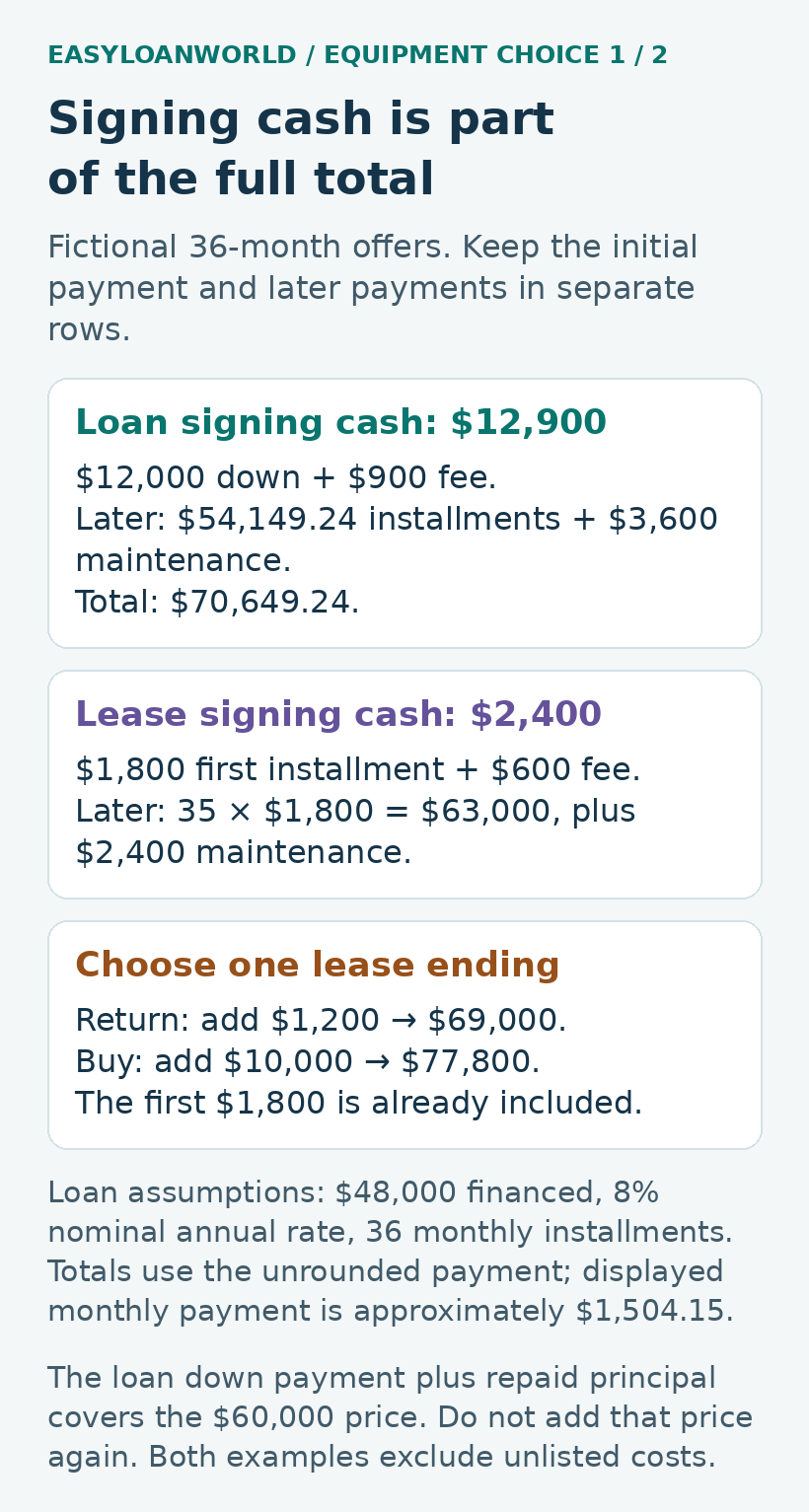
- Return path: $64,800 installments + $600 fee + $2,400 maintenance + $1,200 return = $69,000.
- Purchase path: $64,800 installments + $600 fee + $2,400 maintenance + $10,000 purchase = $77,800.
The first payment plus the inception fee requires $2,400 at signing. Adding that first payment a second time would overstate the lease total. Likewise, adding both the return charge and purchase price would combine incompatible endings.
U.S. Bank’s equipment-lease discussion highlights purchase, renewal and return possibilities and warns about unclear ending terms and fees. Read your agreement and riders for the actual options, notice requirements and remaining charges. A possible option is not an automatic right, and returning equipment does not establish that every obligation has ended.
Compare matching ownership outcomes
The loan costs $70,649.24, while lease-return costs $69,000. The $1,649.24 cash difference does not establish that returning is the better deal: one ending retains the machine and the other does not.
If both comparisons must end with ownership, the relevant figures are $70,649.24 for the loan and $77,800 for lease-purchase. The loan uses $7,150.76 less cash under these assumptions. That result belongs to this example; it is not a general ranking of loans and leases.
A resale assumption is another separate scenario. If the fully paid loan equipment actually sells at month 36 for a hypothetical net $9,000 after selling costs, net cash outlay becomes $61,649.24. This assumes a completed sale and is not a guaranteed resale price, appraisal or tax-profit figure. Keeping a machine valued at $9,000 does not deposit $9,000 in the bank.
Make a short decision record
Keep the proposal version, asset specification and comparison date together. Record the following beside each offer:
- Every payment amount and date, including whether signing payments count toward the quoted total.
- Separately paid fees and service costs, with the same maintenance scope across alternatives.
- The chosen ending, its cash requirement, any required notice and evidence of ownership or remaining debt.
- Any unresolved resale estimate, cost exclusion or difference between the proposal and agreement.
Ask the provider to clarify discrepancies in writing before relying on the comparison. Have a qualified adviser assess tax and accounting consequences separately; this cash example calculates neither. The useful result is two answers for each offer: how much cash leaves the business, and what the business owns or still owes when the period ends.
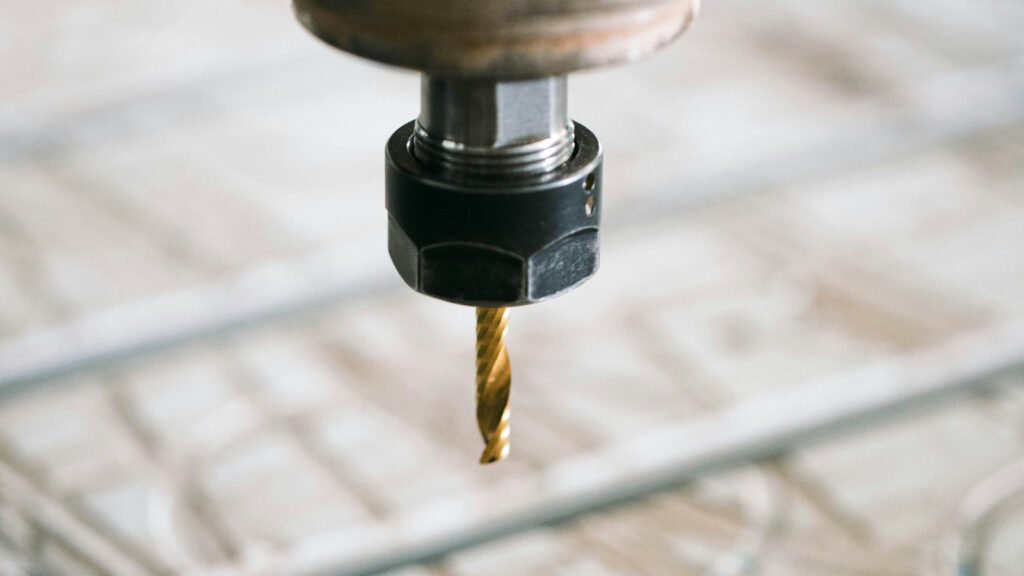
Featured photo: A close-up of workshop equipment. Photo: Jonathan Castañeda / Unsplash. Used under the Unsplash license.
SBA Surety Bonds vs. Working-Capital Loans: Four Contractor Scenarios
Follow Riverton Build through four fictional alternatives at one pre-start review. Identify what remains unresolved and prepare a focused next conversation.
Export Payment Documents: A Two-Packet Review
A worked export-packet review follows an unresolved instruction proposal, an incomplete selected inventory and an unknown carrier arrangement, without inventing the missing evidence.
Profitable Business, Falling Cash: Reconcile the Difference
An invented one-month example reconciles net income, customer receipts, supplier payments, equipment, debt and an owner distribution to the closing cash balance.