FHA Condos: Prepare Your Lender Questions
Match the property record to the question, identify who holds the requested evidence and keep unresolved answers visible.

Estimated reading time: 8 minutes
An FHA condo lookup is a starting point for questions, not a financing decision. Match the project and unit carefully, save the record, and ask the lender what review and documentation remain.
When a condo search produces a confusing record, the next useful step is a focused lender question. Save what you found, identify the property accurately and ask what review remains. Don’t turn a search label or an administrative reference into your own financing decision.
This guide is a preparation aid for an ordinary FHA forward-purchase inquiry. It doesn’t cover refinancing, HUD-owned property purchases or site-condominium treatment. Ask the lender to confirm the property’s classification and which current requirements apply before using this workflow.
FHA condo lookup: match the correct project
HUD’s condominium search accepts location, name and status criteria. Enter details you know; fewer criteria broaden the results. Modify the search if necessary.
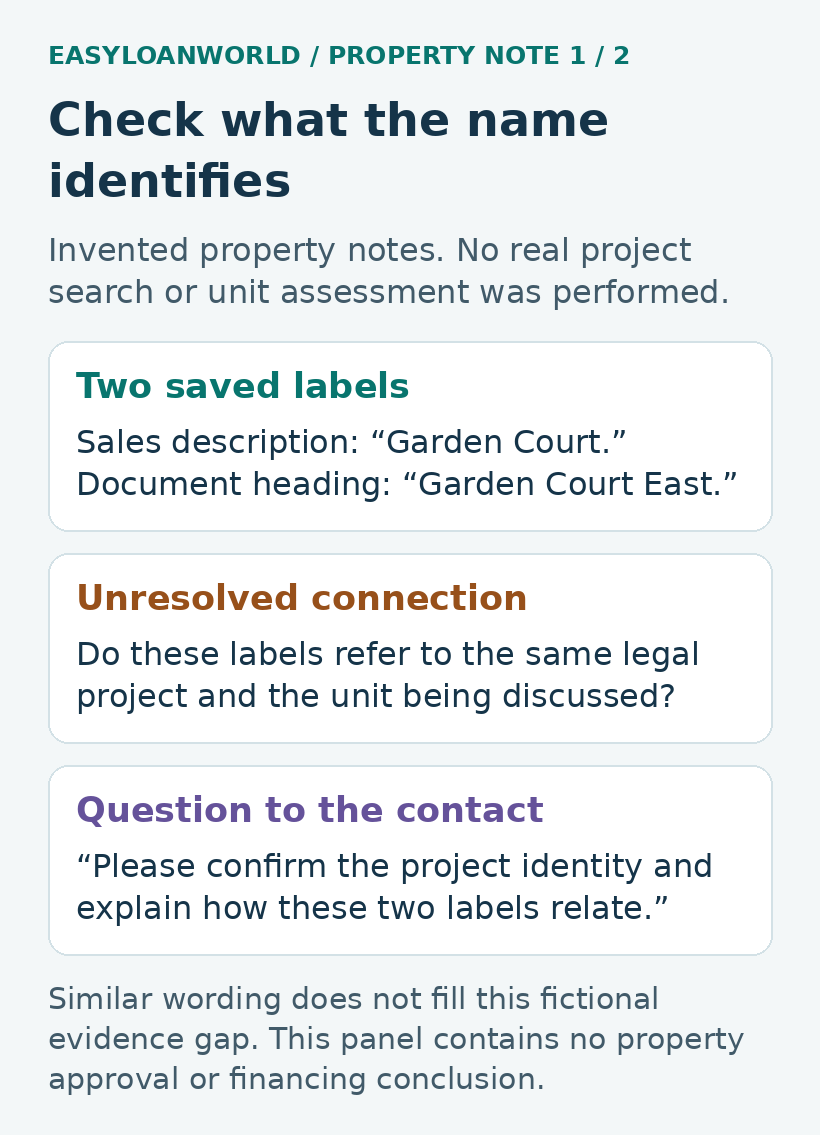
A similar building name is a lead to check, not proof of identity. Ask the lender or association contact to confirm the legal project name and the connection to the unit under discussion. Save the date, link and exact displayed wording privately, without rewriting an unfamiliar status into your own conclusion.
If you find nothing, preserve the criteria you tried. That lets the next person investigate the same question rather than guessing which location or spelling you used. No actual property search was performed for this guide.
Ask which review is being considered
HUD’s condominium overview describes FHA-approved projects and Single-Unit Approval (SUA) for qualifying units in projects that aren’t FHA-approved. SUA has additional requirements; an unapproved project doesn’t automatically qualify.
Ask the lender to name the applicable route and the unresolved question. If its explanation differs from a sales description, request clarification rather than choosing the more reassuring wording. Keep the answer with the dated record it addresses.
Separate a case number from the substantive review
HUD’s May 20, 2026 announcement, FHA INFO 2026-10, describes streamlined SUA case-number assignment. It explicitly separates case-number issuance from unit or project approval. The change concerns internal processing, not an expansion of the condo program.
Find the owner of each requested document
HUD’s SUA documentation list is a minimum, not an exhaustive checklist. It includes HUD-9991 and applicable legal, financial, insurance, flood and litigation material. The lender must analyze the required evidence for compliance; additional records may be needed.
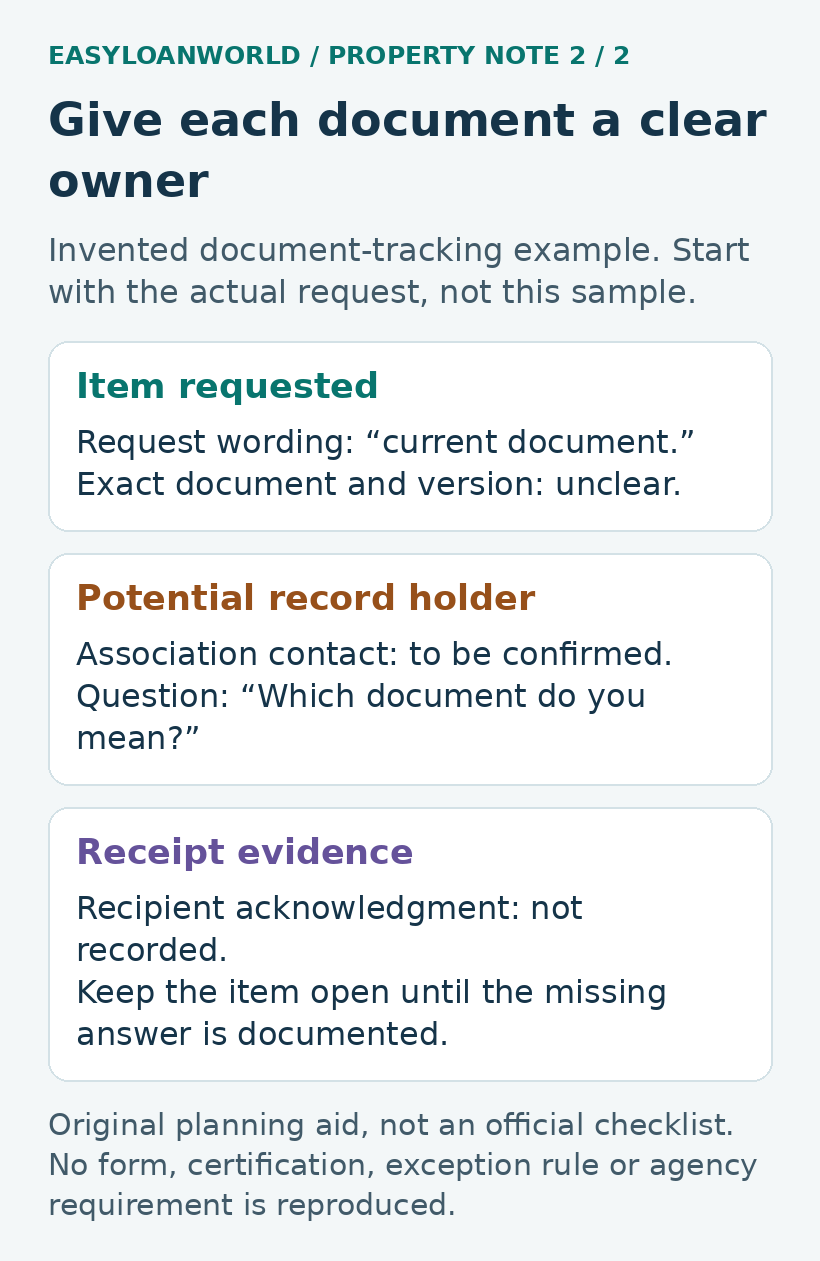
Work from the lender’s actual request. Beside each item, write who holds it, which version was requested and who will confirm receipt. If the association manager and lender use different document names, ask them to resolve the mismatch before ordering a replacement. Don’t complete another party’s certification yourself.
FHA condo lookup: resolve identity before interpreting a status
For a new fictional variation, a buyer sees records called Oak Court I and Oak Court II, while the sales listing uses only Oak Court. Similar words don’t establish that either record covers the unit being considered.
Keep the legal project name, location, unit identification and displayed record reference together. Ask the lender or association contact to explain the connection rather than choosing the entry with the more favorable status.
If the record and sales material use different names, preserve both. A marketing name may be a useful lead, but this guide can’t decide whether two labels identify the same legal project.
Save the exact search criteria as well as any results. A search with an extra filter can omit records that a broader search shows. A blank result needs investigation; it isn’t an automatic conclusion about every possible review route.
No real Oak Court search was performed. The names demonstrate an identity question and aren’t an assertion about an actual project’s approval or eligibility.
FHA condo lookup: keep the review question distinct
After identity is confirmed, ask which route the lender is actually evaluating and which current requirements apply to that unit. The project and the buyer’s loan each have review questions; a single search result can’t answer all of them.
The original HUD overview describes approved projects and the possibility of Single-Unit Approval for qualifying units elsewhere. Don’t relabel every unapproved project as eligible for SUA. The lender still needs the applicable evidence and analysis.
Likewise, the administrative case-number step described above isn’t a substitute for substantive review. Record it as an administrative reference with its date and source, without copying “approved” into an unresolved field.
If the lender’s explanation changes, ask which fact or requirement changed and retain the dated answer. An earlier sales statement shouldn’t remain the controlling note after a different review route is identified.
Keep any uncertain classification visible. This guide excludes several transaction and property categories; it can’t decide the proper treatment from an exterior photograph or listing description.
Count documents without inventing an approval percentage
For an independent workflow exercise, assume the lender has requested six specifically identified items and acknowledged receiving three. Those invented counts concern this hypothetical request only, not HUD’s universal minimum list.
Three of six means half the requested items have receipt acknowledgements. It doesn’t mean the project is 50% approved, the loan has a 50% success probability or half the substantive requirements are satisfied.
One received document can contain an unresolved problem, and one missing document can be critical. Item counts don’t price importance or establish compliance. Keep receipt status and review outcome in separate columns.
If another file is uploaded, don’t mark it received until the relevant process confirms that step. If a received file is outdated or incomplete, record the replacement request without deleting the history.
The completed evidence map should distinguish requested, held by the association, requested from the holder, sent, received and reviewed. These are organizational labels, not invented official approval stages.
Match each request to the right holder and version
For each actual lender request, copy the exact document name, period or effective date, requested version and recipient. Ask who holds it and who can appropriately complete any certification.
A file named “budget” may refer to a different year from the one requested. An insurance summary may not contain every page the lender needs. Ask about the mismatch rather than assuming similarly titled files are interchangeable.
If the association manager and lender use different terms, give them the specific descriptions to reconcile. Don’t create an apparent answer by filling another party’s certification yourself.
Keep any document fee or expected delivery date attributed to the party that supplied it. An estimated turnaround isn’t a lender’s promise to approve the unit by that date.
Preserve the original source file and the exact version submitted. A later replacement should have a distinct date or filename so the reviewer can identify which evidence its response addresses.
Finish the inquiry with an actionable open question
A useful follow-up names the project and unit through a private channel, the record reference, proposed review route and exact item still outstanding. Ask who handles the next action and how completion will be confirmed.
If a closing timetable is approaching, raise the actual dates with the lender and appropriate advisers. Don’t treat an administrative reference or a preliminary lookup as confirmation that financing will be ready on time.
Keep borrower qualification, appraisal, cash needs and any other loan conditions separate from the project inquiry. This worksheet doesn’t determine those matters or certify compliance with every FHA exception.
The purpose is a traceable handoff, not a self-issued approval. A record that clearly says what remains unknown can be more useful than a reassuring status copied from the wrong project or an incomplete review.
An FHA condo lookup file should show which result or document each response addresses. If the legal project identity changes, revisit the earlier search rather than carrying its status into the new record. The lender needs the actual unit and project connection; a tidy folder can’t compensate for matching the wrong property.
Count requested items by their actual requirements, not by filenames. One complete file may address several requested items, while several uploaded files may still omit a required page. Ask the lender which item each acknowledgement covers. The number of attachments alone can’t establish that the requested evidence is complete.
A fictional inquiry that stays open
A buyer finds a project entry that isn’t currently approved and hears that a case number has been assigned. The buyer asks: “Which review applies to this unit, and which evidence is still outstanding?” The working note remains “review outstanding.” Neither the example nor its administrative reference establishes a favorable outcome.
For your own inquiry, record the confirmed project identity, lookup date, exact result, lender’s proposed review, association contact role and missing evidence. Leave a final space for the next answer you need. Keep real buyer and association documents out of public comments. This educational organizing aid doesn’t certify a project, interpret every FHA exception or establish loan eligibility.
While the property review continues, keep your household homebuying budget separate from a preliminary financing indication.
Featured photo: Residential-building exteriors, shown for illustration. Photo: Dmytro Koplyk / Unsplash. Used under the Unsplash license.

One Mortgage Form, Two Borrowers
Match each person’s share.