Home Appraisal vs Inspection: Track Open Questions
Use a fictional roof finding to separate property questions, repair costs and next steps.
Estimated reading time: 8 minutes
An appraisal vs inspection comparison starts with the question each report can answer. Use the fictional roof example to separate the property’s condition, the repair budget and any lender requirements before planning the next step.
Appraisal vs inspection: what each report can tell you
An appraisal gives an opinion of value for the lending decision; an independent inspection examines physical condition for the buyer. A valuation isn’t a substitute for that inspection. Some lenders use other valuation methods. CFPB valuation guidance.
Major repairs can also become financing conditions. An appraisal may be subject to repairs, and a lender may require completion before closing. A seller need not accept a requested repair concession; contract terms matter. CFPB inspection guidance.
One roof finding, three separate decisions
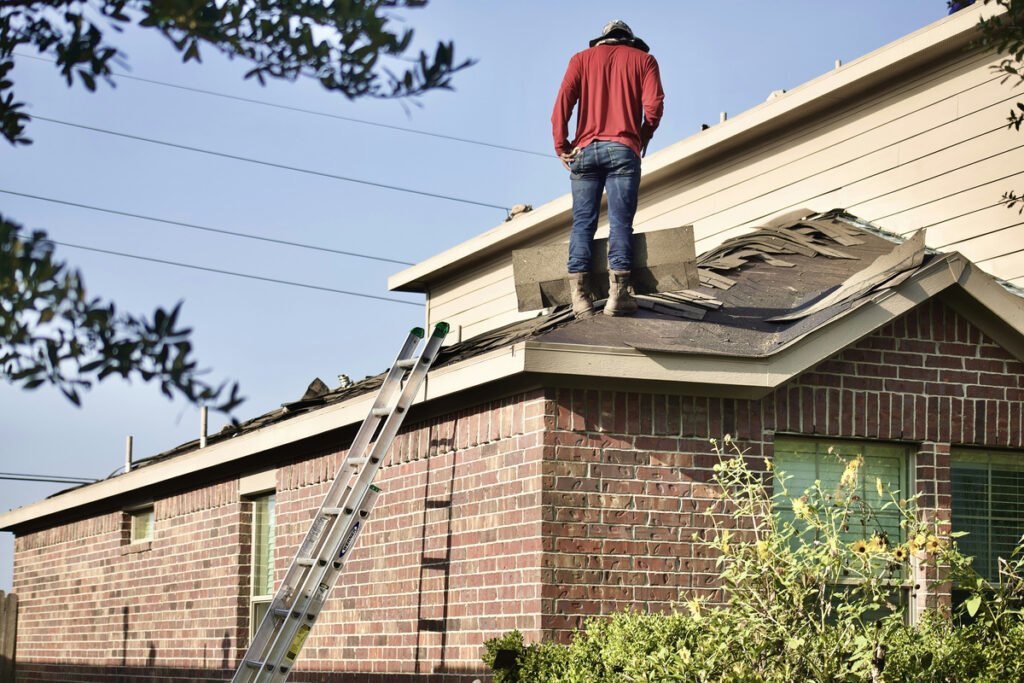
Imagine an inspector reports staining beneath the roof and recommends further evaluation. This is a fictional observation, not a diagnosis of a leak or a statement about any real property. The buyer also has a valuation report whose stated value matches the agreed price. That number doesn’t answer what caused the stain.
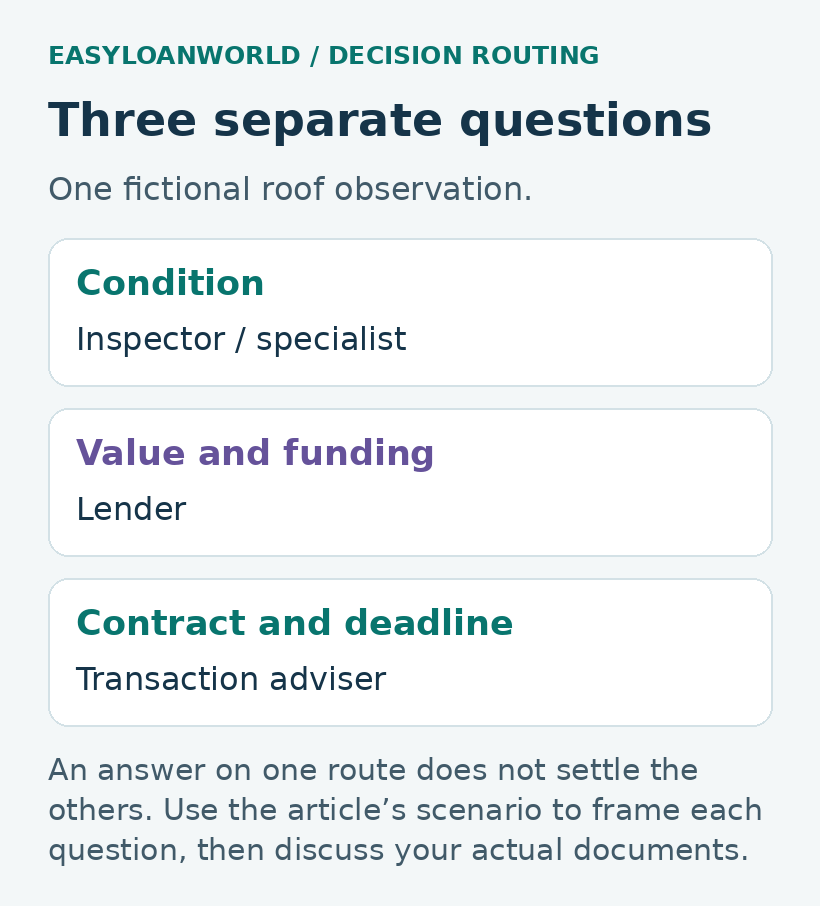
- Condition: Ask the inspector what was observed, which areas were inaccessible and what specialist should investigate. Suppose a roofer then identifies a repair scope and supplies a $6,100 estimate. Ask what the estimate excludes and whether the assessment supports the proposed work; don’t infer that every stain requires a new roof.
- Value and funding: Ask the lender whether the valuation is conditional on repairs, what completion evidence it requires, and whether the specialist’s findings change its requirements. Send the actual finding rather than reporting only “the estimate is affordable.” A quote describes proposed work, not completed work.
- Your purchase commitment: Ask your transaction adviser about the inspection deadline, permitted notices and contractual options. In this example, suppose an inspection deadline is tomorrow while the lender’s response is outstanding. Bring up both dates now; waiting for one answer shouldn’t silently decide what you do about the other.
The buyer could be satisfied with the proposed repair yet unwilling to accept its disruption. Or the buyer could want the house while still needing a lender answer. Identify which decision remains open instead of compressing all three into “the property passed.”
Appraisal vs inspection: put repair costs in their proper place
Assume the buyer separately earmarked $10,000 that’s genuinely available for work, after other purchase commitments. A $350 specialist assessment plus the $6,100 repair estimate uses $6,450, leaving $3,550. There’s no seller contribution in this example, and the assessment isn’t included in the estimate.
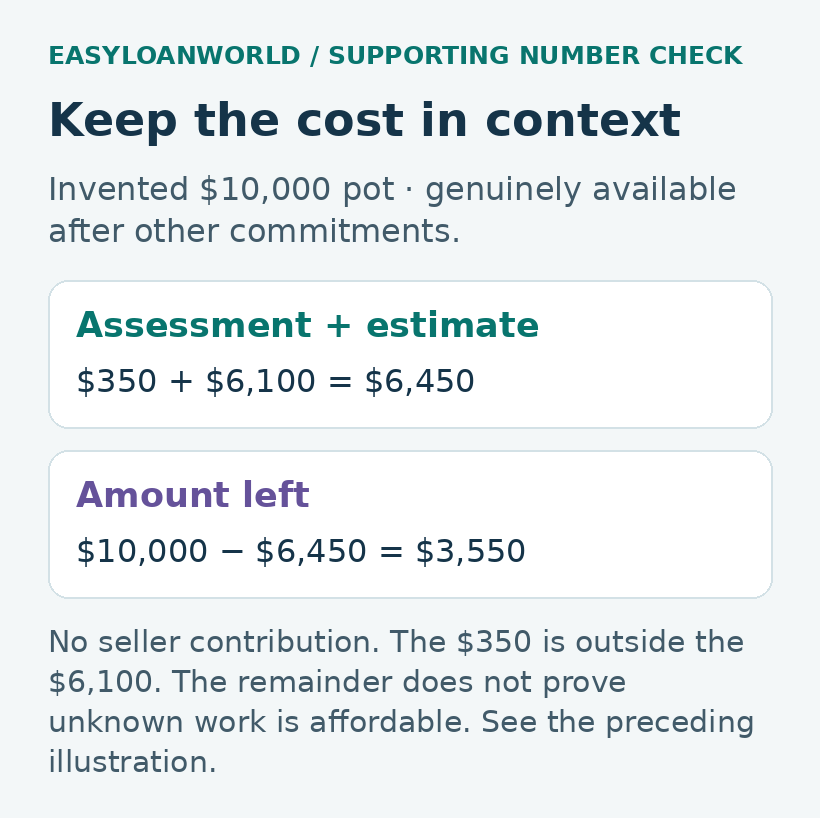
That remaining amount is only a planning result. It doesn’t show that unknown work is affordable. If finding the repair money would consume funds already committed elsewhere, revisit the homebuying-budget guide before treating the estimate as manageable.
Appraisal vs inspection: build a question register
Turn the roof scenario into three rows: condition, lender requirements and purchase-contract decision. Give each row its own question, responsible contact, supporting record and current status.
For condition, the question is what caused the reported staining and what evaluation or work is supported. For lending, the question is what the lender requires for this transaction. For the contract, the question concerns the actual deadline, notices and available choices.
A response in one row shouldn’t automatically close another. A specialist’s estimate can inform the budget while the lender’s completion requirements remain unknown. A matching valuation can coexist with unresolved condition questions.
This structure is useful because “the property passed” is too broad. It conceals which reviewer answered which question and whether any timing condition remains open.
Reconcile estimate scope before adding a contingency
The original budget assumes the $350 assessment is separate from the $6,100 repair estimate. Together they use $6,450 of the genuinely available $10,000, leaving $3,550.
For an independent alternative, assume a revised $6,100 estimate explicitly includes that same $350 assessment, with no additional assessment charge. The modeled combined use would then be $6,100 and the remaining amount $3,900.
The two versions differ by $350 because of what is included, not because the subtraction changed. Confirm whether a fee is included before adding it again. A label such as “total estimate” needs its actual scope.
Neither remainder is a validated contingency for unknown work. The exercise doesn’t assign probabilities or determine the likely cost of concealed damage. Unknown scope stays unknown until appropriately investigated and priced.
Appraisal vs inspection: test a changed quote
Return to the original assumption of a separate $350 assessment. Suppose a new independent repair estimate is $7,800 instead of $6,100, with all other budget inputs unchanged.
The combined modeled use becomes $8,150, leaving $1,850 of the $10,000. The quote increase of $1,700 reduces the remainder by the same $1,700.
This sensitivity doesn’t establish that the higher quote is appropriate or more complete. Compare the proposed work, exclusions and evaluation basis rather than assuming that price alone proves the repair scope.
If another expense has already committed part of the $10,000, the starting available-work fund must change too. Money assigned to closing, moving or another obligation can’t also be counted in full for this repair.
Separate a quote from a completed repair
The specialist’s estimate describes proposed work under its stated assumptions. It doesn’t document that work occurred or that the lender accepted its completion evidence.
For a fictional status sequence, record assessment received, scope quoted, work authorized, work completed and lender evidence accepted as separate stages. A completed earlier stage doesn’t prove the later ones.
Ask the lender exactly what it requires if the valuation or loan approval is conditional on repairs. Use its response for that transaction rather than assuming a contractor invoice will satisfy every condition.
Keep technical conclusions with the qualified specialist. This exercise doesn’t diagnose the stain, inspect the roof or certify that a particular repair makes the property sound.
Put the open lender answer beside the contract deadline
The original scenario has an inspection deadline tomorrow and an unanswered lender question. Record both facts. Waiting for the lender is an event in one row, not a documented extension of the contract deadline.
Ask the transaction adviser about the actual contract and required notices promptly. The exercise doesn’t interpret a contingency, provide notice wording or determine whether the buyer can cancel without consequences.
If an extension is requested, label it requested until the relevant agreement confirms it. A conversation about more time isn’t automatically evidence that the deadline changed.
Likewise, a proposed seller contribution remains a proposal until confirmed and reviewed in the transaction. Don’t enter it as cash already available or assume it resolves the lender’s repair condition.
Keep value questions distinct from condition evidence
A valuation equal to the agreed price answers a valuation question under the report’s scope and conditions. It doesn’t explain the stain’s cause or guarantee the absence of future repair costs.
If a factual appraisal concern arises, retain the report location and supporting evidence for the lender’s applicable process. A repair estimate and an unsupported desired valuation are different materials.
Don’t subtract the $6,100 quote from the appraised value and call that an automatic corrected value. A repair price isn’t an appraisal adjustment formula. Ask the lender how the actual finding affects its review.
Similarly, a condition report shouldn’t be rewritten to fit the financing result. Preserve what the inspector observed, what remains inaccessible or uncertain and which further evaluation was recommended.
Close each row with the right evidence
For the condition row, retain the specialist’s explanation and scope. For the budget row, retain the dated estimate and actual funds available after other commitments. For the lender row, retain the actual conditions and acceptance response.
For the contract row, keep the relevant agreement, adviser explanation and any confirmed action. These records may interact, but they should remain identifiable rather than being compressed into one generic approval note.
When a quote or finding changes, date the revision and ask which other rows need updating. An increased cost may affect the budget while a changed scope may also require another lender answer.
The completed appraisal vs inspection review should identify what is known, which decisions remain open and the next responsible contact. A correct subtraction helps plan cash; it doesn’t replace condition assessment, underwriting or contract advice.
For the original roof example, ask a second reader to name the three open decisions without using the word “passed.” If the answer collapses condition, lending and contract timing into one conclusion, return to the separate records. Each contact should be able to identify the particular question being asked and the evidence supporting it.
U.S. education, checked October 19, 2026; not individual financial, legal or technical advice.
Featured photo: Illustrative photograph. Zohair Mirza / Unsplash. Used under the Unsplash license.
For separate next steps, review Fannie Mae reconsideration of value evidence and the scope of renovation loan programs when repairs require financing.

One Mortgage Form, Two Borrowers
Match each person’s share.