Identity-Theft Records: A Report-by-Report Matrix
Use a fictional account-by-bureau matrix to separate three report appearances from two accounts and track which responses still need checking.
Estimated reading time: 8 minutes
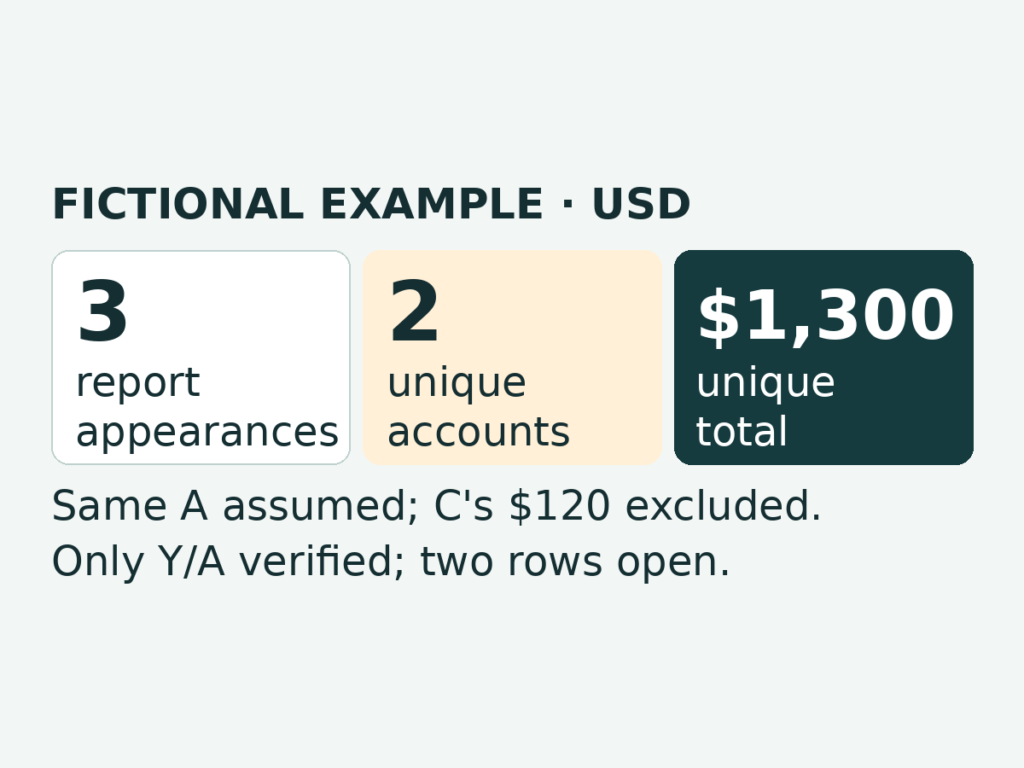
Keep one row for each credit-report appearance of an alleged identity-theft account, then track the submission, response and later report separately. One account on two reports is still one underlying account, but it creates two places to verify the outcome. The example below shows how $1,300 of unique alleged accounts can appear as $2,200 when a duplicated appearance is counted twice.
Identity theft records: one row per appearance
Use short local labels for accounts and reports. Keep the actual entry reference in your private record so you can find the right item again. Write down the report date beside it; an undated screenshot can be hard to compare with a later response.
Here, A, B and C are invented account labels, and X, Y and Z are invented bureau labels. All amounts are fictional U.S. dollars from one snapshot. We stipulate that A is the same underlying account on X and Y. Equal balances alone wouldn’t establish that in a real case.
| Record | Bureau | Account | Shown balance | Example treatment |
|---|---|---|---|---|
| X/A | X | A | $900 | Alleged identity theft |
| Y/A | Y | A | $900 | Same alleged account as X/A |
| Y/B | Y | B | $400 | Alleged identity theft |
| Z/C | Z | C | $120 | Separate ordinary amount dispute |
In this example, C is stipulated to be unrelated to identity theft. Its disputed amount isn’t a reason to relabel it. Describe each real item truthfully and leave uncertain connections unresolved rather than forcing them into the example’s categories.
Identity theft records: count accounts and recipients
The working list has three targeted appearances: X/A, Y/A and Y/B. It has two underlying alleged accounts, A and B, and two affected recipients, X and Y. The organizer can link both Y rows to the same packet record while retaining a separate outcome for each row.
The unique-account total is $900 + $400 = $1,300. Adding the three appearances instead gives $900 + $900 + $400 = $2,200. That second sum includes A’s $900 twice. Keep C’s $120 outside both totals.
These figures describe the fictional records. They do not estimate money owed, money recovered or a credit-score change. Before combining real entries, reconcile differing report dates, balances and creditor or collector references. If you cannot establish whether two entries concern the same account, mark that link uncertain and postpone a combined total.
Keep the legal reference beside the record
Section 605B generally requires a credit bureau to block the identified information within four business days after it receives the following four items. This recordkeeping checklist doesn’t decide whether a particular submission is legally sufficient.
| Item | What your organizer should identify |
|---|---|
| Appropriate proof of your identity | The document or authentication method supplied to the recipient. |
| A copy of an identity-theft report | The report version included in the packet. |
| Identification of the information resulting from alleged identity theft | The specific report entries the request concerns. |
| Your statement that the information does not relate to your transactions | The statement included with that packet. |
The statute also allows refusal or rescission on reasonable determinations of error, a relevant material factual misrepresentation by the consumer, or the consumer’s receipt of goods, services or money from the transaction. The bureau must promptly notify the furnisher of the alleged theft, filed report, block request and effective block dates, and notify the consumer if it refuses or rescinds the block.
Regulation V permits reasonable, time-bounded requests for additional information to assess an identity-theft report. Identity-proof requirements must match you with the correct file and reflect misidentification risk. Check the recipient’s verified official requirements rather than assuming one document works everywhere.
Use separate fields for packet version, attachment list, submission date, receipt evidence, questions raised and your replies. An upload confirmation and an attachment list answer different recordkeeping questions. Record what each item actually shows. If completeness is uncertain or disputed, write that down. This organizer makes no legal-sufficiency finding and calculates no calendar deadline.
For example, “uploaded Tuesday” doesn’t, by itself, establish which attachments were included or resolve a later question about identity proof. Preserve the uploaded packet and confirmation together, then record the recipient’s specific question and your response. Don’t label the four-business-day requirement as satisfied or violated merely by counting from an unverified upload date. The statutory and Regulation V source checks above were updated October 25, 2026.
Identity theft records: verify each later report
For this fictional checkpoint, X’s response about A and Y’s response about A both say the requests were carried out. The reader has checked a later Y report and found A absent, but hasn’t checked a later X report. Y has also asked for more information about B.
| Record | Response held | Later report observation | Organizer status |
|---|---|---|---|
| X/A | Matching result received | Not checked | Verification pending |
| Y/A | Matching result received | Entry absent on checked report | Snapshot verified |
| Y/B | More information requested | Not checked | Response unresolved |
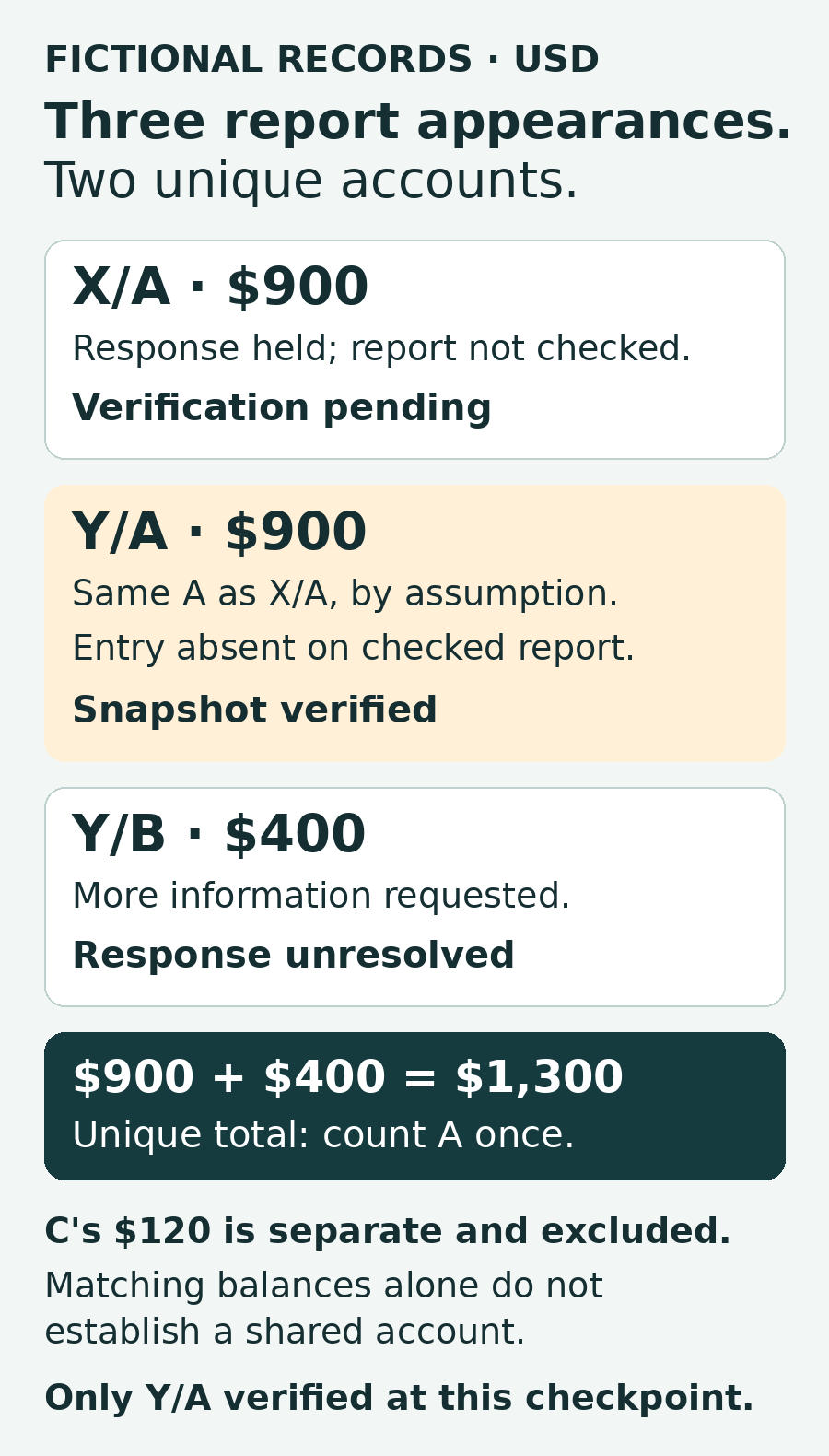
Only Y/A earns the organizer’s “snapshot verified” label. This is a count of completed checks, not a success rate or compliance finding. The label describes that particular observation and makes no promise about later reports. X/A stays open even though a response arrived. Z/C remains in its separate record.
For every check, save the report date, the entry you looked for and what you observed. Keep the recipient’s response alongside that observation. An absent entry records what you saw; the response records what the recipient says happened. Don’t copy one row’s status across the whole account.
Identity theft records: preserve a new observation without overwriting the old one
Extend the fictional matrix with a later report review. Suppose X/A is now checked and the relevant entry is absent on that dated X report. Add that observation to X/A; don’t copy Y/A’s earlier report date into the row. The two checks may concern the same stipulated account while still relying on different documents and dates.
The underlying alleged-account count remains two, A and B. Completing another report check doesn’t create a new account or another $900 of claimed loss. Keep the original $1,300 snapshot total labeled with its date instead of adding repeated appearances whenever a new report is obtained.
If a later report shows a changed balance, first reconcile the account reference and dates. Equal amounts alone don’t prove identity, and different amounts alone don’t prove that the entry is a different account. Mark uncertain links as unresolved before preparing a combined total. This organizer doesn’t determine an amount owed or recovered.
For Y/B, suppose the recipient clarifies which identity-proof item it needs. Record the exact request, the packet version containing your response and the submission confirmation through its verified process. Keep the earlier packet and request. A new document for Y/B doesn’t establish that X received it, that Y/A needs the same action or that every row’s verification is complete.
Use separate columns for response status and later-report observation. “Information supplied” describes your action. “Recipient confirmed its result” describes the response. “Entry absent on report dated ___” describes a later observation. Those statements shouldn’t be collapsed into one undated green check.
If an entry appears again after a previously checked absence, retain both report versions and identify the precise reference and date. Seek an account-specific explanation through the recipient’s verified channel, using the relevant statutory and agency guidance as needed. The appearance alone doesn’t establish why it changed or permit an unsupported conclusion about compliance.
Review identity theft records one row at a time, then create a short next-action list. Include the missing evidence, who can clarify it and the next checkpoint you choose. A personal reminder isn’t a calculated legal deadline. Keep sensitive proofs and full identifiers in the secure recovery process rather than a public planning sheet or comment.
Make an unresolved response specific
For Y/B, record the exact item requested, the request date and the referenced account. Compare it with the attachment list for the packet version already held. If the request doesn’t identify what is missing, put “clarification needed” in that row instead of inventing an answer or marking it complete.
A useful private note might read: “Y/B: request names B; requested item unclear; compare packet version 2 and seek clarification through Y’s verified channel.” This is a recordkeeping example, not a letter template. When you have a response, append its date and contents, preserve the earlier record, and decide what remains unchecked.
Finish each review with a concrete next step for every open row. In this example: check X/A against a later report; retain the dated Y/A observation; clarify Y/B’s unresolved request. That small list is more useful than treating every appearance as a separate debt or every reply as a finished check.
Related reading
For a related question, read Denied a Checking Account? Find the Right Screening Report.