Incremental Tax Savings
A fictional tax model shows why an assumed eligible borrowing cost can change tax by less than cost times a headline rate.
Estimated reading time: 5 minutes
A fictional tax model shows why an assumed eligible borrowing cost can change tax by less than cost times a headline rate.
Separate this arithmetic from actual eligibility
This invented schedule is not a current federal tax calculation or a determination that anyone’s interest is deductible. It isolates deduction selection and tax-layer arithmetic.
Assume a person may choose either a fixed $10,000 deduction or the total of specified eligible costs, whichever is larger. The additional borrowing-related cost is $1,000 and, solely for this model, is fully eligible within that total. Both deduction routes are assumed permissible. There are no credits, other deduction limits, state taxes or payroll taxes.
After subtracting the selected deduction from starting income, taxable income cannot fall below zero. Our fictional schedule taxes the first $30,000 of positive taxable income at 10% and any amount above that at 20%. Thus $40,000 produces $3,000 + $2,000 = $5,000 of tax.
Recompute the baseline before multiplying
Cases A, B and C each begin with $50,000 before the model’s deduction. Only their other eligible costs differ. First calculate tax without the additional $1,000 cost. Then add that cost, select the deduction again and recompute tax. The saving is the difference between those two tax amounts.
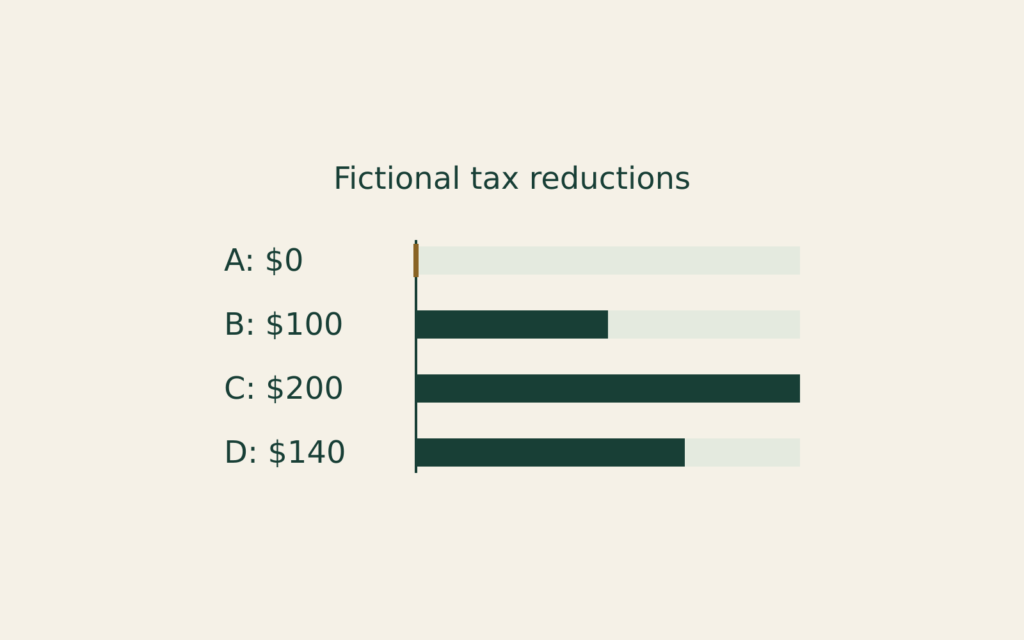
Case A: Other eligible costs are $2,000. Adding $1,000 raises their total to $3,000, still below the fixed $10,000 option. The selected deduction remains $10,000; taxable income remains $40,000 and tax remains $5,000. The incremental tax saving is $0, despite the model treating the entire new cost as eligible.
Case B: Other eligible costs are $9,500. Without the new cost, the fixed deduction wins. With it, the eligible-cost total reaches $10,500. The selected deduction increases by only $500, not $1,000. Taxable income falls from $40,000 to $39,500; tax falls from $5,000 to $4,900. The saving is $100.
Case C: Other eligible costs are $10,500, already above the fixed option. Adding $1,000 raises the selected deduction from $10,500 to $11,500. Taxable income falls from $39,500 to $38,500; tax falls from $4,900 to $4,700. Here the saving is $200.
| Case | Deduction increase | Tax saving |
|---|---|---|
| A | $0 | $0 |
| B | $500 | $100 |
| C | $1,000 | $200 |
Multiplying $1,000 by 20% works for Case C, but not for A or B. Eligibility within the assumed cost total and an increase in the selected deduction are different steps. In B, the first $500 merely closes the gap between $9,500 and the fixed option.
Then check whether the tax layer changes
Case D is a separate person, not a further adjustment to Case C. Starting income is $40,900 and other eligible costs are $10,500. Before adding the cost, taxable income is $30,400: $30,000 taxed at 10%, plus $400 at 20%, for $3,080.
After the additional $1,000 deduction, taxable income is $29,400 and tax is $2,940. The saving is $140. Only $400 of the reduction removes income from the 20% layer; the remaining $600 removes income from the 10% layer. Equivalently, $400 × 20% + $600 × 10% = $140. The full deduction increase does not make the entire saving use the higher rate.
Express the deduction increase in branches
Let S be the assumed fixed deduction, O the other eligible costs and I the new eligible cost. The increase in selected deduction is:
max(S, O + I) − max(S, O).
Here max means choose the larger amount. If O already exceeds S, the increase equals I. Otherwise, part or all of I may first fill the gap S − O. The increase cannot exceed I and cannot be negative when I is nonnegative.
The piecewise result makes the baseline effect explicit. When O ≤ S and I ≤ S − O, neither total exceeds the fixed option, so the increase is zero. When O ≤ S but I > S − O, subtracting the unchanged baseline S leaves O + I − S, or I − (S − O). When O > S, subtracting O from O + I leaves I. These are the three branches illustrated by A, B and C.
That deduction increase is not automatically the taxable-income decrease if the model’s zero floor binds. It does not bind in these four cases. Even when the amounts match, Case D shows why the tax must still be recomputed across the schedule rather than inferred from one rate.
Connect the lesson without using fictional filing rules
The 2025 IRS Schedule A instructions say the larger standard or itemized deduction generally reduces federal tax, while Topic 551 identifies taxpayers who cannot take the standard deduction. The IRS bracket explanation says a higher rate applies to income in that layer, not all income.
Those concepts do not turn this simplified schedule into a U.S. tax calculation. Actual eligibility, filing status, applicable year and other rules remain separate. The examples justify comparing tax with and without an assumed cost; they do not justify incurring interest to obtain a deduction or subtracting a guessed tax saving from a payment due.
Roth Conversion and Account Clocks
Separate five-year tests.
ABLE Distributions Across Month-End
Separate retained purposes.