Inventory Financing: Match Stock Sales to Repayment
Separate units sold from customer cash collected, then test whether one stock order can meet its financing deadline after assigned cash costs.

Estimated reading time: 8 minutes
Inventory financing repayment depends on cash collected, not just stock sold. Track units, receipts and operating costs through the actual cutoff so an apparently successful sale doesn’t hide a payment gap.
Selling 80% of a financed stock order doesn’t prove the business can make its repayment. Customers may not have paid yet, and collected money may already be needed for fulfillment and other costs. The useful test follows the stock all the way into available cash.
This U.S. educational guide reconciles one fictional order at a repayment cutoff. It keeps units purchased, units sold, units paid for and cash available for debt separate. It isn’t a full-business affordability test or a recommendation to borrow.
Inventory financing: record the stock order
Start with the purchase quantity, unit cost, supplier payment date and funding split. Identify the contract’s payment amount and date separately from expected customer collections. Keep invoices and collection evidence behind the figures so you can distinguish a completed event from a forecast.
For the same batch, record:
- Units still unsold, units sold but unpaid, and units sold and paid
- Actual selling prices, including any discounts or returns
- Cash collected by the chosen cutoff
- Assigned cash costs already paid and costs still due
- The debt payment due and any unresolved conditions
Reconcile by product or batch when prices differ. Counting 100 paid units at one price alongside 100 at another without separating their receipts can conceal a cash error. In the example below, every unit has the same cost and selling price so the conversion is visible.
A fictional order with a day-90 deadline
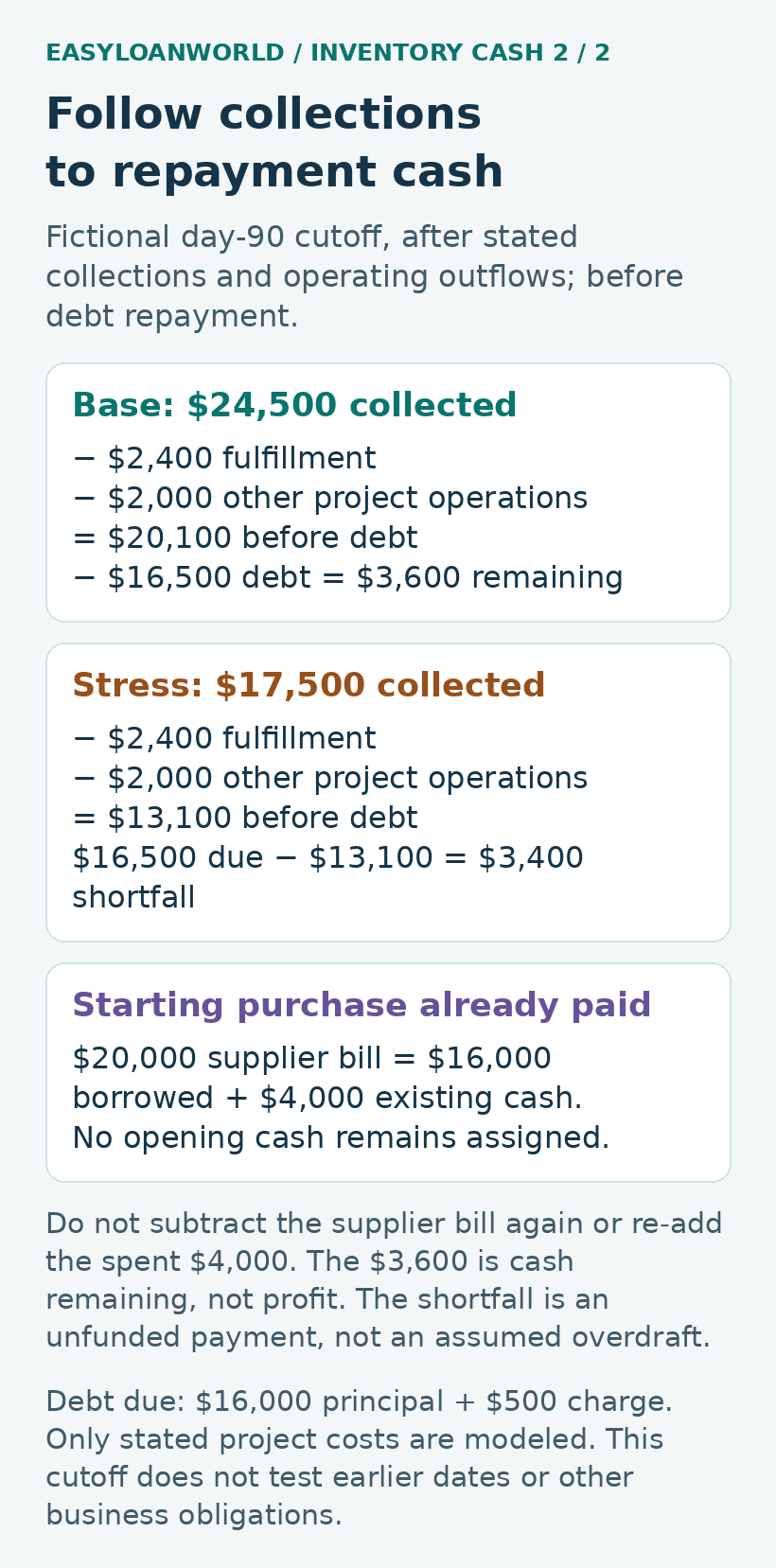
An invented retailer purchases 1,000 units at $20 each. The $20,000 supplier bill is paid at the outset using $16,000 of debt and $4,000 of existing business cash. No opening cash remains assigned to this isolated project.
The fictional agreement requires one $16,500 payment on day 90: $16,000 principal plus a $500 total financing charge, with no earlier payments. These stipulated terms aren’t a lender quote, an APR or a claim about how inventory financing normally works.
The selling price is $35 per unit. By the day-90 cutoff, after the stated collections and operating outflows but before debt repayment, 800 units have sold and 200 remain unsold. Fulfillment costs $3 per unit sold, so $2,400 has been paid. Another $2,000 of project operating cash costs has also been paid.
Those are all costs in this deliberately simplified project. Taxes, returns, losses, processor fees, further purchases, sale restrictions and other business obligations aren’t modeled. A real batch record must add whichever of them apply, on their actual dates.
Inventory financing: 700 units have been paid for
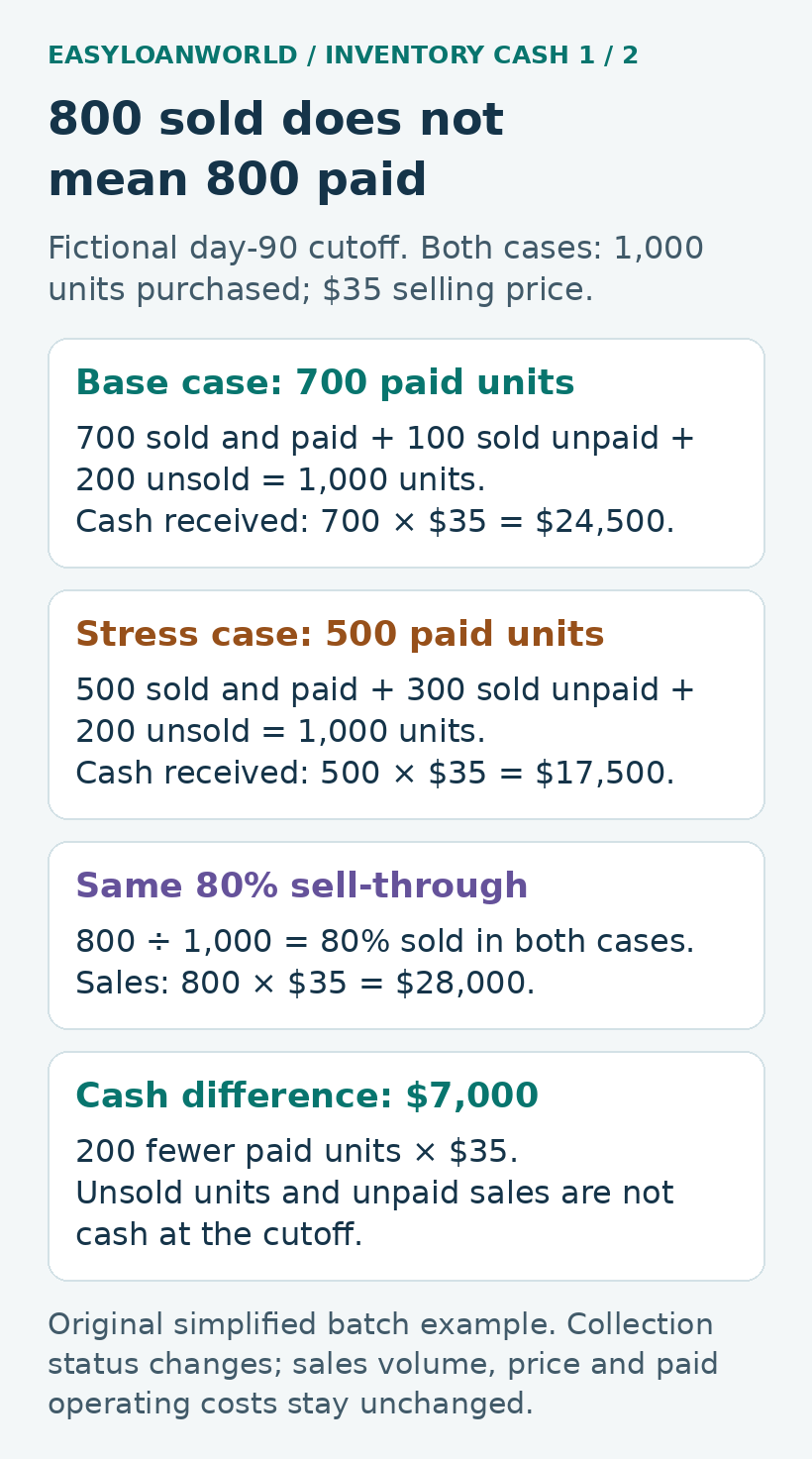
The 800 sold units represent $28,000 of sales. But customers have paid for only 700 units, producing $24,500 of cash. The other 100 sold units represent $3,500 of unpaid sales.
The cash bridge is:
- Start with $24,500 collected.
- Subtract $2,400 of fulfillment payments.
- Subtract $2,000 of other project operating payments.
- That leaves $20,100 before debt repayment.
- Pay the assumed $16,500 obligation, leaving $3,600 of project cash.
The retailer still holds 200 unsold units purchased for $4,000 and has $3,500 of unpaid sales. Neither amount is spendable cash at the cutoff. The stock’s purchase cost is also not a verified liquidation value.
The $3,600 is cash remaining, not accounting profit. It doesn’t by itself restore the business’s $4,000 initial contribution. Determining the full result would require the remaining collections, stock outcome and all applicable costs.
Collection stress: the same sales, only 500 paid units
Keep all assumptions unchanged except collections. The retailer still sells 800 units, so sales remain $28,000 and unsold stock remains 200 units. But customers have paid for only 500 units by the cutoff.
Cash received is now $17,500, with 300 sold units, or $10,500, still unpaid. Subtracting the same $2,400 fulfillment payments and $2,000 operating payments leaves $13,100 before debt. Against the $16,500 obligation, the project has a $3,400 shortfall.
Sell-through remains 80% in both cases. Repayment readiness changes because 200 fewer units have been paid for, reducing cash by $7,000. Expected later receipts can’t fund the day-90 payment before they become available. Any changed repayment deadline needs an agreed change; the forecast doesn’t grant an extension.
Don’t subtract the supplier bill twice
The supplier’s $20,000 was paid at the outset using the stated financing and existing cash. The cutoff bridge begins with later customer receipts. Subtracting the original supplier bill again while also subtracting the debt principal would double count that initial use of funds.
Likewise, don’t add the original $4,000 contribution as though it remains in the bank. It was spent. Keep the opening funding-and-purchase record beside the later collections-and-repayment record so both stages are visible without being counted twice.
Check collateral separately when it applies
The OCC’s Asset-Based Lending handbook discusses inventory liquidity, condition, obsolescence and lender-defined eligibility, as well as controls over proceeds and borrowing availability. Its version 1.1 dates to 2017, with a 2025 revision note. It’s supervisory guidance for OCC-regulated institutions, not a universal borrower rule or current pricing evidence.
If your facility is collateral-backed, ask which stock or receivables remain eligible, what reporting is required and whether contractual controls affect use of collections. Saleable goods, cash received and available borrowing are separate checks. Don’t treat inventory purchase cost as automatically eligible collateral.
Inventory financing: calculate the collected-cash threshold
Keep the original 800 units sold, $35 selling price, $2,400 fulfillment payments, $2,000 other operating payments and $16,500 debt obligation. To cover those operating payments and debt at the cutoff, collections must reach at least $20,900. That is $4,400 of stated operating cash uses plus $16,500.
At $35 per fully paid unit, $20,900 divided by $35 is about 597.14 units. Under the whole-unit payment assumption, at least 598 sold units must be paid for. This is a collection threshold, not an additional sales target: the example already has 800 sold units.
Check the boundary. With 597 paid units, receipts are $20,895; subtracting $4,400 leaves $16,495, five dollars short of debt repayment. With 598 paid units, receipts are $20,930; subtracting $4,400 leaves $16,530, providing only $30 after the $16,500 obligation.
That small positive result isn’t a prudent reserve recommendation. It depends on every exclusion in the fictional case, including no returns, fees or other cash uses. Partial customer payments, different prices or restricted proceeds would require a different cash record rather than a count of fully paid units.
Inventory financing: isolate one additional operating use
As a separate stress, add $1,000 of confirmed project operating payments before the same cutoff. Keep every original input unchanged otherwise. Required collections rise to $21,900, which needs 626 fully paid units at $35 each when rounded up to whole units.
At 625 paid units, $21,875 of receipts minus $5,400 of operating uses leaves $16,475, a $25 shortfall. At 626, $21,910 minus $5,400 leaves $16,510, only $10 above the obligation. The additional cost increases the collection requirement without changing the 80% sell-through figure.
Keep this branch separate from the base and 500-paid-unit stress. Don’t add their ending cash figures together. Each branch answers how the same order looks under a different specified collection or cost condition.
Before relying on any threshold, identify the actual usable collection dates and the contractual rules controlling proceeds. An invoice marked paid may need reconciliation to the cash that becomes available for this repayment. The worksheet doesn’t establish permission to use restricted funds or extend the deadline.
At the 598-paid-unit checkpoint, 202 of the 800 sold units remain unpaid, representing $7,070. The $28,000 sales total then splits into $20,930 collected and $7,070 receivable. That receivable explains the sales-to-cash gap; it isn’t another receipt to add.
Use the cutoff result without overstating it
A positive day-90 result doesn’t prove the project had enough cash on every earlier date. Fulfillment costs may be payable before customers pay. Check the separate operating calendar for those dates; this batch conversion test can’t resolve them.
Finish by labeling each remaining receipt confirmed, expected or unresolved, with its supporting evidence. If the cutoff shows a shortage, establish the actual options with the provider before relying on them. Keep the shortage visible until an agreed solution and its consequences are documented. Unsold goods and unpaid sales belong in the record, but they don’t belong in the cash available to pay today’s obligation.
Source checked October 19, 2026. All quantities, prices and financing terms are hypothetical.
Use the working-capital sizing worksheet when the timing of supplier payments and customer collections creates a broader funding gap.
Featured photo: Ceramic work in a pottery studio. Photo: Jonathan Cosens Photography / Unsplash. Used under the Unsplash license.


