Lease-End Buyout vs. Replacement Purchase: A 36-Month Cost Check
Compare two fictional purchase paths using upfront cash, loan payments, operating outlays, remaining debt and a conditional ending-value threshold.
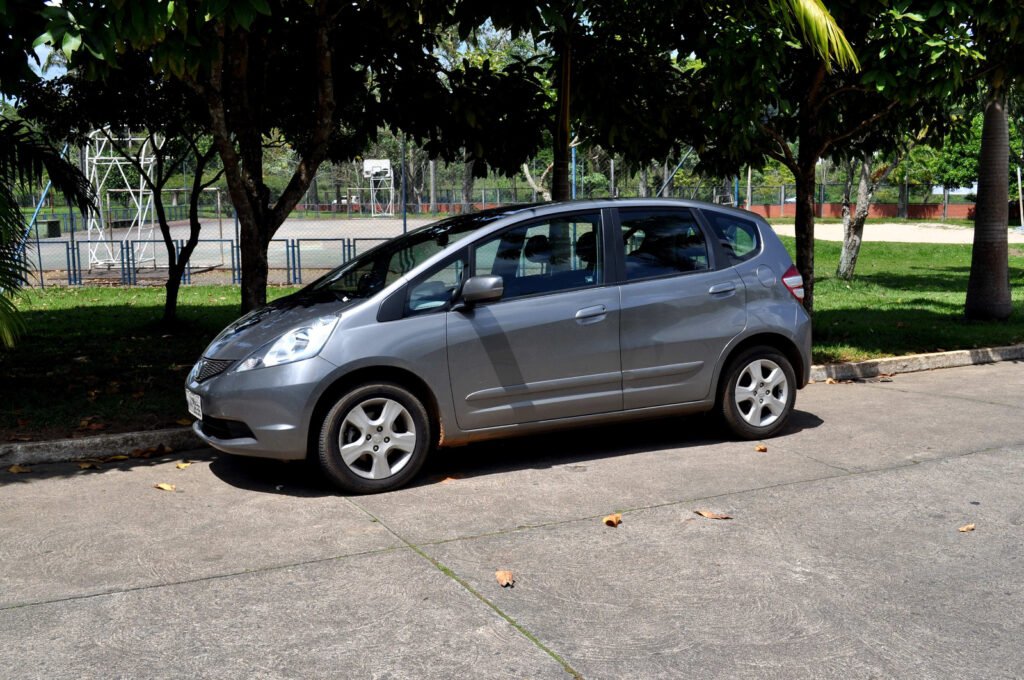
At the end of your current car lease, buying that car and returning it to finance a different purchase lead to two different vehicles, cash commitments and future values. A useful comparison asks: over the next 36 months, how much cash would each choice use, and what vehicle value and debt would remain?
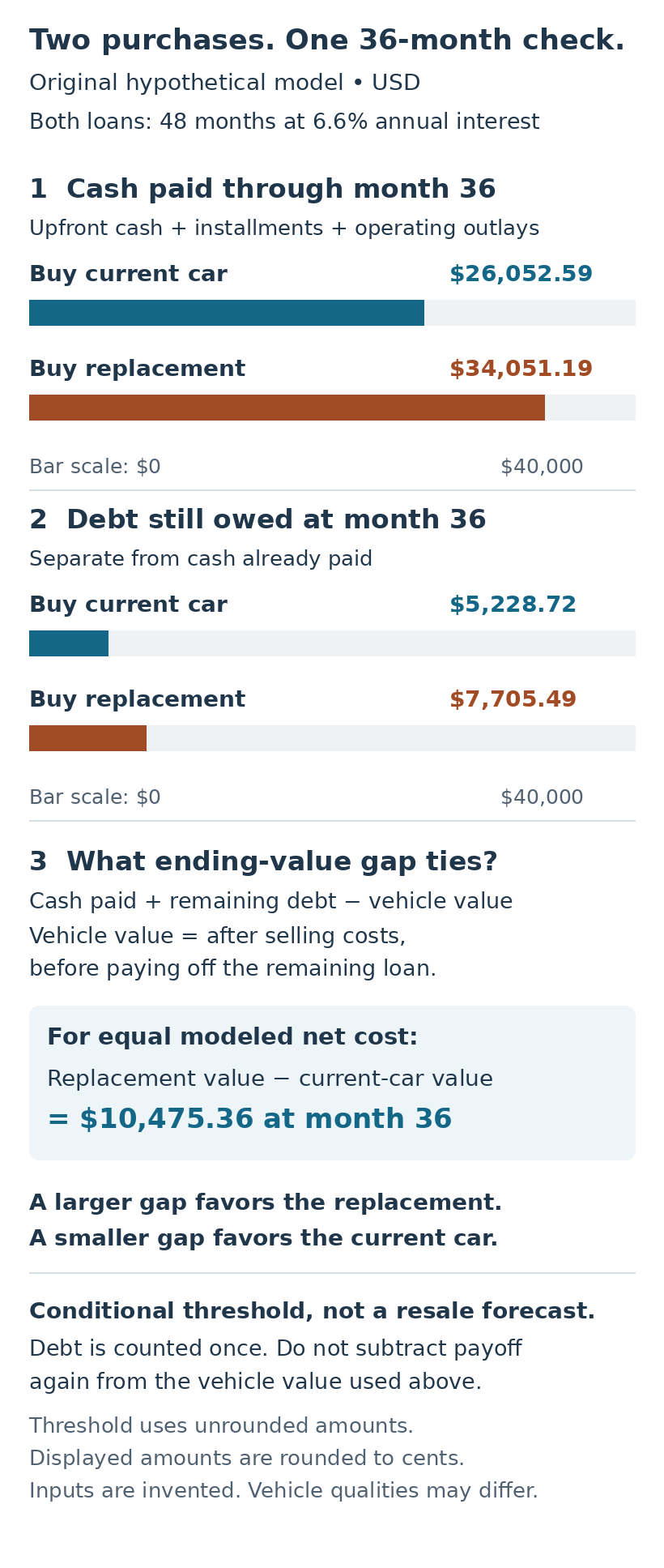
In this invented example, buying the current car uses about $7,999 less cash through month 36. But the replacement could still have the lower value-adjusted cost if its ending value, after selling costs, exceeds the buyout car’s by more than $10,475.36. That threshold is a calculation, not a resale forecast.
The Federal Reserve’s closed-end leasing guide lists return and purchase options, subject to the agreement, and possible disposition, excess-mileage and excess-wear charges on return.
Start at today’s lease-end decision
Leave already-paid lease installments and the original lease down payment out of this forward-looking comparison. Those past payments are sunk costs: neither choice reverses them in this exercise. Include any still-unpaid amounts in the appropriate future path instead of treating them as already paid.
The model starts when the scheduled lease ends. It assumes buying the current car is available on the stated terms, both loans are obtainable, and no unresolved past obligation remains beyond the modeled return costs. Verify your own position with the agreement, dated buyout quote and written return estimate before using either path.
Build two complete starting ledgers
Every price, rate and operating amount below was invented for this exercise. The buyout’s all-in acquisition amount is $21,600, including assumed taxes and transaction fees. A $2,600 cash contribution leaves $19,000 to finance. No separate return charge is included in this branch.
The replacement purchase totals $31,800, also including assumed taxes and transaction fees. Its $3,800 cash contribution leaves $28,000 to finance. Another $900 of assumed lease-return costs is paid separately, making initial cash $4,700. That $900 is neither inside the $31,800 purchase nor financed in the $28,000 loan.
Both fictional loans have a 6.6% fixed nominal annual rate and 48 equal monthly periods, with the first installment one month after funding. There are no separate financing fees, extra payments or payoff charges. The checkpoint is immediately after payment 36, leaving 12 scheduled installments. These assumptions do not describe an available loan.
Separate cash paid from debt still owed
Operating cash over the 36 months is assumed to total $7,200 for the buyout car and $5,400 for the replacement. These invented allowances cover the same chosen scope of fuel, insurance, maintenance and repairs; they are not forecasts. Replace them with your own documented budget and uncertainty range.
| Measure | Buy current leased car | Return and buy replacement |
|---|---|---|
| Initial cash, including separate return costs | $2,600.00 | $4,700.00 |
| Loan principal | $19,000.00 | $28,000.00 |
| Monthly installment | $451.46 | $665.31 |
| First 36 installments | $16,252.59 | $23,951.19 |
| Operating cash allowance | $7,200.00 | $5,400.00 |
| Cash paid through month 36 | $26,052.59 | $34,051.19 |
| Remaining loan balance after payment 36 | $5,228.72 | $7,705.49 |
| Cash plus remaining debt, before ending vehicle value | $31,281.32 | $41,756.68 |
Cash paid is initial cash plus installments plus operating outlays. It does not include an unmade terminal payoff. The last row adds the debt still outstanding for the value-adjusted comparison; it is not another cash-paid total.
Calculations retain unrounded payments and balances internally before displaying cents. Consequently, adding displayed rows can differ from the displayed total by a cent. The loan calculations use monthly rate = 0.066 ÷ 12 and payment = principal × monthly rate ÷ [1 − (1 + monthly rate)−48]. The month-36 balance is the amount left after applying 36 of those unrounded payments.
Give ending vehicle value one clear meaning
Define each car’s ending value as its hypothetical sale proceeds at month 36 after selling costs, but before paying off its loan. Call that amount V. Then:
Value-adjusted 36-month cost = cash paid + remaining loan balance − V.
For the buyout, this is $31,281.32 − Vbuyout. For the replacement, it is $41,756.68 − Vreplacement. This is an undiscounted comparison of outlay and ending financial position, not a tax calculation or a claim that the car has actually sold.
Alternatively, subtract net equity from cash paid, where net equity means V minus remaining debt. Use one method. Adding the balance and also subtracting an equity figure already reduced by that balance would count the payoff twice. If you keep the car, its estimated equity is not cash available in your bank account.
Test the value difference, rather than guess a winner
The replacement starts the terminal comparison $10,475.36 higher. Its value-adjusted cost is lower only when Vreplacement − Vbuyout exceeds that threshold. Equality produces a tie under the model; a smaller difference favors the buyout.
- If the replacement’s net-of-selling-cost value is exactly $9,000 higher, its modeled cost remains $1,475.36 higher.
- If that value is exactly $12,000 higher, its modeled cost becomes $1,524.64 lower.
Neither scenario predicts either vehicle’s price. They show what must be true for the choice to change. With all other inputs fixed, another $1,000 of buyout operating costs lowers the threshold by $1,000. Another $1,000 of replacement operating costs raises it by $1,000. This gives you a direct way to test a repair-cost concern without presenting it as certain.
Check whether the cash schedule works
The replacement requires $2,100 more initially and about $213.85 more per loan installment. Its assumed operating allowance is $50 lower per month when averaged across 36 months, leaving about $163.85 more average monthly outflow after the initial cash. That average is only a budgeting aid; the model does not specify when repairs or other operating bills arrive.
Ask how much cash remains after each initial payment, what monthly amount fits alongside other obligations, and what reserve you want for uneven bills. A favorable ending-value scenario does not supply the extra cash needed today.
Make the real comparison document-specific
- Current lease: What do the agreement and dated quotes say about your buyout eligibility, deadlines, purchase total and separately payable return amounts? Which items differ between your chosen paths?
- Replacement purchase: Does the itemized total reconcile to cash plus borrowing? Are taxes, fees and any selected extras already included? Record the supporting document for each number.
- Credits and deposits: Is there an actual refundable deposit or confirmed credit? Record its amount, timing and destination once. A credit that reduces borrowing must not also be counted as a cash receipt.
- Loans and exit: What are the actual installment dates, financing charges and amount required to settle each loan at your comparison date? Replace the model balance if the documented payoff calculation differs.
- The two cars: What do you know about each vehicle’s condition and service history? Which inspection findings, warranty terms, space needs, features or expected downtime matter to you? Keep unresolved differences visible beside the dollar result.
Choose a feasible cash plan first, then test whether the terminal-value threshold remains persuasive under less comfortable operating and resale assumptions. The model organizes that decision; it cannot decide how much a different car’s practical benefits are worth to you.
College Withdrawal Bill: Reconcile the School Account
Use three school records and a fictional $1,340 example to trace each adjustment, check a changed balance and organize questions for the right office.

Student Aid Credit Balance: Separate the School Ledger From Spendable Cash
Use two fictional aid snapshots and a private payment record to organize the amounts, permissions and dates behind a college-account credit.

Solar Loan Quotes: Compare the Cash Price Before the Low Rate
Match the installation scope, reconcile a fictional $6,000 financed-price uplift, and test the later payment if a planned savings payment never arrives.