Medical Expenses and IRA Additional Tax
Separate income from additional tax.
Estimated reading time: 1 minute
A medical-expense exception can reduce an IRA withdrawal’s additional tax without making the withdrawal income-tax-free.
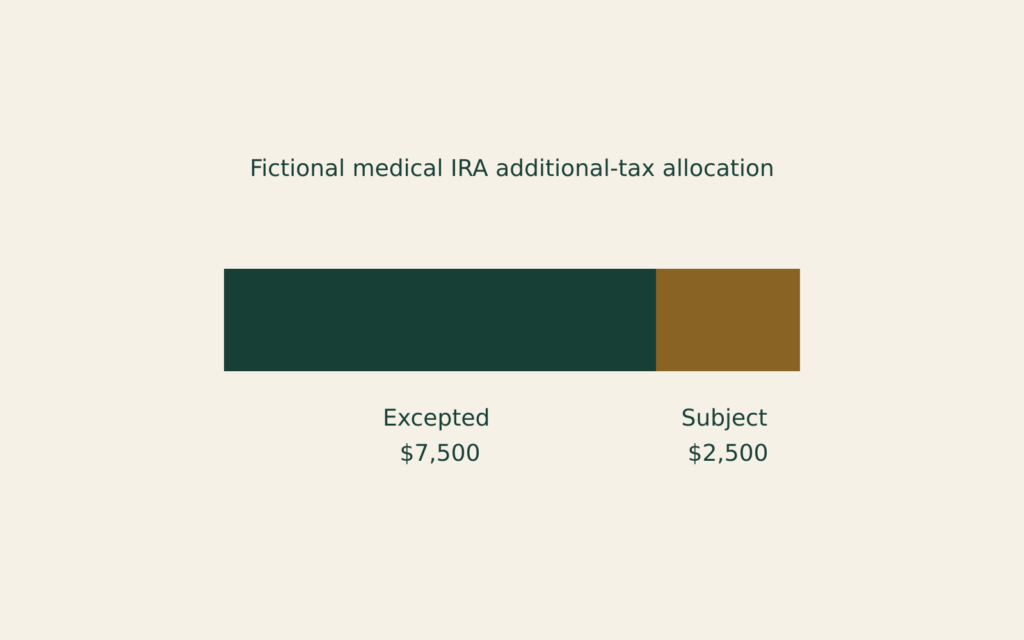
Consider a fictional U.S. individual, age 45 throughout 2025, who owns one ordinary traditional IRA—not inherited, SEP or SIMPLE—with no after-tax basis. Their only distribution is a $10,000 cash withdrawal, with no rollover, repayment or other exception. Verified 2025 adjusted gross income, including this distribution, is $100,000. They paid $15,000 of unreimbursed medical expenses during 2025, all eligible for inclusion in a Schedule A medical-expense calculation.
Publication 590-B (2025) exempts distributions up to eligible expenses exceeding 7.5% of AGI from the 10% additional tax. Itemizing is not required for this exception.
The floor is $7,500. Expenses above it are $15,000 − $7,500 = $7,500. Of the $10,000 withdrawal, $2,500 remains subject to the additional tax: $250.
All $10,000 remains ordinary income. Keep the expense, reimbursement and distribution records together; $250 is not the total income tax or final payment.


Roth Conversion and Account Clocks
Separate five-year tests.

ABLE Distributions Across Month-End
Separate retained purposes.