Read a Mortgage Amortization Schedule Without Mixing Up the Columns
Trace a fictional mortgage schedule from one payment to cumulative totals, with worked balance checks and a separate closing-period illustration.

A mortgage amortization schedule becomes easier to read when you follow one payment across the page, then check where its ending balance appears next. The useful question is not just “How much did I pay?” It is “How much of that payment reduced the modeled principal, and does the next row begin in the right place?”
Freddie Mac’s amortization explanation describes the principal-and-interest allocation in a repayment schedule. In a standard fixed-rate, fully amortizing monthly model, interest depends on the outstanding balance. As that balance falls, the same scheduled payment can repay more principal. The example below isolates that mechanism.
Write the model’s limits above the numbers
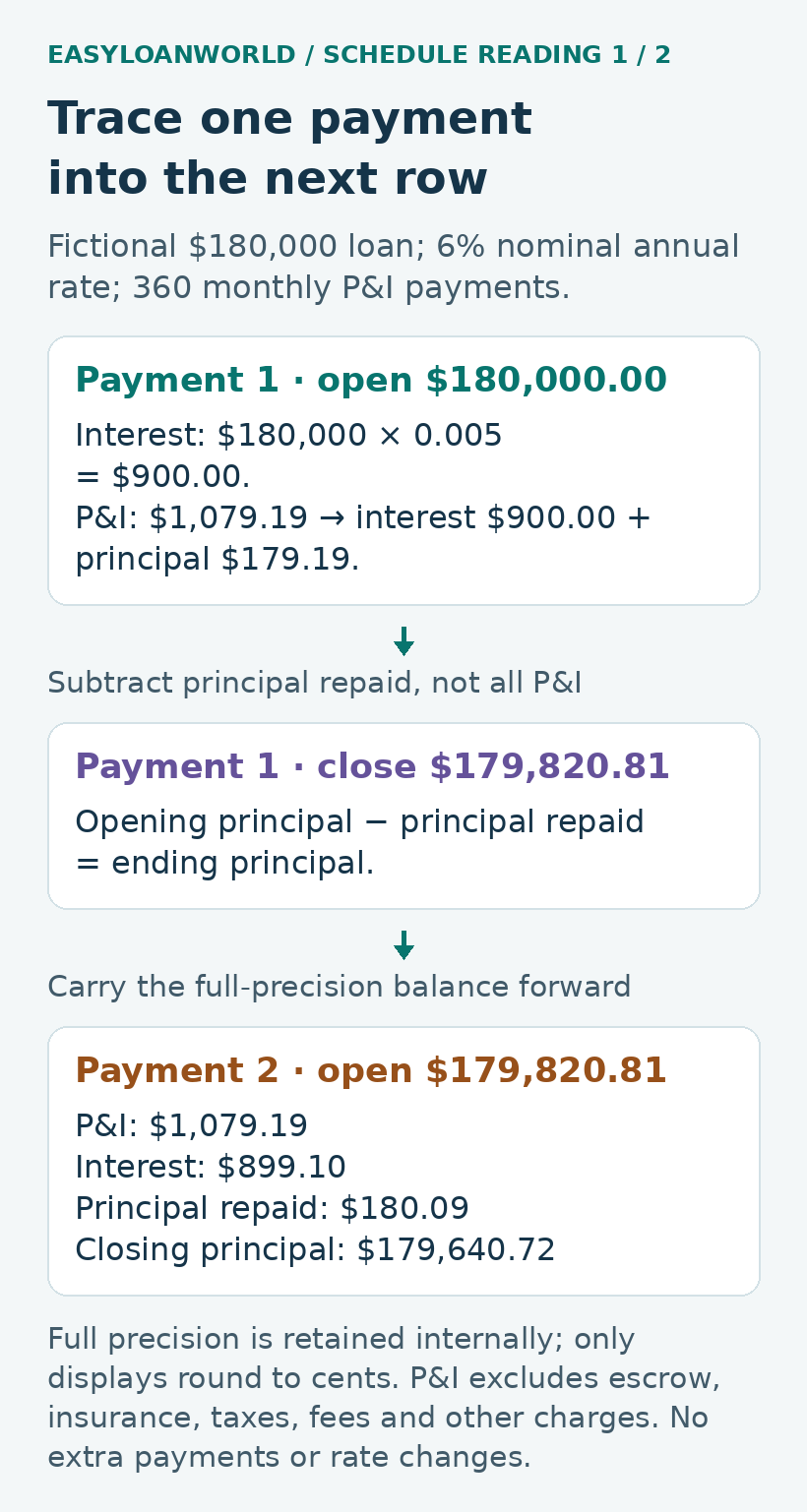
This fictional loan begins with $180,000 of principal, a fixed nominal annual interest rate of 6% and 360 equal monthly principal-and-interest installments. Its monthly rate is 0.5%, or 0.005. The first installment falls exactly one monthly period after the model’s starting point. This is an educational calculation, not a loan offer.
The model excludes escrow, taxes, insurance, mortgage insurance, fees, penalties, extra payments, payment holidays and rate changes. It also excludes an irregular opening period. That means the scheduled amount below is only principal and interest, abbreviated P&I; it is not a prediction of a household’s bank withdrawal.
The payment calculation is principal × monthly rate ÷ [1 − (1 + monthly rate) raised to the power of minus the number of payments]. Here it produces $1,079.190945… per month, displayed as $1,079.19. Calculations retain the unrounded amount throughout; cents are rounded only for presentation.
Read payment 1, then carry its balance forward
The first row starts with $180,000.00. Multiplying by 0.005 produces $900.00 of interest. Subtract that interest from the unrounded payment to obtain $179.19 of principal repaid, displayed to cents. Subtract the principal repaid from the opening balance: the row ends at $179,820.81.
These are three different roles for money in the same row. The payment is cash leaving the borrower in this model. Interest is one part of that payment. Principal repaid is the part that reduces the modeled balance. Do not subtract the whole $1,079.19 from principal after separately counting the $900.00 interest.
Payment 2 begins at the preceding row’s ending balance, using full precision. Its displayed figures are $899.10 interest, $180.09 principal repaid and $179,640.72 ending principal. The scheduled P&I amount stays the same; the split changes.
A practical reading check is to trace the balance column vertically. A row’s ending principal should become the next row’s opening principal under these assumptions. If a worksheet jumps between the two, inspect whether an adjustment or extra payment has been inserted before assuming the basic formula is wrong.
Distinguish one month from the year-to-date total
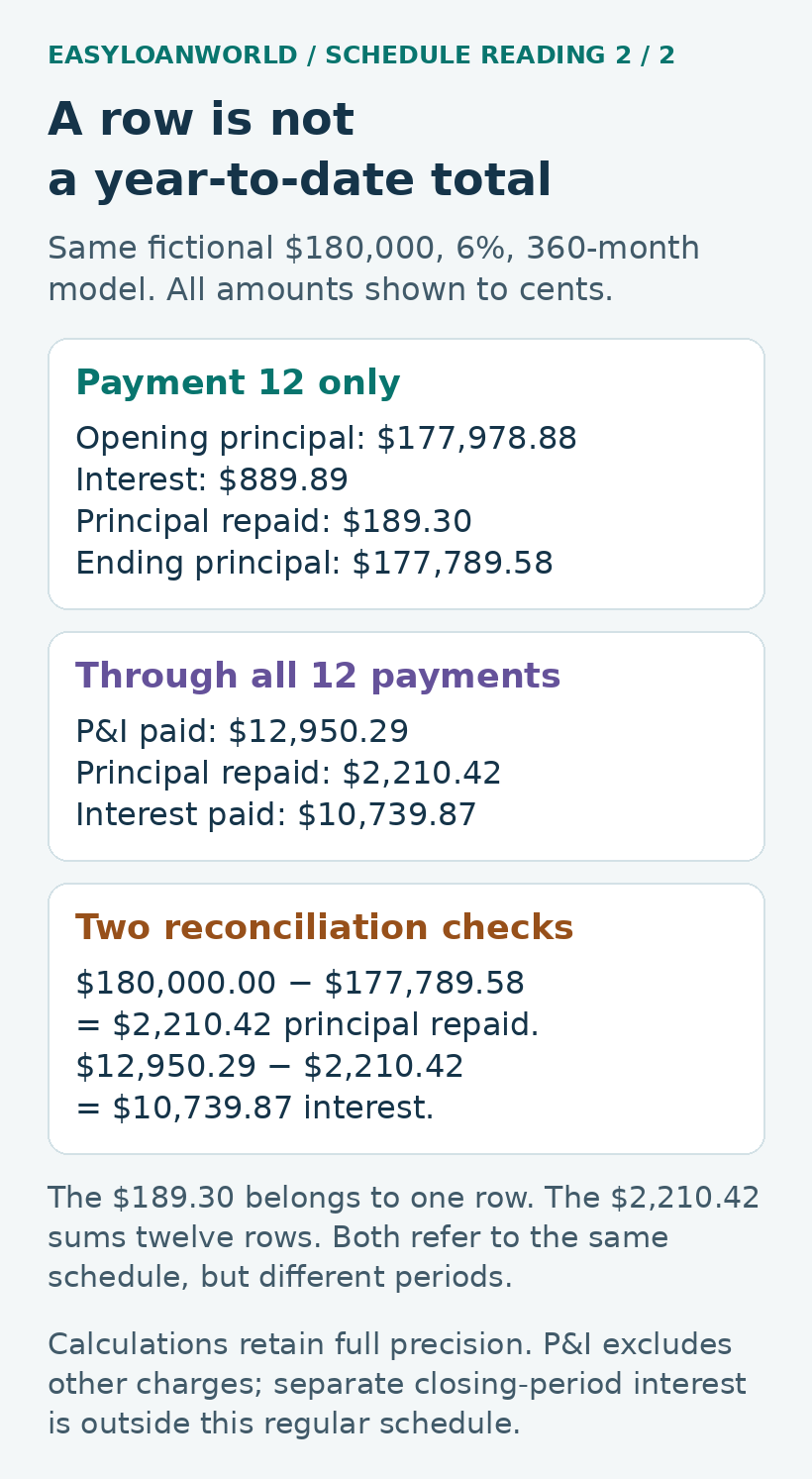
Payment 12 opens at $177,978.88. That row contains $889.89 interest and $189.30 principal repaid, ending at $177,789.58. The $189.30 belongs to payment 12 alone. It is not the entire amount of principal repaid over the first year.
After all 12 installments, the cumulative figures are:
- P&I payments made: $12,950.29.
- Principal repaid: $2,210.42.
- Interest paid: $10,739.87.
- Principal still outstanding: $177,789.58.
Two checks connect those totals. Starting principal minus ending principal gives cumulative principal repaid. Cumulative P&I paid minus cumulative principal repaid gives cumulative interest. Both checks use unrounded values before displaying cents, so adding or subtracting rounded row entries can occasionally differ by a penny.
If you are copying a number into your own notes, include “this payment” or “through payment 12” beside it. That small label prevents a monthly amount from being mistaken for a cumulative figure. Also distinguish a balance at a point in time from payments added across a period.
Half the installments does not mean half the principal
At payment 180, this model opens with $128,325.48, allocates $641.63 to interest and $437.56 to principal, and ends at $127,887.92. Half the 360 installments are complete, but the remaining principal is not $90,000. The equal-payment formula does not promise equal principal reductions.
At payment 360, the displayed opening principal is $1,073.82. Interest is $5.37 and the principal portion clears the balance. Over the unchanged schedule, total P&I is $388,508.74, including $208,508.74 interest. Those totals belong to this specific model and do not include every borrowing or homeownership cost.
Keep closing-period interest outside the regular rows
The CFPB describes prepaid interest as daily interest due at closing for the interval before the period covered by the first monthly payment. Confirm the actual covered dates in your documents; a later first payment date does not establish an interest-free interval.
As a separate fictional illustration, assume $180,000 at 6%, ten prepaid days and actual/365 simple-interest arithmetic. The calculation is $180,000 × 0.06 ÷ 365 × 10 = $295.89. These ten days are outside the 360-row schedule above. In this illustration, the amount is paid separately, not financed or deducted from payment 1.
The stipulated ten days do not identify a closing date or first due date for your loan. Before combining this separate charge with a schedule total, identify which period each amount covers so the same interest is not counted twice.
Write a difference note before calling a mismatch an error
Record four items: the expected row and date; the document and amount you actually see; the component that appears different; and the question still unanswered. For example, comparing modeled P&I with a full withdrawal is not a like-for-like check until the withdrawal’s components are identified.
Next compare starting balance, rate, covered period, rounding method and included charges. A dated payoff quote is also a different comparison from the principal balance in a scheduled row. Use the actual agreement and account records to resolve the real loan; this fictional schedule provides a way to organize the question.
Featured photo: A calculator and handwritten notes illustrate checking a calculation. Photo: Aaron Lefler / Unsplash. Used under the Unsplash license.
Mortgage Charge Questions: Choose the Record That Answers Them
Match a questionable mortgage charge to account detail, service records or adjustments with a worked property-inspection example and a two-part index.

Partial Mortgage Payment: Track Money Held in Suspense
Follow a fictional $1,100 and $700 mortgage payment trail, compare dated records, and build a precise question about an unexplained entry.

Minnesota Contract for Deed: Check the Seller, Title and Balloon
Before signing a Minnesota contract for deed, organize seller, disclosure and title evidence, then test a fictional balloon-payment ledger.