Mortgage Servicer Changed: Check Payment Routing and Records
Build a private transfer file linking payment instructions, receipt evidence and the new mortgage statement, with a fictional reconciliation example.

Estimated reading time: 8 minutes
For a mortgage servicer transfer, start a small file before changing payment settings. The most useful pieces are the transfer notice, the prior statement with payment evidence, and the first statement from the new servicer. Together, they let you compare what was supposed to happen with what each account record actually shows.
A bank debit and a mortgage payment credit are different pieces of evidence. One shows money leaving an account; the other shows how the loan record reflects it. Keeping both avoids turning a missing screen entry into an unsupported conclusion.
This U.S. educational checklist focuses on payment routing and record reconciliation. It isn’t individual financial or legal advice, a refinancing guide or a calculation of what your next payment should be.
Mortgage servicer transfer: make a dated record
Transfer notices identify the effective date and when the old servicer stops accepting payments and the new one starts. A servicing transfer doesn’t change loan terms other than those directly related to servicing. See Regulation X’s transfer provisions.
Copy the stated dates into a private record, keeping their labels intact. “Notice printed,” “notice received” and “transfer effective” should remain separate entries. If two notices disagree, preserve both versions and mark the difference for clarification rather than selecting the date you prefer.
- Documents: filenames or paper locations for each notice.
- Dates: effective date and each stated payment-acceptance date.
- Contacts: old and new servicer details, plus how you checked them.
- Account reference: the private reference used to identify the loan.
- Questions: conflicting instructions or missing information.
As a practical precaution, use a known account channel or contact information from established records to check unexpected instructions. An unsolicited payment link isn’t a substitute for that check. Keep full account numbers and financial documents out of public comments or social-media posts.
Identify who initiates your payment
If your bank or credit union sends mortgage payments through its bill-pay system, update the recipient for the transfer. Review mortgage statements to check accurate crediting. The CFPB’s servicer-change guide explains these checks.
First identify your actual setup. Are you asking a bank to send money, authorizing the servicer to withdraw it, or making individual payments yourself? Record the answer from your settings and recent payment evidence, rather than assuming every recurring payment works the same way.
For servicer-initiated automatic debit, ask whether your authorization will transfer, whether a debit is already pending and what action, if any, you need to take. Save the answer and the confirmation reference. Don’t assume automatic migration, and don’t cancel an existing arrangement merely because a new portal is available.
Before creating any replacement instruction, compare it with pending activity. A screen that offers “set up autopay” doesn’t establish whether another instruction already exists. If the required payment’s status is uncertain, obtain account-specific instructions promptly instead of deciding from the screen alone to pay twice or skip payment.
Mortgage servicer transfer: trace one payment to the loan record
Make a separate payment card for the installment crossing the transfer. Use a fresh line for each event so later information doesn’t overwrite earlier evidence:
- Amount and stated due date.
- Payment method and scheduled processing date.
- Actual recipient shown in the payment instruction.
- Bank funds movement, including its date and reference.
- Recipient’s confirmed receipt date, if available.
- Loan credit, forwarding or return evidence.
Use “not yet confirmed” where a record is missing. It’s more informative than “lost” or “paid” when neither conclusion is established. If a representative supplies an answer by phone, note the date, reference and exact remaining question. Request the relevant account record when the answer depends on a posting you can’t see.
The protection depends on receipt
During the 60 days beginning on the effective transfer date, a payment received by the old servicer on time, including any applicable contractual grace period, can’t be treated as late. This isn’t permission to stop paying. The old servicer must promptly forward a misdirected payment or return it with notice of the proper recipient.
That distinction is why the payment card separates a bank’s debit from a recipient’s receipt. Preserve both records when they are available. Don’t replace a missing receipt date with the date you clicked “pay.”
A fictional transfer record
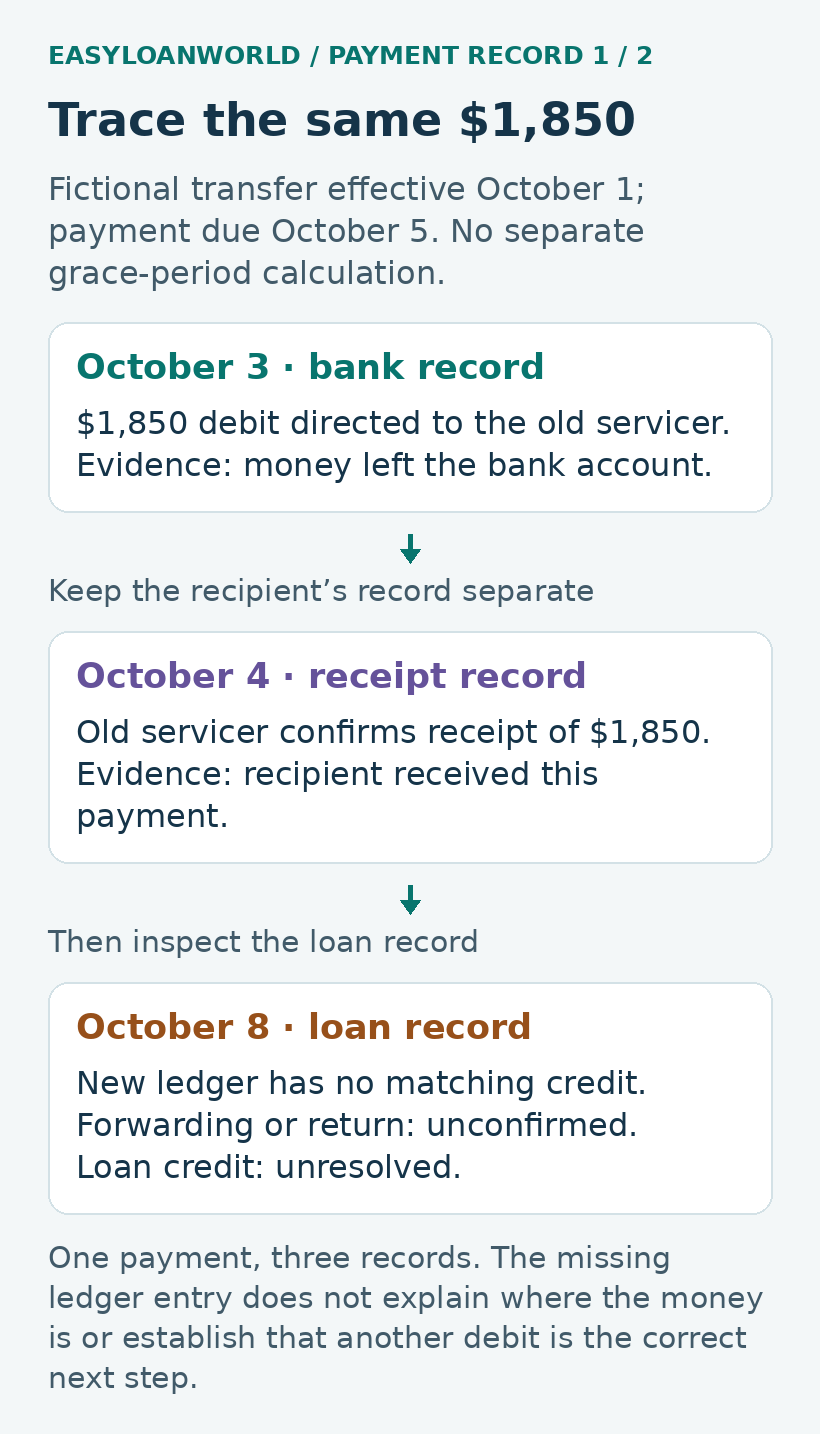
Consider an invented $1,850 monthly payment. The transfer takes effect October 1, and the assumed payment due date is October 5. This example makes no separate grace-period calculation.
- October 3: the bank shows a $1,850 debit directed to the old servicer.
- October 4: the old servicer confirms receiving that payment.
- October 8: the new loan ledger still shows no corresponding credit.
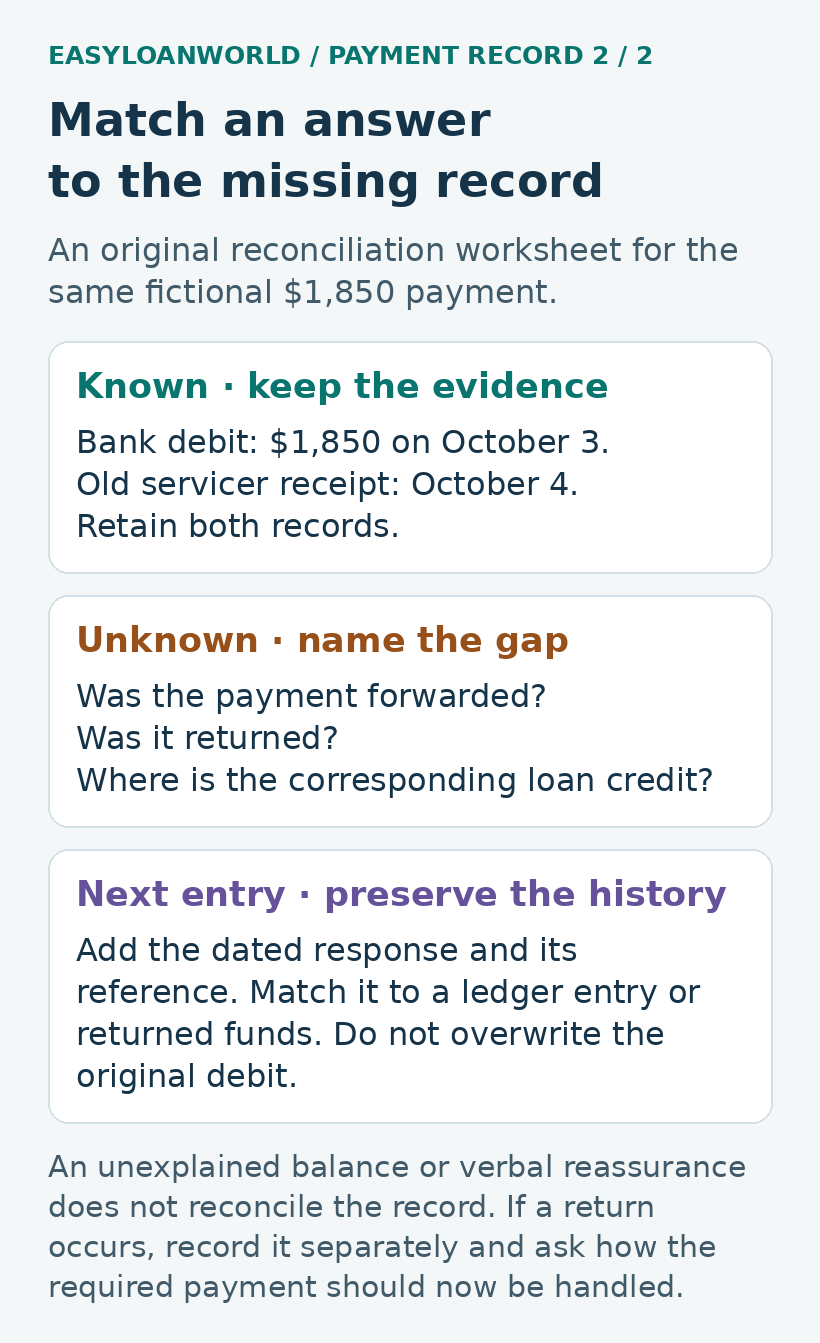
The amount to trace is $1,850. Receipt by the old servicer is confirmed; forwarding or return isn’t. The new loan credit remains unresolved. Those are the findings the evidence supports. The missing display alone doesn’t explain where the money is or establish that another debit is the correct next step.
If a return later appears, add it as another event with its amount and date. Don’t erase the original debit or continue labeling it a completed payment. Ask how the required payment should now be handled; a return doesn’t erase the underlying obligation.
Helper access after a transfer
Chase-specific example: Chase says prior-servicer information authorizations are not valid with Chase; contact it to arrange sharing. Its linked authorization form lets you name individuals within an organization. Without named individuals or another restriction, authorization covers the entire file and entity. Chase may decline disclosure if it can’t authenticate the requester. Authorization lasts until revoked: write or call using the form’s contacts. Read all terms, including the indemnity clause, before signing.
Chase references checked October 25, 2026 (UTC); this example concerns information sharing, not payment routing.
Mortgage servicer transfer: distinguish forwarding from a second payment
Continue the fictional $1,850 payment trail with a later confirmed event. Suppose the old servicer supplies a forwarding reference and the new servicer confirms one $1,850 credit connected to it. Preserve the original bank debit, old-servicer receipt and later loan credit as stages of the same payment.
There’s still only $1,850 of borrower cash paid in this example. Adding the forwarded amount to the original debit would incorrectly report $3,700 paid. The forwarding record explains movement between servicers; it isn’t another withdrawal from the borrower’s bank account.
Match the new credit to the actual installment and ask how its effective date is recorded. A posting visible today and the payment’s credited effective date can be different fields. The exercise supplies neither a universal posting delay nor an instruction to infer the effective date from when the screen changed.
As a separate alternative, suppose the old servicer returns the full $1,850 instead of forwarding it. If the bank later confirms receipt of that return, the original debit and return net to zero cash outflow for those two events. That doesn’t mean the mortgage installment was satisfied. The required payment still needs the servicers’ verified handling instructions.
Don’t combine the forwarding and return alternatives into one completed history. If real records appear to show both, ask which transaction each reference concerns and whether a reversal occurred. Preserve the uncertainty rather than selecting whichever branch makes the account look resolved.
Mortgage servicer transfer: close one discrepancy at a time
Create a short reconciliation with separate columns for bank movement, old-servicer receipt, forwarding or return, and new-loan credit. An entry can be confirmed in one column and missing in another. This is more informative than one undated “payment complete” box.
If a later statement includes a charge you question, record it as a separate discrepancy with its own amount and explanation request. Don’t subtract it from the payment trail or assume it’s caused by the transfer merely because the dates are close. Payment routing, charge validity and any required response need their own evidence.
Before changing recurring instructions, reconcile pending activity and obtain the applicable account-specific steps. Save the confirmed destination, effective date and any cancellation or replacement reference. A documented payment trail helps explain what occurred, but it doesn’t itself authorize a new debit, cancel an existing one or suspend the next required installment.
Close the file with records, not reassurance
For persistent transfer problems, the CFPB guide above points to information requests and notices of error that can be sent to both servicers. Use that official route to investigate unresolved records.
Prepare a concise summary identifying the payment, the evidence already available and the exact missing record. Save each servicer’s response separately. A useful request asks where the specific payment went and how it appears on the loan, rather than asking only whether the account “looks fine.”
Finish by matching the response to the statement entry or returned funds. Keep any disagreement open until the records explain it. This checklist doesn’t supply a universal posting deadline: the goal is a documented resolution of your actual payment trail.
If the new statement also changes the payment amount, separate any escrow shortage and ongoing escrow increase from the transfer-routing question.
Featured photo: A blank notebook illustrates keeping a record of payment details. Photo: Kelly Sikkema / Unsplash. Used under the Unsplash license.

One Mortgage Form, Two Borrowers
Match each person’s share.