No-Closing-Cost Refinance: Trace the Fees and Cash Due
Trace a fictional $5,600 charge group across cash, lender credit and added principal, then catch a credit counted twice in a mixed proposal.

Estimated reading time: 8 minutes
A no-closing-cost refinance deserves a dollar-by-dollar check. Start with the written charges and find the funding source for each one. The result should explain both the new mortgage balance and any money you still need to bring.
The Consumer Financial Protection Bureau describes two common arrangements: a lender credit paired with a higher interest rate, or closing costs added to the loan balance. The label doesn’t mean the services are free. The rate or amount borrowed can carry the cost.
No-closing-cost refinance: check the actual expenses
Chase’s refinancing overview distinguishes lender charges, third-party charges and prepaid items, and notes that funding arrangements can combine approaches. Ask which amounts your particular offer covers, including how prepaid items, escrow funding and any mortgage insurance are treated.
Write down the exact claim being made. “No lender fee,” “no cash for selected fees” and “nothing due at settlement” describe different things to check; don’t assume one phrase establishes the others.
For each cost, reconcile three portions: cash paid by you, an applicable lender credit, and money added to the borrowing. These are ways to fund the same charge. Counting the charge again under each heading would invent extra expenses.
Use a date-specific mortgage payoff when checking the proposed principal, rather than substituting statement principal.
No-closing-cost refinance: three ways to fund $5,600
Every number below is fictional. Each proposed mortgage pays the same agreed $280,000 payoff and provides no additional borrowed cash. Each has a fully amortizing, fixed-rate, 30-year schedule of 360 monthly payments. Assume $5,600 of selected financing and settlement charges, plus $2,400 of separately identified prepaid items and initial escrow funding.
There are no discount points, additional credits, penalties, previously paid costs or other adjustments. The $2,400 is cash-paid in every route by assumption; this isn’t a rule that these items can never be financed or covered by credits.
Payments below are principal and interest, or P&I, only. They exclude property taxes, homeowners insurance, escrow contributions and mortgage insurance, so they aren’t the full housing bill. None of these combinations is a current offer or a promise of eligibility.
Route A: pay the selected charges in cash
- New mortgage: $280,000 at an assumed 6.000% note rate
- Selected charges: $5,600 cash; $0 lender credit; $0 financed
- Separate prepaid and escrow cash: $2,400
- Simplified cash due: $8,000
- Monthly P&I: $1,678.74
Paying these selected charges in cash keeps them outside the new mortgage balance in this example.
Route B: use a credit for the selected charges
- New mortgage: $280,000 at an assumed 6.375% note rate
- Selected charges: $0 cash; $5,600 lender credit; $0 financed
- Separate prepaid and escrow cash: $2,400
- Simplified cash due: $2,400
- Monthly P&I: $1,746.84
Route C: add the selected charges to principal
- New mortgage: $285,600 at an assumed 6.000% note rate
- Principal reconciliation: $280,000 payoff + $5,600 financed charges
- Selected charges: $0 cash; $0 lender credit; $5,600 financed
- Separate prepaid and escrow cash: $2,400
- Simplified cash due: $2,400
- Monthly P&I: $1,712.32
Routes B and C both require $2,400 immediately in this illustration. Yet their rates, principal balances and payments differ. The equal cash figure therefore can’t rank their overall economics.
The payments use the annual note rate divided by 12 and the standard level-payment formula, with no intermediate rounding. Actual lender rounding and timing can change exact figures. A fuller decision needs all costs, your expected repayment period and the debt remaining when you sell or refinance. The lowest installment alone doesn’t identify the best choice.
Catch a credit counted twice in a mixed proposal
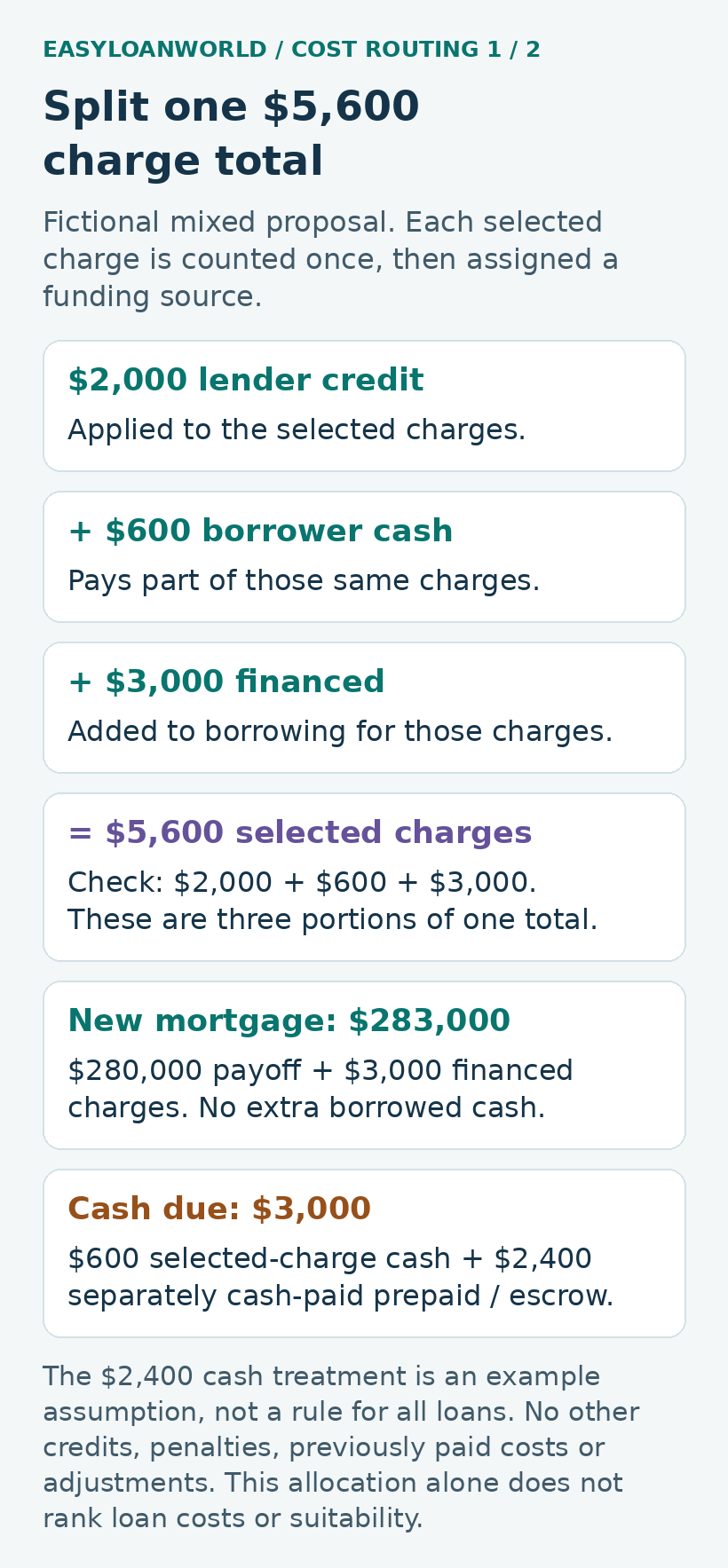
Consider a separate fictional arrangement with the same $280,000 payoff, $5,600 selected charges and $2,400 cash-paid prepaid/escrow amount. The selected charges are funded as follows:
- Lender credit: $2,000
- Borrower cash: $600
- Financed portion: $3,000
The charge allocation balances: $2,000 + $600 + $3,000 = $5,600. New principal is $280,000 + $3,000 = $283,000. Cash due is $600 + $2,400 = $3,000. Only $600 of that cash pays the selected charges.
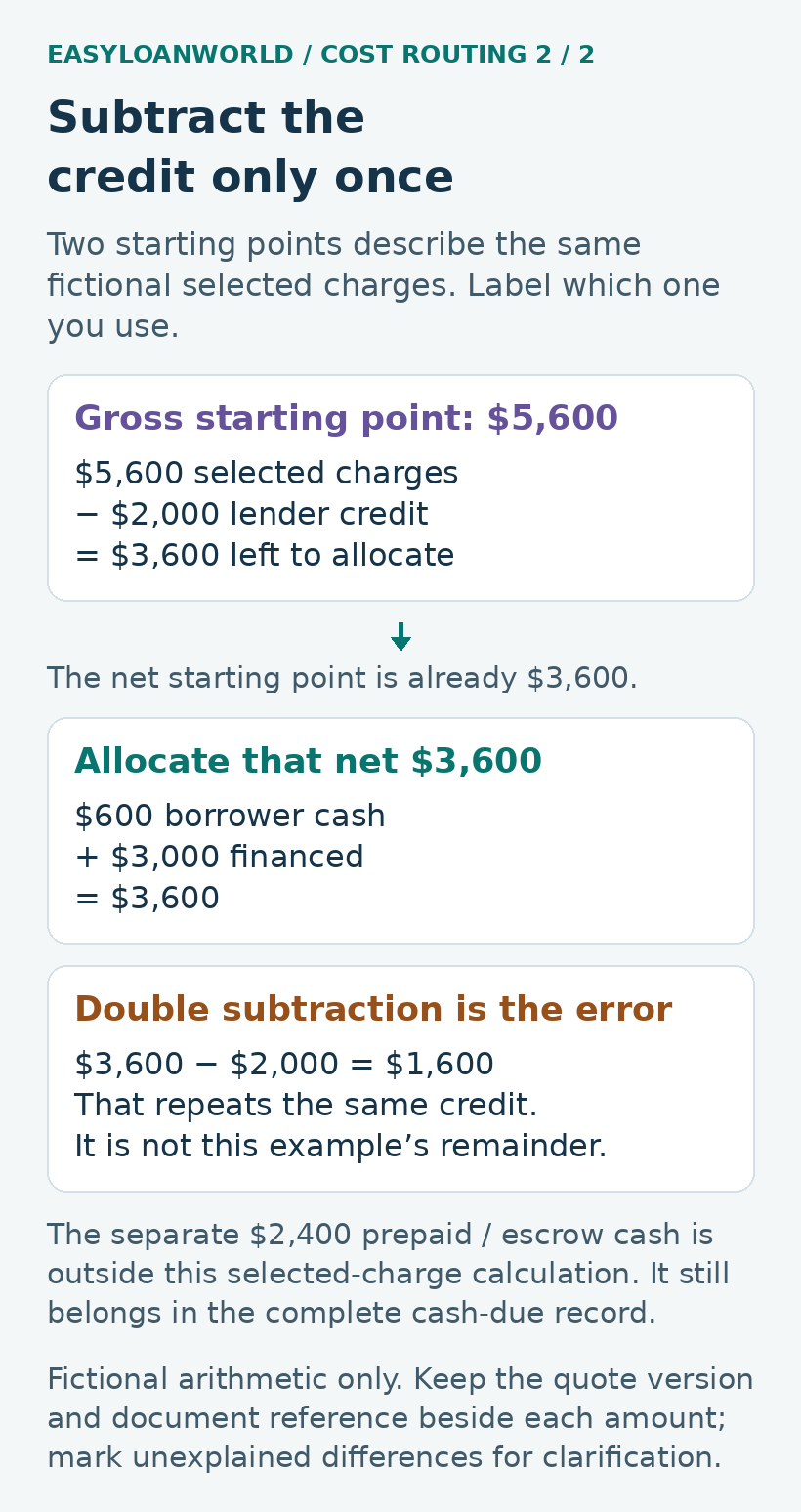
Suppose a worksheet already shows $3,600 after subtracting the $2,000 credit from the gross charges. Subtracting the credit again would incorrectly leave $1,600. Instead, allocate the already-netted $3,600 into $600 cash and $3,000 financed.
You can start with the gross $5,600 or the net $3,600, but label which starting point you chose. They describe the same transaction. Similarly, adding all $5,600 to principal while also showing the $2,000 credit needs an explanation of where those additional funds actually go; it doesn’t match this example.
No-closing-cost refinance: reproduce the three payments
Use this loan-payment calculator to check only the principal-and-interest schedules in Routes A, B and C. Enter 360 months in every run. Use the contractual note rate, not a fee-inclusive APR. Charges funded outside principal aren’t automatically added by the form.
For A, enter $280,000 and 6%. Expected monthly principal and interest is $1,678.74. For B, keep principal at $280,000 and change the rate to 6.375%; expected payment is $1,746.84. For C, enter $285,600 and 6%, producing $1,712.32.
The C input includes the financed $5,600 exactly once. Entering $280,000 would omit those financed charges; entering $291,200 would add them twice. The separate $2,400 prepaid-and-escrow cash remains outside this loan principal in all three stipulated routes.
The form’s total interest is a schedule measure, not a complete ranking of these offers. A has $5,600 of selected charges paid in cash; B uses a rate-linked credit; C carries those charges in principal. Keep each route’s initial cash, financed amount and repayment schedule connected when choosing a comparison horizon.
No-closing-cost refinance: inspect an equal-date balance
Open the calculation table and inspect payment 60 in each run. Immediately after that installment, modeled remaining principal is $260,552.20 for A, $261,730.68 for B and $265,763.24 for C. These balances use the same timing boundary and full-precision schedules.
A smaller initial cash requirement doesn’t mean the remaining debts are equal five years later. A same-date exit comparison must include the applicable payoff, payments made and separate upfront cash. Don’t compare only sixty installments while omitting each route’s residual debt.
For the separately illustrated mixed proposal, the $283,000 principal can be reconciled from the $280,000 payoff plus $3,000 financed charges. No note rate is supplied for that branch, so it has no calculated payment here. Borrowing A’s rate to fill the blank would invent an offer term.
After checking the mathematics, return to the actual written proposal. Confirm which credit applies to which charge and whether any change affects rate, principal or cash due. Matching the fictional payment doesn’t verify eligibility, quote validity or a real lender’s final payoff method.
Retain one labeled output for each route. Changing a rate in the same form replaces the displayed scenario; it doesn’t preserve the earlier result. Save the inputs beside each payment and balance so comparisons remain reproducible.
Keep a private charge-routing record
Create one short entry per cost group. This is an arithmetic check, not an official disclosure template. Keep the documents privately; EasyLoanWorld doesn’t need your statements or payment instructions.
- Name the version. Record the quote date, advertised promise, proposed new principal and reference documents.
- Split each charge. Note its description, gross amount, cash portion, credit portion, financed portion and document line. The three portions must equal the gross charge.
- Separate other uses. Give prepaid/escrow and other amounts their own entries and funding treatment. Similar labels alone don’t prove duplication.
- Check principal. Compare the proposed balance with the payoff and every other documented financed use. Put any unexplained difference in a discrepancy log.
- Check cash. Reconcile remaining cash-paid amounts and actual adjustments. Don’t reuse a credit already allocated elsewhere.
- Preserve the correction. Record the question, answer, revised amount and supporting document. Check whether the change affects the rate, balance, required cash or your plan.
Resolve unallocated amounts before relying on the offer
Ask the lender or closing professional to explain a missing allocation. Keep it marked unconfirmed instead of entering zero. A lender credit shouldn’t be assumed to be unrestricted spending money, and the examples don’t establish that every cost can be financed.
Once the record balances, you know where the expenses went. You still need to decide whether the mortgage’s repayment obligation fits your budget and plans, without relying on a future refinance to fix an unsuitable loan.
U.S. educational information. Fictional examples illustrate cost allocation, not an individualized loan recommendation.
If the rate changes with the upfront price, compare the points and break-even calculation at the same expected payoff date.
Featured photo: Photo by Katie Harp on Unsplash. Used under the Unsplash license. Illustrative calculator and stationery. Photo by Katie Harp on Unsplash.

One Mortgage Form, Two Borrowers
Match each person’s share.