Prepaid Tuition Records
Read prepaid tuition benefits, purchase conditions and payout records separately. A stated tuition benefit isn’t a complete college budget.
Estimated reading time: 5 minutes
Before borrowing for a college balance, identify what an existing prepaid benefit actually represents. These independent examples explain named records, not interchangeable programs or investment recommendations.
Identify the benchmark behind a GET unit
Washington’s GET payout page distinguishes the price paid to purchase a unit from its value when used. The purchase price is set annually by the WA529 Committee with the state actuary; payout depends on public-university tuition rates.
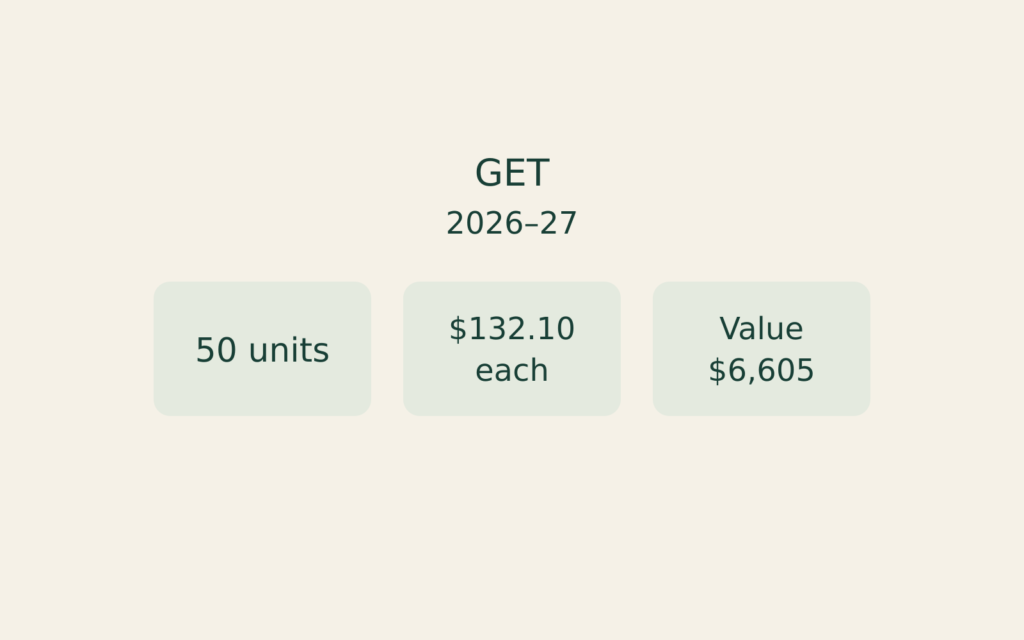
One hundred units correspond to one year of resident undergraduate tuition and state-mandated fees at Washington’s highest-priced public university. The page specifies $132.10 per unit effective August 1, 2026, for 2026–27. That benchmark isn’t a statement that every student’s complete annual college bill equals that amount.
For a limited arithmetic illustration, 50 eligible units at $132.10 produce $6,605. This assumes the units are usable and excludes any other account condition. The page separately requires purchase at least two years before use; a current purchase quote isn’t the same record as the applicable payout value.
Read the certificate’s plan year and issue date
Private College 529’s plan details say contributions during a July-through-June Plan Year are aggregated into one Tuition Certificate. The issue date is the first purchase date during that Plan Year, not a separate date for every contribution.
Certificates require 36 months from issue before tuition redemption at a participating school.
The plan separately requires at least $500 of contributions within two years of account opening. Otherwise, it describes returning the purchase amount without interest and terminating the contract.
Its refund provision uses a different twelve-month holding period. Refund value adjusts contributions for net investment returns, subject to a maximum annual increase of two percent compounded annually.
Distinguish Texas Transfer Value from in-state benefits
The Texas Tuition Promise Fund uses a separate Transfer Value for specified schools where tuition and fees aren’t locked in, including private and out-of-state colleges.
That value is the lesser of what the units would cover at a Texas public institution or their original purchase price adjusted for the plan’s net investment earnings or losses. State-provided or procured matching contributions and their earnings are excluded. Don’t substitute a Texas public-school coverage figure for this separate calculation.
The plan’s required-fee definition excludes course-specific laboratory or equipment charges and fees related to a major or year of study. Texas also requires units to be fully paid before redemption.
Check how the university actually bills the plan
The University of Florida’s billing explanation says its bursar matches an electronic Florida Prepaid file against enrolled students’ names and Social Security numbers. Students don’t need to present their Florida Prepaid documentation for this ordinary process.
UF automatically bills tuition and applicable fees each term while the student remains registered and has available hours. It explicitly warns that Florida Prepaid contracts don’t cover every tuition and fee charge.
UF separately identifies billing assistance for study-abroad and correspondence instruction: its International Center handles the former, and Continuing Education handles the latter. For housing, UF supplies a separate Housing Florida Prepaid Information page and a housing contact route for parents and students.
Locate U.Plan maturity and older activity records
MEFA’s U.Plan explanation distinguishes chosen maturity years from the date a family later decides to use the money. Its bonds don’t become liquid until the chosen maturity year; MEFA says early access can’t be guaranteed. Certificates remain valid for six years after that maturity year.
There’s also a specific records issue following its portal change: activity before February 2026 is no longer available online. MEFA says owners can request a full history of deposits, redemptions, withdrawals, statements or tax forms, delivered by email or mail. An absent old portal entry isn’t proof that the event never occurred.
MEFA describes U.Plan’s own 1099-DIV and 1099-OID records. The latter reports certificate value growth, with the reported figure depending on how the certificate was used.
MEFA requires institutional approval for part-time, continuing-education or certificate-program study using these certificates.
Identify the recipient on Form 1099-Q
The IRS’s April 2025 Form 1099-Q instructions are marked for continuing use until superseded. For a qualified tuition program, a distribution directly to the student beneficiary or to an eligible school for that beneficiary is reported with the beneficiary as recipient. The instructions also cover a qualifying direct Roth IRA transfer; otherwise, they identify the account owner as recipient.
Box 1 can include tuition credits, certificates, vouchers and waivers, not just a cash payment received personally. A form bearing the student’s name therefore doesn’t necessarily mean money arrived in that student’s bank account.
Boxes 5a and 5b distinguish private and state qualified tuition programs, while 5c identifies a Coverdell account. Box 6 indicates that the recipient isn’t the designated beneficiary. These are record-identification distinctions, not a calculation of anyone’s taxable income or borrowing need.

Parent Pays Student Loan Interest: Who Deducts?
Separate payment and obligation.

Returned Loan Debit: Two Fees?
Trace the payment and fees.

Rehabilitation Payment Too High?
Check an alternative request.