Private Student Loans: In-School Payment Choices
Compare three fictional $9,000 student-loan schedules and see why $810 paid early produces a $198.86 modeled difference in total cost.

Estimated reading time: 8 minutes
In-school student loan payments affect both today’s cash needs and the balance carried into later repayment. For private loans, compare the actual payment options, unpaid interest and any capitalization terms together.
When comparing private student loan payment choices, separate the cash required now, interest accumulating unpaid, and any later addition of that interest to principal. Those are different parts of the schedule. A low required payment can fit today’s budget while leaving a larger balance for later.
The CFPB explains capitalization as adding unpaid interest to principal, after which interest is charged on that larger principal. Accrued interest is already owed before that event. Ask which events trigger capitalization under your private loan’s contract; interest accrual and capitalization aren’t the same thing.
In-school student loan payments: check your actual options
Private loans have their own payment-start rules. Check your documents or servicer, including how any grace period treats interest. Don’t assume every loan provides the same payment-free interval.
As one provider example, Sallie Mae lists deferred, fixed and interest repayment for specified undergraduate and graduate products, with exceptions for residency/relocation and bar-study loans. Its page says interest begins at disbursement; options can have different rates. For its stated fixed and deferred choices, unpaid interest is added to principal at the end of the grace/separation period. These terms are product-specific.
The example below holds the rate constant to isolate payment timing. It isn’t Sallie Mae’s pricing or a claim that every lender offers all three choices. Obtain figures for the options actually available to you.
In-school student loan payments: a $9,000 experiment
Assume $9,000 is provided at the outset at a fixed 9% nominal annual interest rate. There are twelve equal monthly school periods, followed by sixty equal principal-and-interest payments beginning in month 13. There are no fees, discounts, further disbursements, missed payments or rate changes.
For this model, monthly interest is $9,000 × 9% ÷ 12 = $67.50. During the first twelve periods, interest does not capitalize monthly. Payments apply to unpaid interest first. At the end of month 12, after that month’s payment if applicable, any remaining unpaid interest capitalizes once.
This capitalization date is an invented contract assumption. The three paths have the same rate and later term; actual quoted options may differ. All totals use unrounded installments before rounding to cents, so displayed payment amounts may not multiply exactly. An actual schedule may adjust its final payment.
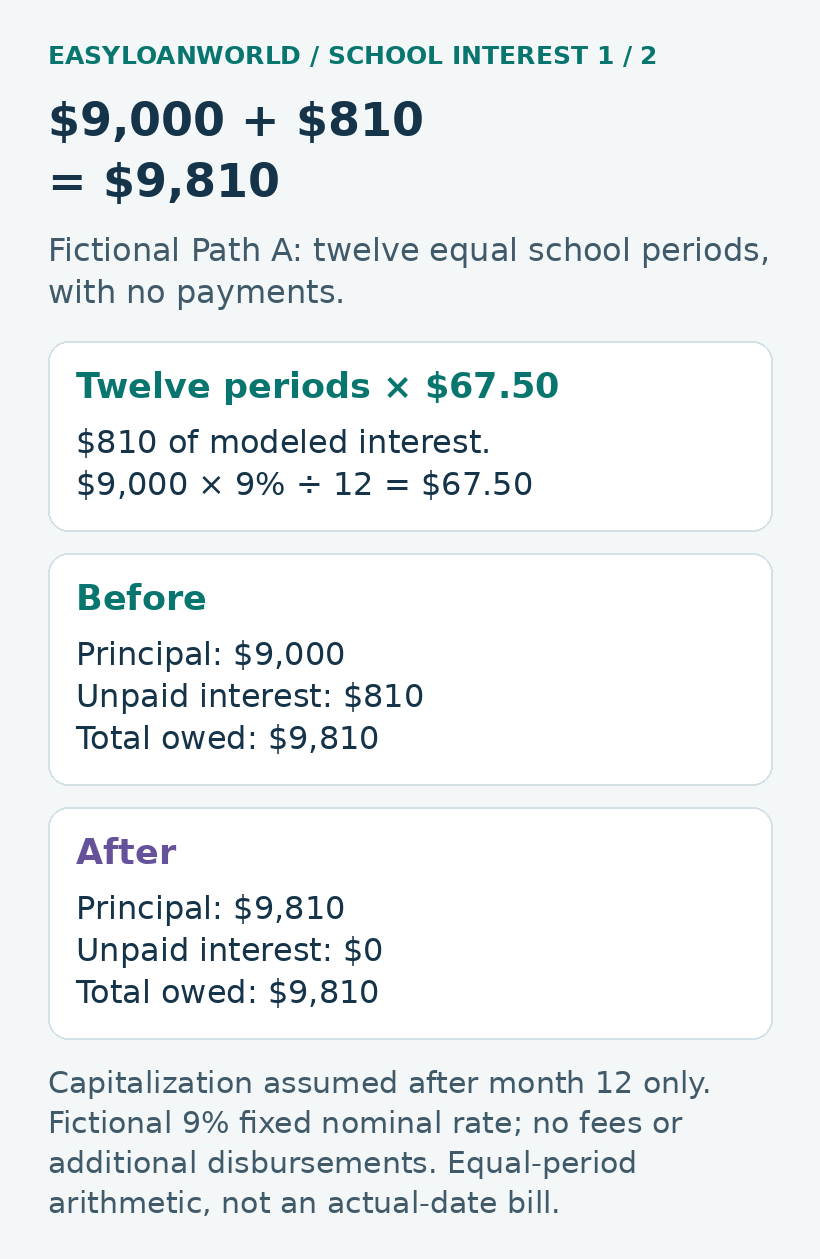
Path A: make no payments during the twelve school periods
- Cash paid during school: $0
- Before capitalization: $9,000 principal plus $810 unpaid interest, totaling $9,810 owed
- After capitalization: $9,810 principal, still totaling $9,810 owed
- Next monthly-model interest: approximately $73.58
- Later installment: approximately $203.64
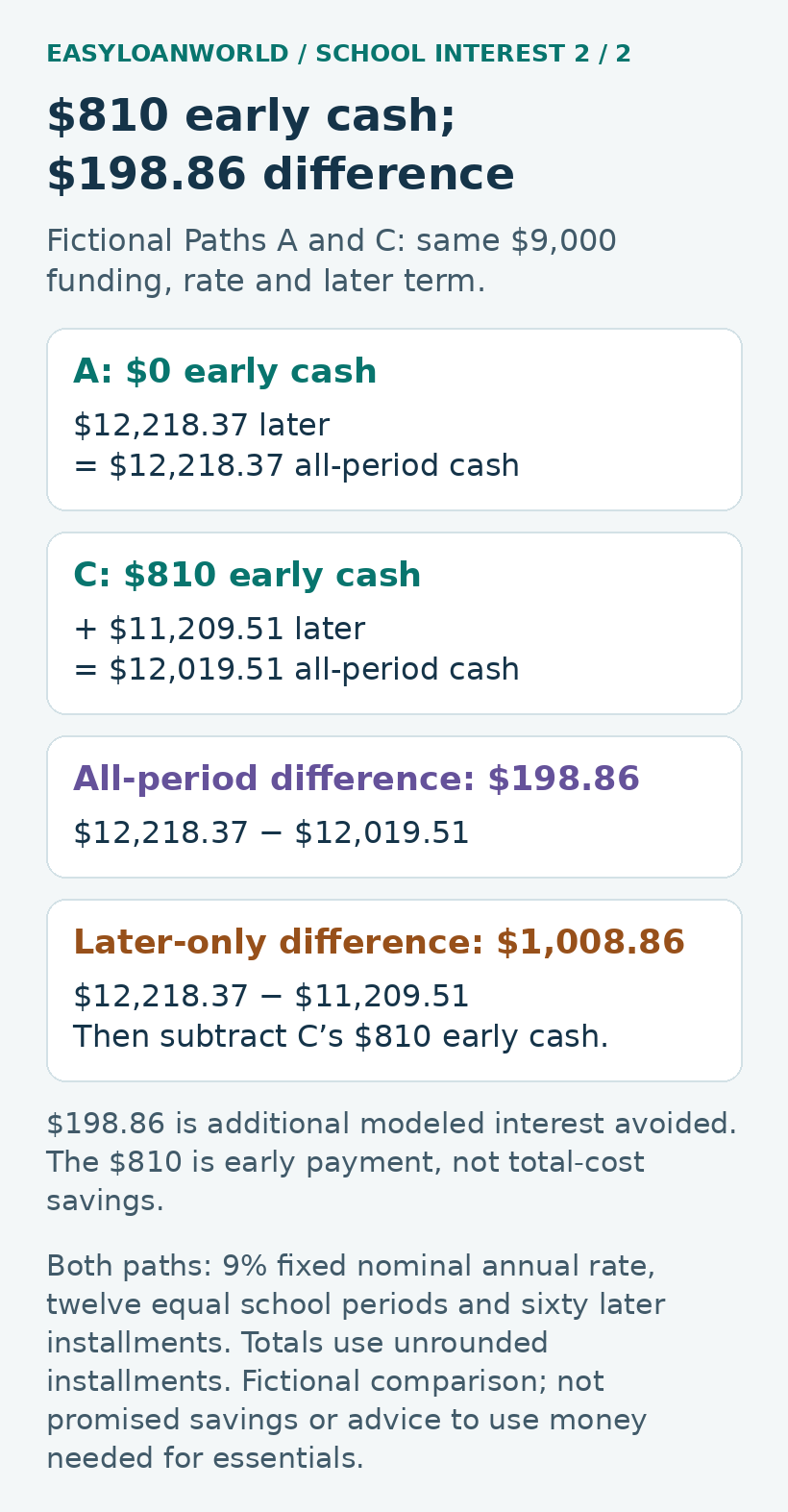
- Sixty later payments and all-period outflow: $12,218.37
- Total interest above the $9,000 provided: $3,218.37
Path B: pay a fixed $30 each school month
- Cash paid during school: $360
- Unpaid interest after month 12: $810 − $360 = $450
- Before capitalization: $9,000 principal plus $450 unpaid interest
- After capitalization: $9,450 principal, without a new disbursement
- Next monthly-model interest: approximately $70.88
- Later installment: approximately $196.17; sixty later payments total $11,769.99
- All-period outflow, including the earlier $360: $12,129.99
- Total interest: $3,129.99
Every required $30 payment is made, but it doesn’t cover the model’s $67.50 monthly interest. The unpaid amount therefore grows by $37.50 each month. “Fixed payment” describes the payment amount here; that label alone wouldn’t establish an actual loan’s interest-rate type.
Path C: pay the full $67.50 monthly-model interest
- Cash paid during school: $810
- Unpaid interest at the assumed capitalization date: $0
- Principal remains $9,000
- Next monthly-model interest: $67.50
- Later installment: approximately $186.83; sixty later payments total $11,209.51
- All-period outflow, including the earlier $810: $12,019.51
- Total interest: $3,019.51
Paying $810 early doesn’t create $810 of total-cost savings. It pays interest already accruing. Compared with Path A, Path C removes $810 from the later starting principal and avoids approximately $198.86 of additional modeled interest on that amount.
The all-period difference is $12,218.37 − $12,019.51 = $198.86. Comparing only the later-payment totals would leave out the $810 paid earlier. These are fictional cash flows, not promised savings or a recommendation to use money needed for essentials.
Why a fixed dollar payment may miss actual interest
The main example uses equal monthly periods. For a separate sensitivity check, assume actual/365 daily interest on the same $9,000 at 9%, with no intervening changes:
- 30 days: $9,000 × 9% × 30 ÷ 365 ≈ $66.58
- 31 days: $9,000 × 9% × 31 ÷ 365 ≈ $68.79
A $67.50 payment leaves approximately $1.29 unpaid after that hypothetical 31-day period, assuming interest-first allocation and no fees or prior interest. Don’t mix these daily figures into the equal-month totals above. Actual bills depend on the contract’s dates, balance, rate, accrual and rounding method.
A daily accrual method doesn’t, by itself, mean interest becomes principal every day. Verify capitalization separately.
In-school student loan payments: test each later repayment schedule
Use this loan-payment calculator for the sixty-payment period after the assumed capitalization event. Enter 9% contractual annual interest and 60 months in every run. The principal input is the post-capitalization balance for the chosen path, not automatically the original $9,000 disbursement.
For Path A, enter $9,810. Expected payment is $203.64 and later total principal plus interest is $12,218.37. The tool reports $2,408.37 of interest during those sixty later periods. Add the $810 of school-period interest once to explain the article’s $3,218.37 all-period interest above the original disbursement.
For Path B, enter $9,450. Expected payment is $196.17 and later payments total $11,769.99. Include the $360 paid during school when comparing all-period cash: the resulting total is $12,129.99. Omitting that earlier cash would make the fixed-payment branch look artificially cheaper.
Path B’s all-period interest also reconciles as $360 paid during school, $450 capitalized and $2,319.99 accrued during later repayment. Their sum is $3,129.99. The capitalized $450 was already owed; it isn’t another disbursement. Relative to Path A, the modeled complete-cost difference is $88.38, rather than the $360 paid earlier. Compare like phases and include earlier cash before labeling any difference a saving.
For Path C, enter $9,000. Expected payment is $186.83 and later total payments are $11,209.51. Add the separately paid $810 school-period interest to reach $12,019.51 all-period outflow. The tool doesn’t know about money paid before its starting balance.
In-school student loan payments: check the daily sensitivity separately
The simple-interest calculator below can reproduce the separate daily-accrual sensitivity. Enter $9,000, 9% and Actual days / 365. Thirty days should produce $66.58 of interest; thirty-one should produce $68.79.
The $67.50 payment in the 31-day sensitivity is less than the displayed interest by $1.29. This doesn’t revise the equal-month school-period totals above. It uses a different time convention for a separately labeled question.
Don’t enter $9,810 in this daily check merely because it was the later principal in Path A. The sensitivity starts with $9,000 and no intervening changes. Carrying a balance from another phase into it would combine incompatible assumptions.
Save each run’s inputs and period alongside its output. The later repayment tool uses equal monthly amortization; the sensitivity tool uses elapsed days at constant principal. Neither determines your actual capitalization trigger or confirms an available payment option. Use the contract and dated servicer explanation to connect a real schedule’s phases.
Make one option-and-date card
Keep a separate card for each offered option, with a document reference beside each answer:
- Product, document version and selected option
- Required school-period cash, any separation/grace-period payments, and the first later payment date
- Principal, unpaid interest and total owed, shown separately; capitalization trigger and expected amount
- Option-specific rate and conditions; later payment estimate and total including early payments
- Whether an option change is allowed, what changes if enrollment changes, and the written response reference
Date each answer and preserve the supporting document. Leave an unknown entry open instead of carrying an assumption from another product into this card.
If you want a different option, ask about permission, timing and revised figures before treating a change as approved. An informational question doesn’t authorize a payment pause. Keep using confirmed instructions while resolving what would change.
Check cash flow during school and when the later payment begins. The lower modeled cost is useful only alongside a plan you can sustain. Keep your statements privately; if figures don’t reconcile, ask which dates, balances and payment entries were used. This card records instructions and questions, not a replacement bill.
When comparing lenders, use the private student loan offer worksheet to include school-period payments in each complete schedule.
Featured photo: Blank stationery for tracking education costs. Photo: Cht Gsml / Unsplash. Used under the Unsplash license.

Parent Pays Student Loan Interest: Who Deducts?
Separate payment and obligation.

Returned Loan Debit: Two Fees?
Trace the payment and fees.

Rehabilitation Payment Too High?
Check an alternative request.