Qualified Business Income: Two Calculations
Separate profit from the deduction.
Estimated reading time: 1 minute
A business’s net profit is not automatically its qualified business income deduction.
In a fictional 2025 case, a single U.S. resident operates one regular domestic retail sole proprietorship. Schedule C net profit is $50,000. The separately verified deductions for half of self-employment tax and self-employed health insurance total $5,000, entirely attributable to this business. There are no other business adjustments, excluded tips, carryovers, suspended losses, cooperative, REIT or publicly traded partnership items.
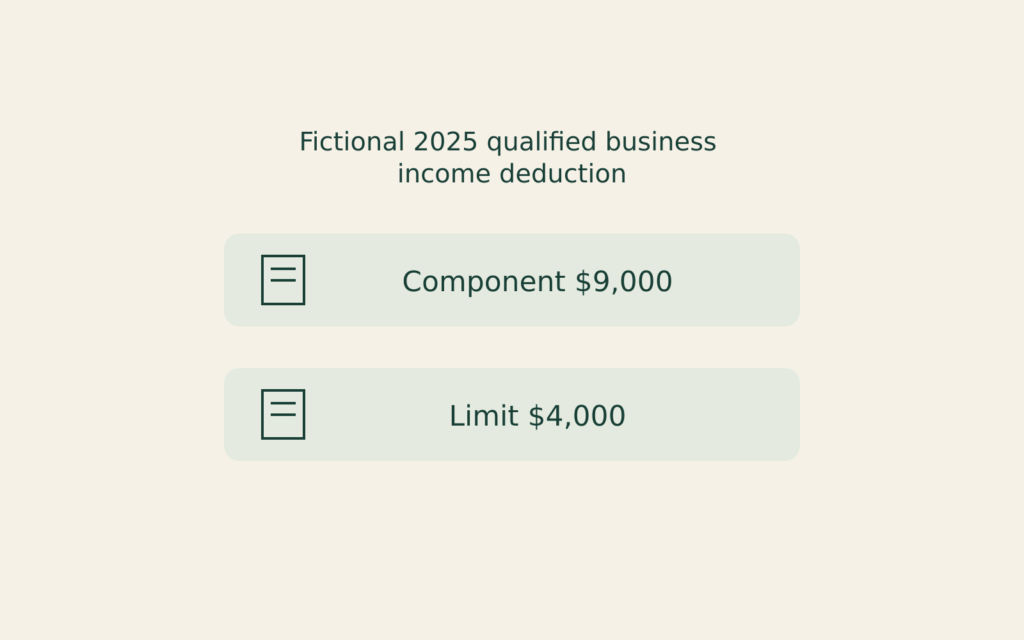
Under Form 8995’s instructions, those adjustments reduce qualified business income: $50,000−$5,000=$45,000. Its 20% component is $9,000—not $10,000 from unadjusted profit.
Separately verified taxable income before this deduction is $30,000, including $10,000 qualified dividends and no capital gains or losses. The income limitation is 20%×($30,000−$10,000)=$4,000. Form 8995 selects the smaller of $9,000 and $4,000: a $4,000 deduction.
Match the business-profit, attributable-adjustment and taxable-income records. The deduction is not a $4,000 tax credit, cash payment or self-employment-tax reduction; final income tax remains separate.


Roth Conversion and Account Clocks
Separate five-year tests.

ABLE Distributions Across Month-End
Separate retained purposes.