Qualified Dividends: Separate Rate Portions
Allocate dividends above ordinary income.
Estimated reading time: 1 minute
A qualified-dividend label does not assign one flat rate to every dividend dollar.
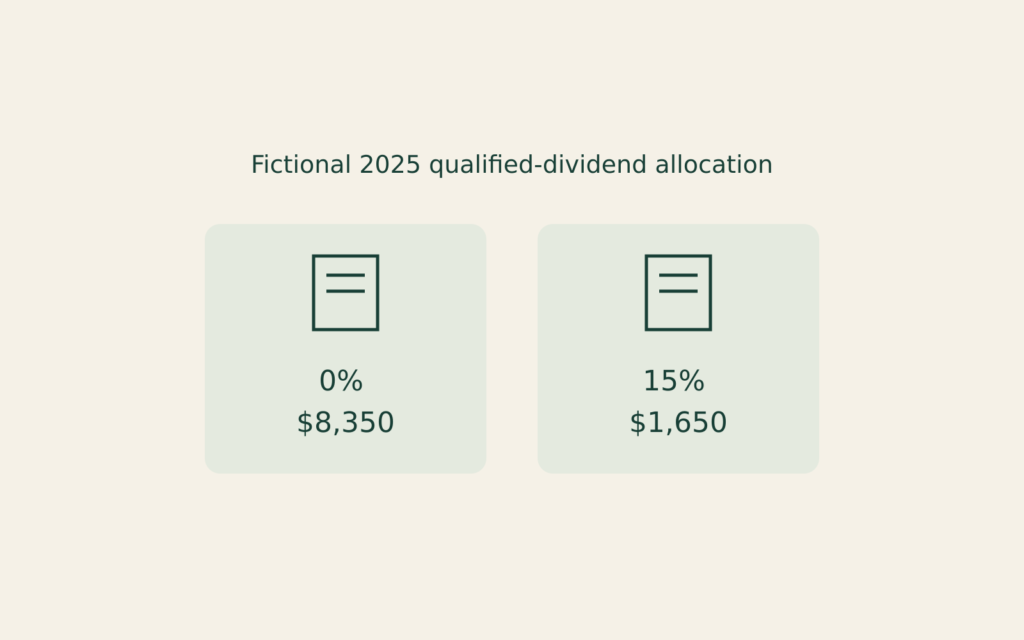
In a fictional 2025 case, a 40-year-old single U.S. citizen has $50,000 taxable income after all deductions: $10,000 of verified qualified dividends and $40,000 other ordinary taxable income. There are no capital gains or losses, investment-interest elections, foreign-income adjustments, farming/fishing income or special tax-computation methods.
The 2025 qualified-dividend worksheet places the ordinary income below the dividends. The single-filer 0% ceiling is $48,350, leaving $48,350−$40,000=$8,350 of dividends in that band. The remaining $1,650 uses 15%, producing $247.50—not $1,500 on all dividends.
The Tax Table gives $4,565 on $40,000. Adding $247.50 produces $4,812.50. The worksheet compares that with $5,920, the table tax on all $50,000 as ordinary income, and selects the smaller $4,812.50 before return rounding.
This completes that worksheet, not the entire return or payment calculation. Credits, additional taxes and payments are separate; the example is not an investment recommendation.


Roth Conversion and Account Clocks
Separate five-year tests.

ABLE Distributions Across Month-End
Separate retained purposes.