Replacement Horizons
A fictional equipment comparison shows why a lower purchase price per service year need not produce the smaller acquisition bill at every endpoint.
Estimated reading time: 5 minutes
A fictional equipment comparison shows why a lower purchase price per service year need not produce the smaller acquisition bill at every endpoint.
Specify the service, not just the purchase price
Machine A costs $900 and provides exactly three years of service. Machine B costs $1,400 and provides exactly five. Either supplies the same required service continuously from time zero. Each replacement is immediately available with the same price and lifetime as its predecessor. All lifetimes and prices are stipulated, not forecasts.
Count only undiscounted acquisition cash through a chosen horizon. Assume no maintenance, taxes, financing, inflation, disposal payments or sale proceeds. Unused remaining life receives no credit. Equal service through the endpoint does not mean equal remaining assets there; this is neither an all-in economic-cost comparison nor an equal-terminal-wealth calculation.
Do not buy a replacement after service ends
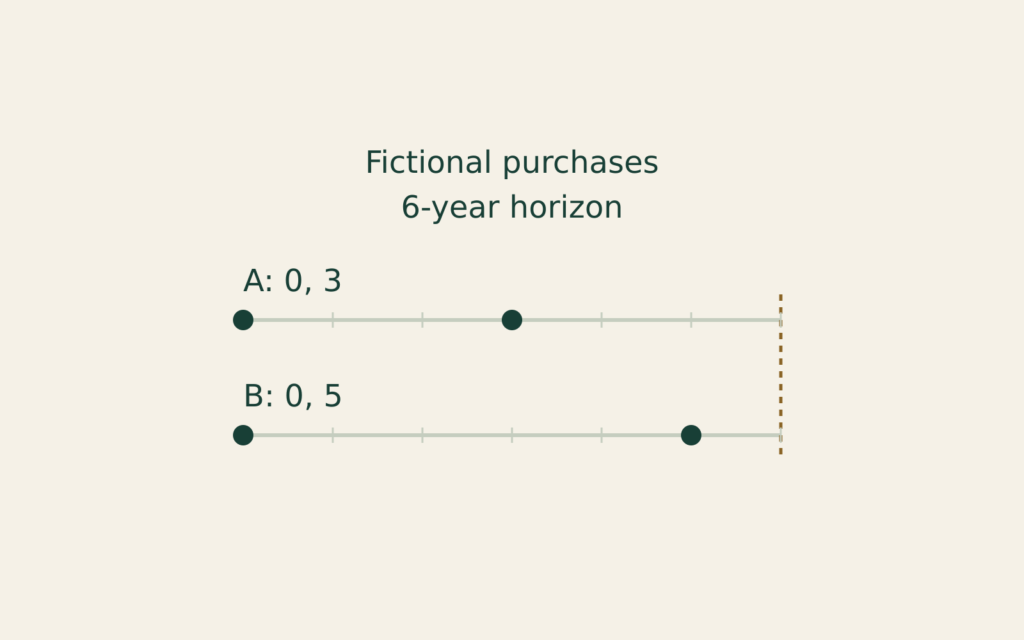
Purchases occur strictly before the horizon. At a six-year endpoint, A is purchased at years zero and three. The second machine serves through year six, so buying another at six would fund service outside the question. B is purchased at zero and five; its replacement supplies the final required year.
At a seven-year endpoint, A does require its year-six replacement. The change from six to seven years therefore adds a complete $900 purchase, not one-third of a machine. B still needs only its purchases at zero and five. These indivisible purchases create steps in the cumulative bill.
For a positive integer horizon H, the purchase counts are ceil(H/3) for A and ceil(H/5) for B. Here ceil means round upward to the next integer, leaving an integer unchanged. Thus A’s six-year count is two, while its seven-year count is three.
To justify the count, n purchased machines supply n full lifetimes. The smallest sufficient whole number n therefore satisfies nL ≥ H, where L is the lifetime. Its last purchase occurs at (n − 1)L, strictly before H.
Check several horizons before claiming a pattern
| Years | A cash | B cash |
|---|---|---|
| 5 | $1,800 | $1,400 |
| 6 | $1,800 | $2,800 |
| 10 | $3,600 | $2,800 |
| 11 | $3,600 | $4,200 |
| 15 | $4,500 | $4,200 |
B requires less acquisition cash at five years, A at six, B at ten, and A at eleven. Neither the first purchase price nor the first observed reversal establishes which total is smaller at every later horizon. The bills change only when another purchase becomes necessary.
Dividing price by complete lifetime gives $300 per service year for A and $280 for B. Those quotients describe complete cycles. They do not prorate an actual purchase into smaller payments or erase the unused years of the last machine. At fifteen years both complete whole cycles: five A purchases cost $4,500; three B purchases cost $4,200.
Use the common cycle to prove what happens later
Define D(H) as A’s acquisition cash minus B’s. A negative value means A requires less; a positive value means B requires less. Its exact expression is:
D(H) = 900 × ceil(H/3) − 1,400 × ceil(H/5).
Adding fifteen years increases A’s count by five and B’s by three, regardless of the starting integer horizon. Therefore:
D(H + 15) = D(H) + 5 × 900 − 3 × 1,400 = D(H) + 300.
The timing pattern repeats, but the cash difference does not simply repeat: it shifts $300 toward B each cycle. This identity lets a finite calculation answer every positive integer horizon, rather than relying on a long but incomplete list of examples.
Every positive integer H has exactly one representation H = r + 15k, with r from one through fifteen and k a nonnegative integer. The first-cycle differences, grouped where equal, are:
- Years 1–3: −$500; years 4–5: $400.
- Year 6: −$1,000; years 7–9: −$100.
- Year 10: $800; years 11–12: −$600.
- Years 13–15: $300.
For each group, add $300k. The −$1,000 starting difference at year six stays negative for k = 0, 1, 2 and 3, corresponding to years 6, 21, 36 and 51. At year 51 the totals are $15,300 for A and $15,400 for B—still a $100 advantage to A.
The other negative starting groups stop sooner. The −$500 group is negative only for k zero or one; the −$100 group only for zero. The −$600 group is negative for zero or one and ties at k two, producing ties at years 41 and 42. Initially positive groups stay positive.
Consequently, year 51 is the last positive integer horizon at which A has the smaller acquisition total. At every integer horizon from 52 onward, B has the smaller total. That conclusion follows from all fifteen possible starting positions, not from assuming the ranking at year fifteen lasts forever.
Keep the result inside its stated cost boundary
The Department of Energy’s commercial energy-code methodology describes a broader life-cycle assessment: future costs and savings are discounted, and maintenance, interim replacements and end-period residual value are considered. Those features are deliberately absent here. The fictional totals cannot establish the better real investment, its financing affordability or equal value left at the endpoint. They establish only how exact replacement counts change the stipulated acquisition-cash comparison.
Roth Conversion and Account Clocks
Separate five-year tests.
ABLE Distributions Across Month-End
Separate retained purposes.