SBA 7(a), 504 or Microloan: Sort the Uses Before Applying
Break a mixed funding request into specific expenses, record unanswered questions and prepare a focused program-use conversation.
Estimated reading time: 8 minutes
SBA loan uses matter before the size of the request. Separate equipment, inventory and existing-debt purposes so the program conversation can address each cost and its supporting evidence.
Before asking which SBA program fits a business funding request, separate what the money would actually buy or repay. A single total can conceal different purposes. Build a purpose-by-purpose record so your first conversation addresses the unresolved uses, not just the size of the loan.
SBA loan uses: give each expense its own line
For each proposed cost, record the amount, recipient, description, date needed and supporting quote or statement. Mark whether it’s a new purchase or repayment of existing debt. Where a quote bundles different items, ask for enough detail to distinguish them without changing the actual transaction.
Check for overlap before adding the lines. If a debt balance already financed an invoice in the list, counting both as fresh spending could overstate the request. Keep taxes, delivery or installation visible if they are part of the actual project; ask how they are treated rather than silently labeling everything equipment.
Use three working labels: potentially compatible, excluded for that program, and insufficient information. These are discussion labels, not loan decisions.
SBA loan uses: read the program and application channel
7(a)
SBA’s 7(a) overview lists working capital, machinery, qualifying real-estate and business-debt uses. Apply through a lender. Broad use categories don’t establish that your business or transaction qualifies.
504
SBA’s 504 overview focuses on qualifying major fixed assets, through Certified Development Companies (CDCs). Working capital and inventory are excluded. Some debt consolidation or refinancing can qualify under specified conditions. Equipment must have at least 10 years of remaining useful life; ask the CDC to assess the actual project.
Microloan
SBA’s Microloan overview lists working capital, inventory and equipment among permitted purposes, but excludes paying existing debt or buying real estate. Applications go through an SBA-approved intermediary, which makes credit decisions and sets terms. The program describes loans up to $50,000; that isn’t an offer to fund your request.
SBA loan uses: sort a fictional $51,000 request
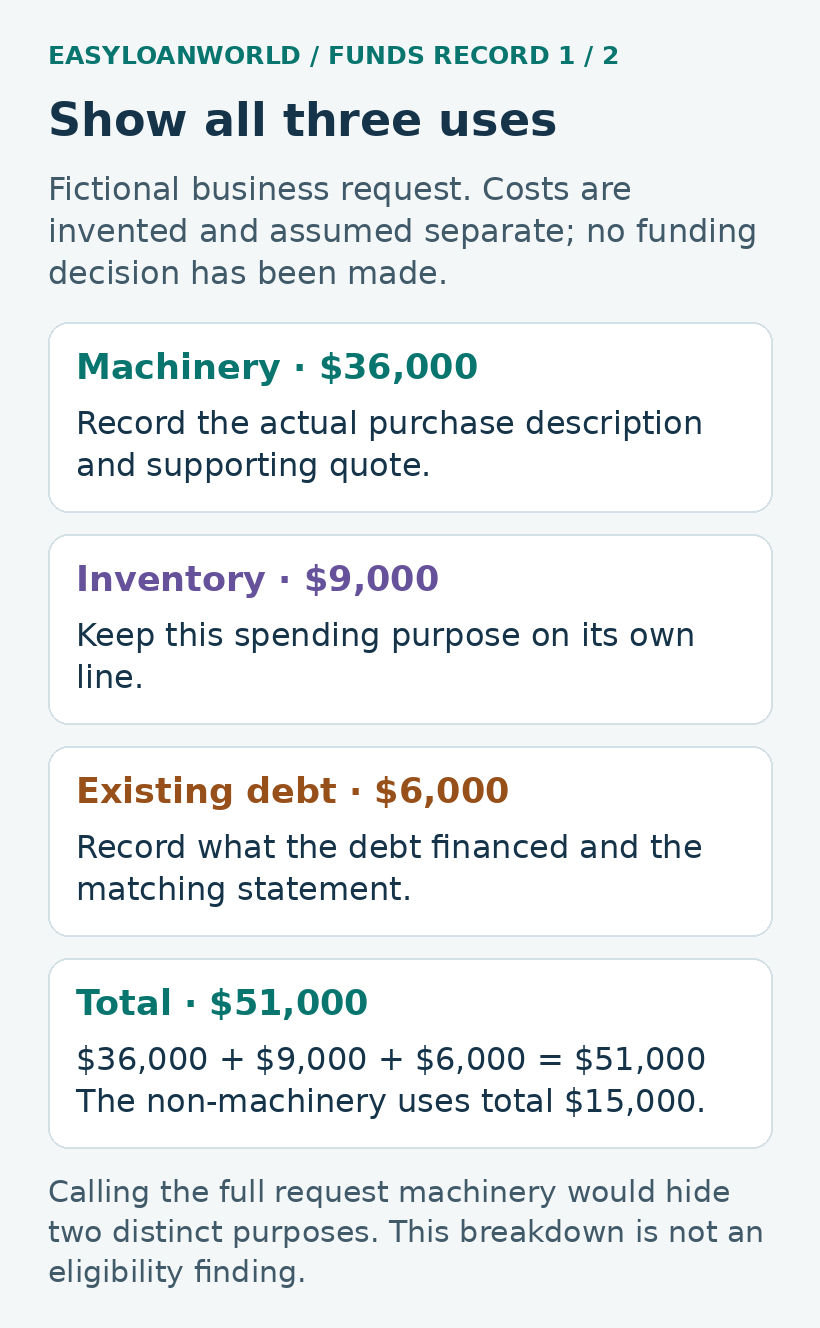
Suppose a business lists $36,000 for machinery, $9,000 for inventory and $6,000 to repay existing business debt. All figures are invented, and the three costs are assumed separate. The owner hasn’t yet obtained a program-specific determination.
The arithmetic is $36,000 + $9,000 + $6,000 = $51,000. Calling the whole request a machinery purchase would lose information about $15,000 of the intended uses.
- 7(a): Ask the lender about this mixed-purpose request; qualification remains unresolved.
- 504: The $9,000 inventory use doesn’t fit. The machinery needs a remaining-life and project review. Whether the $6,000 debt qualifies is unknown, not automatically excluded.
- Microloan: The $6,000 existing-debt payoff doesn’t fit. The machinery and inventory are potentially compatible uses, subject to the intermediary’s review.
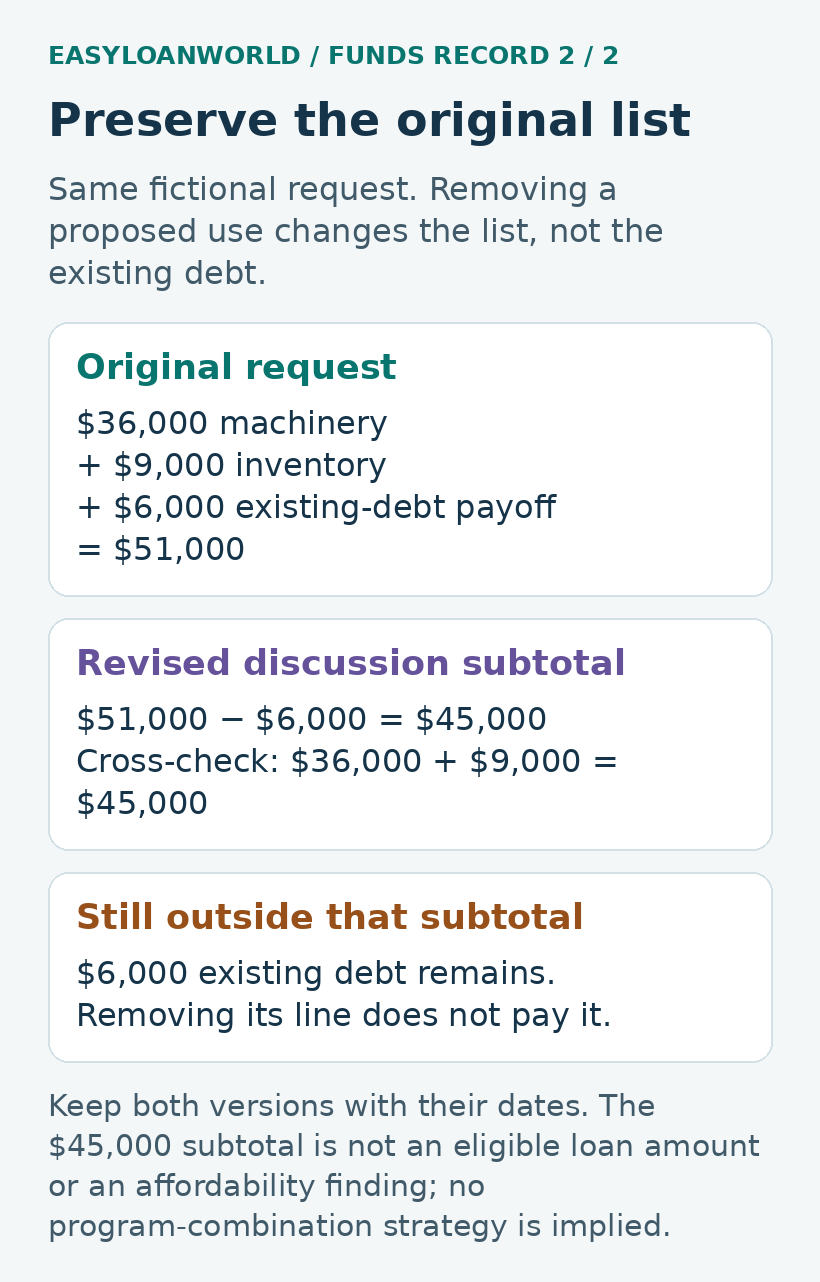
Removing the proposed debt payoff from the discussion gives $51,000 − $6,000 = $45,000, also equal to $36,000 + $9,000. This subtotal is neither an eligible loan amount nor an affordability finding. The $6,000 debt still exists; removing a line from a proposed use-of-funds list doesn’t pay it.
The example identifies questions to resolve. It doesn’t recommend another loan for the excluded amount, combining programs, or splitting an application to bypass a restriction. Keep the original list alongside any revised version so a change in scope stays visible.
SBA loan uses: reconcile a revised quote before changing the request
Return to the fictional $36,000 machinery, $9,000 inventory and $6,000 existing-debt list. Suppose a new quote shows $1,800 delivery and $2,200 installation, neither included in the original machinery amount. The revised machinery-related package totals $40,000.
The complete revised list is therefore $40,000 plus $9,000 plus $6,000, or $55,000. The $4,000 increase has an identifiable source. Keep the original $51,000 list with a version note instead of replacing it without explanation.
These added descriptions don’t decide program treatment. Ask the lender, CDC or intermediary how the actual delivery and installation costs are assessed. A cost can be necessary to the project while still requiring a program-specific review.
Now suppose the owner has $5,000 of unrestricted cash expressly committed to these listed costs, with all other operating reserves kept separate. The unfunded amount is $50,000: $55,000 of listed uses minus $5,000 of committed cash. That arithmetic is a financing need, not an approved SBA loan amount.
If the owner removes the $6,000 debt repayment from this revised project, listed uses become $49,000. With the same $5,000 committed cash, the unfunded portion becomes $44,000. The existing debt remains outstanding and needs its own truthful cash and obligation record.
Don’t describe this smaller request as a way to avoid a program restriction while using proceeds for the removed debt anyway. The revised use list must match the actual intended spending. Changing a worksheet label can’t change the underlying transaction.
SBA loan uses: give the funding calendar the same version as the project
Suppose the supplier requires a $10,000 deposit before delivery and the rest of the machinery package later. The complete package remains $40,000; the deposit is part of that price, not another $10,000 cost to add on top.
If the only available project cash at that first date is the stipulated $5,000, there’s a $5,000 timing gap before the deposit. The $44,000 unfunded full-project figure doesn’t establish that money will be available on the deposit date.
Ask the proposed financing provider about the actual disbursement conditions and timing before making commitments. This example supplies no approval, reimbursement arrangement or bridge funding. A contemplated loan can’t be counted as received cash.
Keep the quote version, deposit terms, delivery date and funding assumptions together. If a delivery change alters the deposit date, revise the calendar even when the total price stays unchanged. If the price changes too, reconcile both changes separately.
SBA loan uses: distinguish an answer about purpose from an offer
Suppose an intermediary says machinery and inventory are purposes it can consider, then asks for financial records. That response advances the purpose discussion. It doesn’t establish that this applicant qualifies, that every listed cost is accepted or that $44,000 will be offered.
A later proposal needs its own principal, rate, fees, payment schedule, collateral and other terms. Don’t run a payment calculator using a guessed rate and present the result as an SBA quote. The use-of-funds worksheet can be complete while financing terms remain unresolved.
If a requested document is unavailable, identify the missing fact and ask what alternative support is acceptable. Don’t manufacture a useful-life estimate, invoice or ownership statement to fill a checklist.
The practical result is a consistent project: costs add correctly, payments are counted once, committed cash has one purpose and each uncertain use has a named question. That gives the relevant provider a clearer basis for review without implying an approval outcome.
Prepare the specific question before sending documents
Choose the relevant official program page above to identify its application channel. Start with a short factual description of the intended spending and the uncertain line. Ask what information the recipient needs to classify that use. Don’t send a large document collection before confirming the recipient and request.
For the fictional machinery line, the owner could ask which specifications and ownership or use details are needed for assessment. For the debt line, the owner should identify what the debt financed and ask which records are needed to evaluate that exact transaction. Neither question requires changing the expense’s description to sound more suitable.
Keep a compact contact packet:
- The current expense list, with a version date and a separate total for any proposed revision.
- Matching quotes and debt records relevant to the unresolved purpose.
- The intended timing, including which costs can change and which commitments already exist.
- The recipient’s requested ownership or use facts, recorded accurately.
- A short list of unanswered conditions, with space for the answer and its date.
This packet supports a use-of-funds conversation. It isn’t a complete application checklist and doesn’t establish approval, an interest rate, payment terms or funding speed.
Record what the answer changes
When you receive an answer, attach it to the specific expense line. Note whether it applies to the described transaction, depends on additional facts, or requires a revised project. A general statement about equipment isn’t necessarily an answer about your machine, intended use and financing structure.
If a purpose remains unresolved, keep it visible. If you revise the project, update the actual spending plan and total honestly. Compare complete written terms only when an actual financing proposal exists; a potentially compatible use is an earlier checkpoint.
General U.S. business-finance education, not individualized financial or legal advice. Sources checked October 19, 2026. All example costs are fictional; no eligibility or funding outcome is promised.
For a short-term operating gap, use the working-capital cash calendar to distinguish the funding amount from the business’s annual sales.
Featured photo: Hand tools organized in a woodworking space. Photo: Sparsh Paliwal / Unsplash. Used under the Unsplash license.


