Self-Employed Health Insurance Limits
Check coverage eligibility before enrollment.
Estimated reading time: 1 minute
Declining an employer health plan does not necessarily preserve a self-employed insurance deduction.
Fictional 2025 case: a U.S. sole proprietor pays $2,000 monthly, January–December, for their own medical insurance policy established under their single domestic nonfarm business. Premiums are unreimbursed, outside the Marketplace, and contain no long-term-care coverage. No retirement-plan funding or foreign-income exclusions apply.
They have no subsidized employer-plan eligibility in January–March. From April 1 through December 31, they are eligible for their spouse’s subsidized employer medical plan but never enroll.
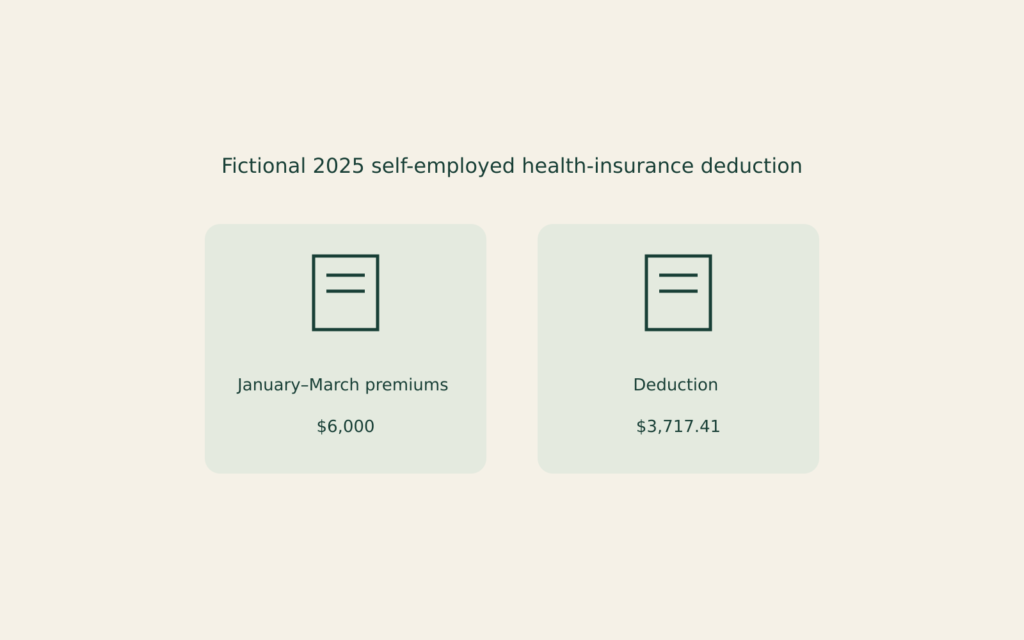
Form 7206’s instructions exclude eligible months even without participation. Of $24,000 paid, April–December’s $18,000 is excluded; January–March leaves $6,000.
Verified Schedule C profit is $4,000. The separately calculated half-self-employment-tax deduction is $282.59, entirely attributable here; there are no other businesses, optional methods or adjustments. Business capacity is $4,000−$282.59=$3,717.41.
The smaller of $6,000 and $3,717.41 is the self-employed health-insurance deduction. The remaining $20,282.59 is not automatically an itemized deduction or carryforward. Figures precede return rounding; this is not a tax-saving calculation.
Mid-Quarter Depreciation Across Purchases
Check the entire acquisition pool.
Alternative Minimum Tax Reconciliation
Separate tentative and additional tax.
Wages and Self-Employment Tax Bases
Allocate two different tax bases.