Self-Employment Tax and Its Half-Tax Deduction
Keep the two calculations separate.
Estimated reading time: 1 minute
A deduction for half of self-employment tax does not halve that tax.
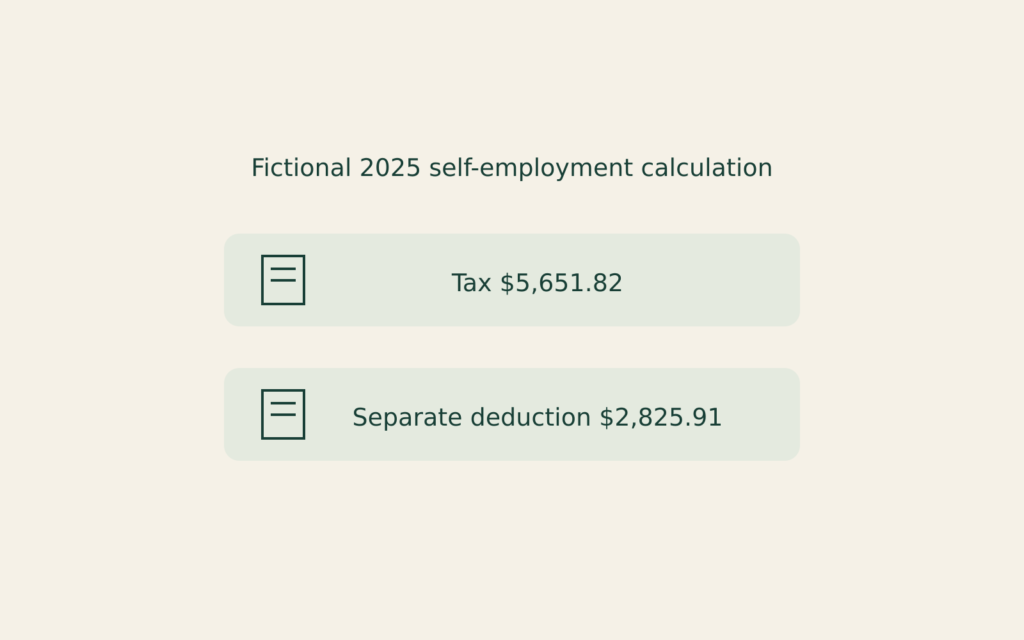
Fictional 2025 calculation
Assume a single U.S. resident sole proprietor has verified Schedule C net profit of $40,000 from one ordinary nonfarm business. There are no wages, other self-employment earnings, exemptions, special adjustments or optional methods.
Using the IRS regular method, net earnings are $40,000 × 92.35% = $36,940. Below the applicable Social Security ceiling, the combined 15.3% rate produces $5,651.82 of self-employment tax. Half is $2,825.91. These calculations retain cents, before return rounding.
Separate calculations
The half-tax deduction adjusts income for income-tax purposes. It does not reduce the $36,940 earnings base or the $5,651.82 self-employment tax again. Nor is $2,825.91 a tax credit or a promised refund.
Match the profit calculation, self-employment-tax calculation and separate income adjustment. This example determines neither total federal tax nor the remaining payment after credits and prior payments.


Roth Conversion and Account Clocks
Separate five-year tests.

ABLE Distributions Across Month-End
Separate retained purposes.