SSDI and Workers’ Compensation
Reconcile two disability benefit records.
Estimated reading time: 1 minute
Workers’ compensation can reduce Social Security disability benefits without reducing the workers’ compensation payment.
Compare the applicable limit
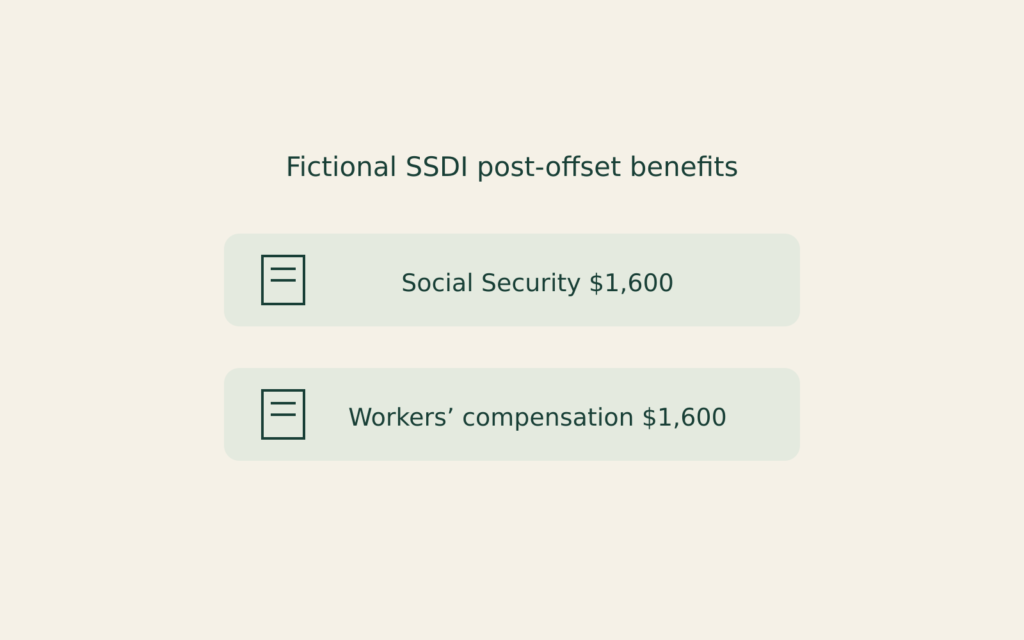
In a fictional first concurrent month in 2025, SSA confirms that offset applies to a 50-year-old disabled worker. Verified monthly inputs are $4,000 average current earnings, $2,000 Social Security disability benefits and $1,600 periodic state workers’ compensation. There are no auxiliary beneficiaries, other public disability payments, reverse offset, lump sums, excluded expenses or other adjustments.
SSA’s computation sequence compares 80% of average current earnings with the total family benefit and uses the higher amount. Here, $3,200 exceeds $2,000.
Subtracting $1,600 workers’ compensation leaves $1,600 Social Security benefits: a $400 reduction from $2,000. The combined amount is $3,200, not $3,600. Workers’ compensation remains $1,600.
Match both award records and SSA’s established earnings figure. This example does not determine eligibility, average current earnings, tax treatment or bank-deposit timing.

Roth Conversion and Account Clocks
Separate five-year tests.
ABLE Distributions Across Month-End
Separate retained purposes.