Startup Loan Forecasts: Support Assumptions With Evidence
Separate actual startup results from assumptions, test a sales forecast against operating capacity and document the evidence behind a borrowing plan.

A startup forecast becomes more useful when each important number has an explanation, a supporting record and a visible uncertainty. Before relying on future sales to support a loan request, check both the demand assumption and whether the business could deliver the work it predicts.
This U.S. guide builds an assumption-evidence register and a fictional sales-capacity test. It does not calculate a borrowing limit or show that a startup qualifies for financing.
Connect the forecast to its evidence
The SBA’s business-planning guidance recommends explaining projections and matching them to the funding request, with greater detail in the first year. It also discusses researching startup expense estimates. Ask the particular lender which forecast horizon and format it needs.
Start with a dated version of the model. Record the last date covered by completed business activity and the first date of the forecast. A later revision should identify which inputs changed and why, rather than overwriting the assumptions that supported an earlier borrowing plan.
Label what you know and what you assume
Use these three working labels. They organize evidence; they are not accounting standards or official underwriting categories.
- Observed: a completed event supported by a dated record. Keep the sale date and actual collection date distinct.
- Documented future condition: an order, quote or other record concerning future activity. Identify any conditions, expiry, cancellation, fulfillment or collection uncertainty.
- Assumption: a chosen future input, such as inquiries, selling price or opening date. State the reason for choosing it and what would cause a revision.
A signed order is not a completed paid sale merely because it is documented. A supplier quotation also needs its conditions checked before you rely on the price. Ask an accountant about appropriate accounting treatment; this labeling exercise does not determine when revenue should be recognized.
Keep one evidence card per important input
PNC’s business-plan guide recommends using available history and relevant research to support assumptions, accounting for seasonality and startup ramp-up. That is planning guidance, not confirmation that a particular startup meets the bank’s lending requirements.
Create a compact card with six fields:
- Input and period: precisely what is estimated and the dates it covers.
- Value and units: customers, jobs, dollars per job, collection days or another defined unit.
- Evidence: record title and date, population covered and the part of the input it supports.
- Gap: what the record does not establish, including differences in channel, season, location or customer mix.
- Alternative test: a chosen lower-demand, lower-capacity or higher-cost scenario, without assigning an unsupported probability.
- Next evidence and owner: the observation needed, who will obtain it and when the model will be updated.
Keep the completed cards and supporting records private. A reference to “market research” is less useful than identifying the actual record and its limits. If there is no trading history, say so; do not relabel an estimate as actual revenue.
Worked example: demand exceeds the delivery plan
Every record and number in this example is fictional. Within the invented scenario, a completed pilot is kept separate from assumptions about the next month. Nothing here is measured industry demand or information about a real applicant.
The fictional pilot observation
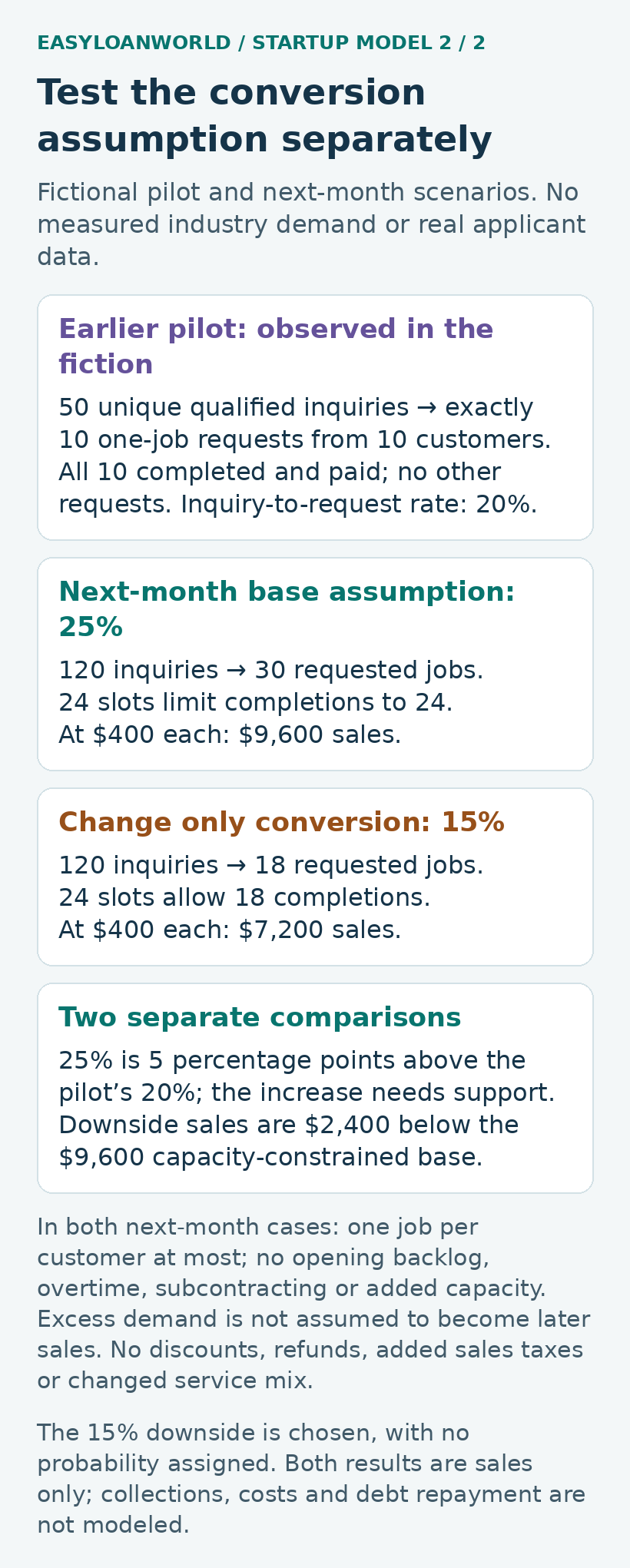
During one completed pilot period, 50 unique qualified inquiries produced exactly 10 one-job requests from 10 distinct customers. All 10 requested jobs were completed and paid, and no other requests arose from those 50 inquiries. The observed inquiry-to-request conversion is 10 ÷ 50 = 20%.
This small, earlier group does not establish a reliable rate for every future month. Define an inquiry consistently: repeated contacts from one person are not new unique inquiries. The pilot observation also does not establish next month’s number of inquiries.
The next-month draft
The model assumes:
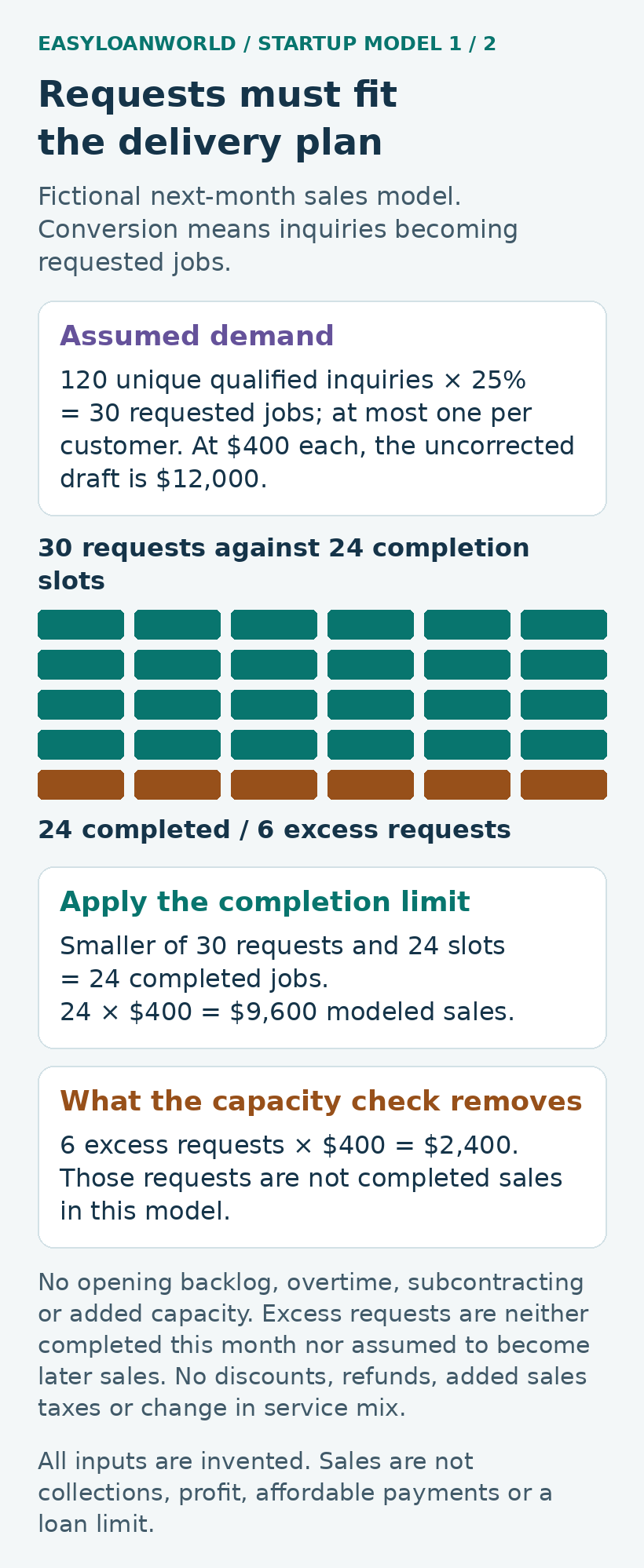
- 120 new unique qualified inquiries
- 25% conversion into requested jobs, with at most one job per customer
- $400 per completed job, without discounts, refunds, added sales taxes or a different service mix in this simplified calculation
- 24 completion slots under the proposed operating plan, without overtime, subcontracting or added capacity
There is no opening backlog. Excess requests are not completed or counted as sales in this modeled month, and the model does not assume they become later sales.
Raw demand is 120 × 25% = 30 requested jobs. Multiplying 30 by $400 gives $12,000 before the capacity check. That is an uncorrected demand calculation, not the month’s deliverable sales.
Apply the completion limit
The business can complete the smaller of 30 requested jobs and 24 available slots: 24 jobs. Modeled completed-job sales are therefore 24 × $400 = $9,600.
The six excess requests are not completed sales here. The $12,000 draft overstates modeled completed sales by $2,400 under its own capacity assumption.
Correcting the formula does not validate the inputs. The proposed 25% conversion is five percentage points above the fictional pilot’s 20%. What evidence supports that increase? Separately, what supports 120 inquiries, 24 usable slots and a $400 realized price?
Change only conversion for a downside test
Choose 15% conversion as an illustrative downside, keeping inquiries, capacity and price unchanged. Demand becomes 120 × 15% = 18 jobs. Capacity does not bind, so modeled completed sales are 18 × $400 = $7,200.
That is $2,400 below the capacity-constrained base. This difference compares the downside with $9,600; the earlier $2,400 compared the uncorrected draft with $9,600. They are different comparisons, not two amounts to add into a funding request.
Sales still do not answer the repayment question
The $9,600 and $7,200 are sales-model outputs. They are not cash on hand, profit, free cash flow, affordable debt payments or loan limits. The example has not modeled collections, operating costs, taxes, owner needs, existing debts, capital spending or proposed loan terms.
Completed work may be collected later. A borrowing plan needs a separately reconciled, dated cash forecast. Keep financing proceeds and owner investment separate from customer sales, and do not count an expected loan as available funding before its conditions are resolved.
Also separate startup spending already paid from genuinely future spending. Ask your accountant to reconcile the projected income statement, balance sheet and cash flows. Adding six delivery slots would require evidence about staffing or suppliers and their costs; it cannot be inserted as free capacity.
Take the unresolved assumptions to the next conversation
Record the forecast version, historical cutoff, forward period, funding use and requested timing. Highlight the two or three inputs driving the outcome, their evidence, the capacity-constrained base and the downside. State which cash and repayment analysis is still missing.
SCORE’s startup projection resources describe assumption testing and optional mentor review. A review can help identify questions; it is not an audit or a lender’s approval.
Before changing the borrowing request, identify the actual repair needed: stronger evidence, a feasible operating plan, revised timing or a different funding and repayment plan. A complete-looking spreadsheet does not resolve unanswered eligibility questions.
Sources checked October 19, 2026. This educational model is not individualized lending, accounting or tax advice.
Featured photo: Photo by Julio Lopez on Unsplash. Used under the Unsplash license. Illustrative equipment. Photo by Julio Lopez on Unsplash.

SBA Surety Bonds vs. Working-Capital Loans: Four Contractor Scenarios
Follow Riverton Build through four fictional alternatives at one pre-start review. Identify what remains unresolved and prepare a focused next conversation.

Export Payment Documents: A Two-Packet Review
A worked export-packet review follows an unresolved instruction proposal, an incomplete selected inventory and an unknown carrier arrangement, without inventing the missing evidence.
Profitable Business, Falling Cash: Reconcile the Difference
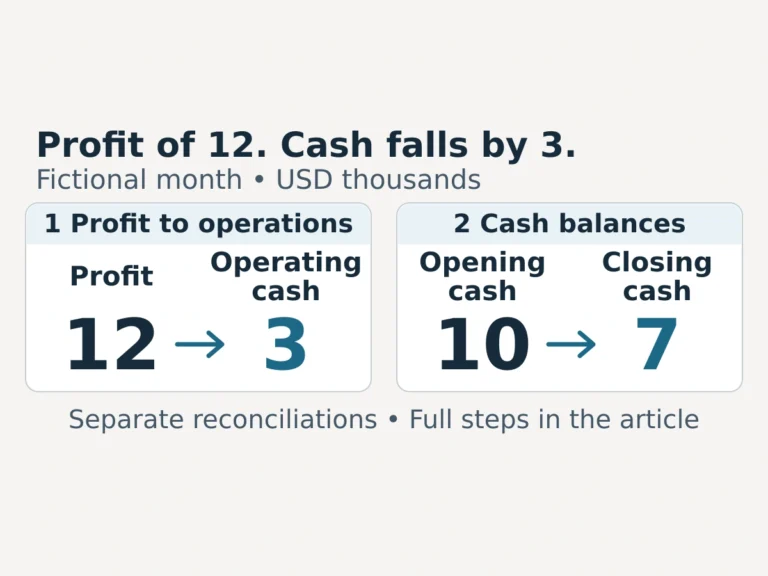
An invented one-month example reconciles net income, customer receipts, supplier payments, equipment, debt and an owner distribution to the closing cash balance.