Temporary Buydowns: The Payment Path
Follow a temporary mortgage buydown through its first three years and test whether your budget can afford the full payment after the subsidy ends.
Estimated reading time: 7 minutes
A temporary buydown changes the borrower’s payment path without removing the later full-payment question. Follow the fictional mortgage below through the subsidy period, then test the year-three amount without assuming a refinance.
Under Fannie Mae’s rules, a temporary buydown leaves the note unchanged. Qualification uses the note rate; you remain liable if subsidy funds fail. This fixed-note example isn’t an ARM reset or permanent discount points.
Start with the payment in year three. In the invented example below, someone who can spare $1,800 a month for principal and interest has room during the first two years, then faces a $96.20 monthly shortfall. A temporary head start doesn’t repair that ongoing mismatch.
Temporary buydown: build the $300,000 example
Assume a $300,000 mortgage at a fixed 6.5% annual nominal interest rate, repaid over 360 equal monthly periods. The first installment is one month later. There are no financed fees, extra payments or late payments. Taxes, insurance, mortgage insurance, association charges and other ownership costs sit outside this principal-and-interest calculation and can change.
For this invented 2-1 arrangement, calculate the borrower’s first-year contribution using $300,000, 4.5% and 360 months, and the second-year contribution using $300,000, 5.5% and 360 months. Starting in month 25, use the 6.5% calculation. Assume an eligible third party funds the entire subsidy and no separate charge is imposed on the buyer in this illustration; this does not establish that a real offer is free.
The monthly payment formula is P × r ÷ [1 − (1 + r)−n], where P is principal, r is the annual nominal rate divided by 12, and n is the number of months. It produces $1,896.20 at 6.5%, $1,520.06 at 4.5% and $1,703.37 at 5.5%.
The subsidy covers the difference. In this model that’s about $376.15 monthly for 12 months, then $192.84 monthly for 12 months. Adding the 24 unrounded differences gives $6,827.82 of initial funding. Months 25–36 use none.
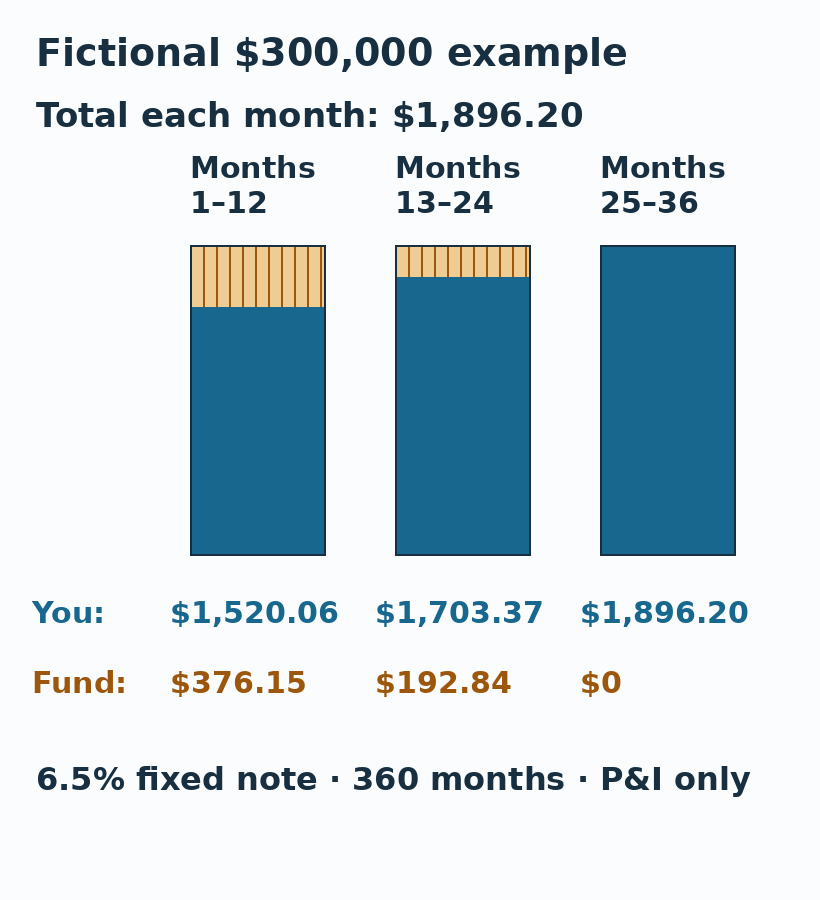
| Period | You contribute | Fund contributes | Combined |
|---|---|---|---|
| Year 1 | $1,520.06 | $376.15 | $1,896.20 |
| Year 2 | $1,703.37 | $192.84 | $1,896.20 |
| Year 3 | $1,896.20 | $0.00 | $1,896.20 |
Follow every payment through month 36
The table applies monthly interest of 6.5% ÷ 12 to the opening balance, then subtracts the full calculated installment. In month one, interest is $1,625.00 and principal repayment is $271.20. The next month’s interest uses the resulting balance. Values are independently rounded; totals retain precision, so multiplying the displayed subsidies overstates the modeled fund by six cents. This is not a cent-rounded servicing ledger.
| Month | Borrower contribution | Subsidy contribution | Full installment | Balance, either version |
|---|---|---|---|---|
| 1 | $1,520.06 | $376.15 | $1,896.20 | $299,728.80 |
| 2 | $1,520.06 | $376.15 | $1,896.20 | $299,456.12 |
| 3 | $1,520.06 | $376.15 | $1,896.20 | $299,181.97 |
| 4 | $1,520.06 | $376.15 | $1,896.20 | $298,906.34 |
| 5 | $1,520.06 | $376.15 | $1,896.20 | $298,629.21 |
| 6 | $1,520.06 | $376.15 | $1,896.20 | $298,350.58 |
| 7 | $1,520.06 | $376.15 | $1,896.20 | $298,070.44 |
| 8 | $1,520.06 | $376.15 | $1,896.20 | $297,788.79 |
| 9 | $1,520.06 | $376.15 | $1,896.20 | $297,505.60 |
| 10 | $1,520.06 | $376.15 | $1,896.20 | $297,220.89 |
| 11 | $1,520.06 | $376.15 | $1,896.20 | $296,934.63 |
| 12 | $1,520.06 | $376.15 | $1,896.20 | $296,646.82 |
| 13 | $1,703.37 | $192.84 | $1,896.20 | $296,357.46 |
| 14 | $1,703.37 | $192.84 | $1,896.20 | $296,066.52 |
| 15 | $1,703.37 | $192.84 | $1,896.20 | $295,774.01 |
| 16 | $1,703.37 | $192.84 | $1,896.20 | $295,479.92 |
| 17 | $1,703.37 | $192.84 | $1,896.20 | $295,184.23 |
| 18 | $1,703.37 | $192.84 | $1,896.20 | $294,886.94 |
| 19 | $1,703.37 | $192.84 | $1,896.20 | $294,588.04 |
| 20 | $1,703.37 | $192.84 | $1,896.20 | $294,287.52 |
| 21 | $1,703.37 | $192.84 | $1,896.20 | $293,985.37 |
| 22 | $1,703.37 | $192.84 | $1,896.20 | $293,681.59 |
| 23 | $1,703.37 | $192.84 | $1,896.20 | $293,376.16 |
| 24 | $1,703.37 | $192.84 | $1,896.20 | $293,069.08 |
| 25 | $1,896.20 | $0.00 | $1,896.20 | $292,760.33 |
| 26 | $1,896.20 | $0.00 | $1,896.20 | $292,449.91 |
| 27 | $1,896.20 | $0.00 | $1,896.20 | $292,137.81 |
| 28 | $1,896.20 | $0.00 | $1,896.20 | $291,824.02 |
| 29 | $1,896.20 | $0.00 | $1,896.20 | $291,508.53 |
| 30 | $1,896.20 | $0.00 | $1,896.20 | $291,191.33 |
| 31 | $1,896.20 | $0.00 | $1,896.20 | $290,872.41 |
| 32 | $1,896.20 | $0.00 | $1,896.20 | $290,551.77 |
| 33 | $1,896.20 | $0.00 | $1,896.20 | $290,229.39 |
| 34 | $1,896.20 | $0.00 | $1,896.20 | $289,905.26 |
| 35 | $1,896.20 | $0.00 | $1,896.20 | $289,579.37 |
| 36 | $1,896.20 | $0.00 | $1,896.20 | $289,251.73 |
Without subsidy, the borrower supplies $1,896.20 monthly; balances match.
Over 36 months, the borrower contributes $61,435.52 in the illustrated plan, while the fund supplies $6,827.82. Without it, the borrower supplies all $68,263.35. Interest charged over those months is $57,515.07 in either calculation. No extra principal reduction results.
Temporary buydown: verify the contribution formulas and the actual loan
Enter $300,000 principal, 6.5% annual interest and 360 months in the calculator. The expected $1,896.20 installment is the full principal-and-interest amount used to amortize this fictional mortgage throughout. The borrower and fund supply that amount together during the subsidy period.
To check the first-year contribution formula only, change the rate to 4.5%, retaining the original principal and 360 months. The payment output is $1,520.06. At 5.5%, it is $1,703.37, the second-year contribution formula. These lower-rate calculations determine contributions in the invented arrangement; they don’t change the mortgage note.
Don’t use the calculator’s 4.5% balance path as the actual mortgage balance, then carry it into the 5.5% version in year two. Each contribution formula uses the stipulated original inputs, while the actual loan continues at 6.5%. Treating the contribution rates as successive note rates would create a different amortization schedule and misstate principal.
Restore 6.5% before inspecting the actual-loan table. At month 24, principal should be $293,069.08. At month 36, it should be $289,251.73, with $57,515.07 cumulative interest. The fund changes who supplies part of the installment, not the principal reduction generated by that full installment.
Keep precision when calculating subsidy differences. Subtract the underlying payment formulas before totaling the twelve contributions for each year. The rounded displayed amounts can differ by a cent from the rounded difference, and multiplying them can produce the six-cent total difference already explained above. That’s why this illustration isn’t a cent-rounded servicing ledger.
For an actual temporary buydown, compare the note, written agreement and lender’s payment schedule. Confirm the funding source, what happens if funds are unavailable and how unused funds are handled. Keep the year-three household test separate from a hoped-for refinance. The calculator can reproduce the stated formulas; it can’t verify that a real subsidy is funded or that the full later obligation fits your budget.
Test year three without a refinance
For the hypothetical $1,800 principal-and-interest capacity, year one leaves $279.94, year two leaves $96.63 and year three is short $96.20 each month. The contribution increases about $183.31 at month 13 and $192.84 at month 25. Compared with year one, the month-25 burden is about $376.15 higher.
Replace $1,800 with the amount your household can sustain after its other commitments and ownership costs. A planned raise or refinance isn’t cash available today. If the final payment doesn’t fit without either event, consider a smaller purchase or a different timing plan rather than treating two manageable years as proof of long-term affordability.
Ask what happens to unused temporary buydown funds
At payoff, follow the agreement and Fannie Mae’s rules; refunds aren’t guaranteed.
In this model, immediately after payment 12 the fund still contains $2,314.04. If you’re comparing a proposed payoff at that point, identify how that amount will be handled before treating it as cash for your next transaction. This illustration doesn’t calculate a real payoff quote or establish who receives any remainder.
For a separate comparison, see the permanent mortgage-points calculation. Here, the decision is whether the later payment works and whether the offered early contribution is valuable after reviewing the complete purchase terms. U.S. educational information, checked October 19, 2026; no individualized lending advice.
Keep the temporary subsidy separate from permanent mortgage discount points, and compare the full payment with your household homebuying budget.

One Mortgage Form, Two Borrowers
Match each person’s share.