TIPS at Maturity: Original Par Is Not Your Purchase Outlay
Compare a fictional TIPS purchase outlay with maturity principal and coupon receipts, without mistaking one dollar measure for another.
Estimated reading time: 5 minutes
A TIPS holding can repay more than its original face amount yet return less cash than a later buyer paid. Before calling the investment “principal protected,” identify which principal the statement means. Your purchase outlay, the security’s original par amount and its inflation-adjusted principal are separate numbers.
This guide compares those numbers for an individual U.S. Treasury Inflation-Protected Security held to maturity. It’s a record-reading exercise, not a recommendation to buy, sell or select a portfolio allocation. It doesn’t model a TIPS fund.
Find the original par amount first
Treasury’s TIPS guidance explains the maturity payment: the greater of inflation-adjusted principal and original principal. The comparison isn’t between adjusted principal and whatever a later investor paid. TIPS also pay interest every six months; the fixed coupon rate is applied to changing adjusted principal.
For your worksheet, label the original par amount “P,” the actual total purchase cash outflow “C,” and the maturity principal receipt “M.” Don’t replace P with C because both appear in dollar columns. Preserve the trade confirmation and the security identifier alongside those labels.
Build one fictional holding, then test two paths
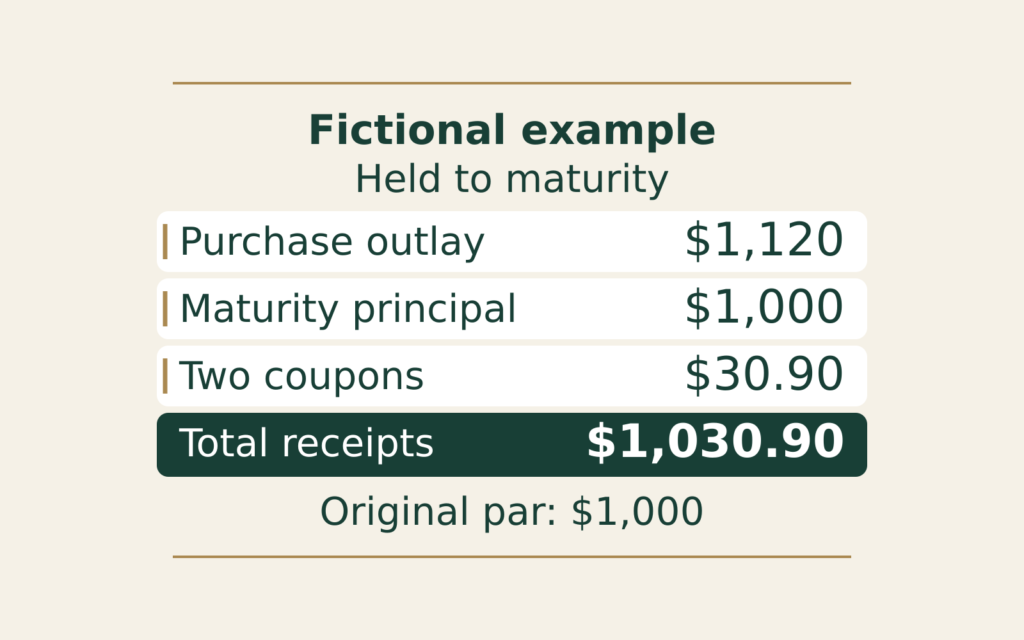
Assume an investor acquires an existing TIPS holding for an all-in cash outlay of $1,120. Its original par amount is $1,000 and its annual coupon rate is 3%. Exactly two future semiannual payments remain, with the second on the maturity date. Assume the investor is entitled to both payments.
The $1,120 is a stipulated complete acquisition outflow, not a quoted price per $100. Any accrued interest and acquisition fees are already included; no further purchase charges should be added. We exclude taxes, reinvestment earnings and all other cash movements. The index ratios below are invented, not forecasts or observations about an actual security.
Treasury’s pricing explanation calculates adjusted principal as original principal multiplied by the applicable index ratio. A semiannual coupon is that result multiplied by half the annual coupon rate. Use the ratio for the relevant payment date, not an annual inflation headline.
In both paths, the first payment’s ratio is 1.08. Thus $1,000 × 1.08 = $1,080, and $1,080 × 0.03 ÷ 2 = $16.20. The paths differ only at the final payment date.
| Final record | Path A | Path B |
|---|---|---|
| Index ratio | 1.05 | 0.98 |
| Adjusted principal | $1,050 | $980 |
| Principal paid | $1,050 | $1,000 |
| Final coupon | $15.75 | $14.70 |
| Both coupons | $31.95 | $30.90 |
| All receipts | $1,081.95 | $1,030.90 |
| Receipts minus outlay | −$38.05 | −$89.10 |
Read the two comparisons separately
Path A pays $1,050 of principal, which is $50 above original par. But $1,050 is also $70 below the investor’s $1,120 purchase outflow. Adding the two coupons reduces that cash shortfall to $38.05. Saying “principal rose $50” doesn’t answer whether this buyer recovered the amount spent.
In Path B, the maturity comparison selects $1,000 rather than $980. That adds $20 to the principal receipt relative to the unprotected adjusted amount. It does not select $1,120. The final coupon calculation still uses $980 × 0.03 ÷ 2 = $14.70; do not silently substitute the principal repayment amount into that calculation.
Neither row is an annualized yield, a purchasing-power result or an after-tax return. The exercise totals specified dollars. The earlier $16.20 coupon and the final payment arrive at different times, so their sum isn’t a statement that all the money was available throughout the holding period.
Reverse the arithmetic to catch a misleading label
For Path A, start with total receipts of $1,081.95 and remove the two coupons of $31.95. The remaining $1,050 matches the principal receipt. Then compare $1,081.95 with the complete $1,120 outlay. This reverse check catches a worksheet that adds interest twice or calls all maturity-day money “principal.”
Now change only the fictional acquisition outflow to $1,080. Keep Path A’s receipts unchanged. The cash difference becomes positive $1.95. The $40 improvement comes entirely from paying $40 less, not from a new protection rule or a larger government payment. This sensitivity check explains why two buyers of the same holding can have different results.
What to ask when your records don’t reconcile
Prepare a short reconciliation with the security identifier, original par, purchase settlement outflow, payment dates, applicable ratios, coupon receipts and final principal receipt. Ask the holding institution to identify any amount labeled simply “value”: does it describe adjusted principal, a market quotation, or cash actually paid? Leave an unexplained amount unresolved rather than forcing it into the nearest column.
Treasury’s TIPS publication warns that a sale before maturity is subject to market valuation and may produce a gain or loss. Therefore, these maturity calculations can’t establish the proceeds of an early sale. Obtain a separate actual quote if that’s the question.
Taxes also need a separate review: Treasury notes that interest and principal adjustments can affect federal taxes. Don’t treat this simplified cash ledger as a tax-basis calculation. For a different product, see our Treasury bill exit comparison or I-bond redemption record guide; their calculations aren’t interchangeable.
Official sources checked October 29, 2026. All amounts and paths are fictional; no current market price, inflation forecast or investment suitability conclusion is implied.


Roth Conversion and Account Clocks
Separate five-year tests.

ABLE Distributions Across Month-End
Separate retained purposes.