Trade-In Negative Equity: Trace the Shortfall
Reconcile two vehicles using a fictional settlement worksheet.

A replacement-car quote involves two vehicles, but it should still produce one explainable borrowing amount. Use the exercise below to separate the purchase calculation from the old car’s settlement.
The CFPB explains that negative equity means owing more than the trade-in value. Use the old loan’s payoff amount, which may differ from its statement balance. Rolling the shortfall into replacement financing increases borrowing and cost. See its trade-in guidance.
Start with two labeled folders
Label one folder “vehicle leaving” and the other “vehicle purchased.” Give every quote a date and label estimates as estimates. If any input changes, recalculate the whole page instead of patching only its final line.
One fictional purchase, two equivalent calculations
These invented figures illustrate bookkeeping, not a price quote, tax calculation or available loan. The replacement vehicle costs $24,000. An already-confirmed combined taxes-and-fees figure is $1,800. The old payoff is $18,400, the agreed trade allowance is $15,000 and the buyer contributes $2,500 cash. There are no add-ons, rebates, separate finance charges, other deposits or other debt.
| Entry | Effect on amount borrowed |
|---|---|
| Replacement price | +$24,000 |
| Combined taxes and fees | +$1,800 |
| Old payoff | +$18,400 |
| Trade allowance | −$15,000 |
| Cash contribution | −$2,500 |
| Result | $26,700 |
Check the same result in two stages. The old-car difference is $18,400 − $15,000 = $3,400. The replacement calculation alone is $24,000 + $1,800 − $2,500 = $23,300. Combining $23,300 and $3,400 gives $26,700.
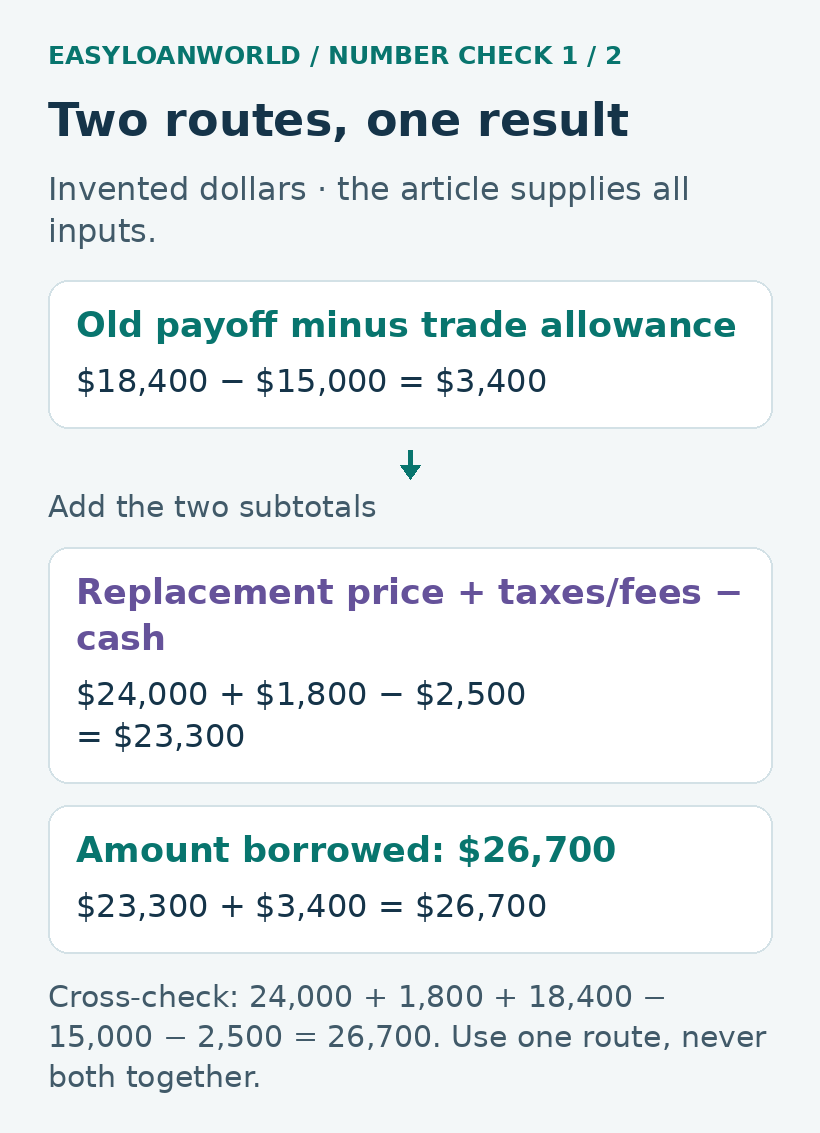
Use either route. Adding both the full $18,400 payoff and the $3,400 difference would count part of the debt twice. Subtracting the trade allowance again after calculating the difference would also distort the result.
Give each cash dollar one job
In a separate fictional version, the buyer brings another $3,400 to cover the old-car difference while keeping the original $2,500 contribution toward the purchase. That requires $5,900 total cash and leaves $23,300 to borrow. It does not create $3,400 of free savings: it exchanges additional cash today for less principal in this model.
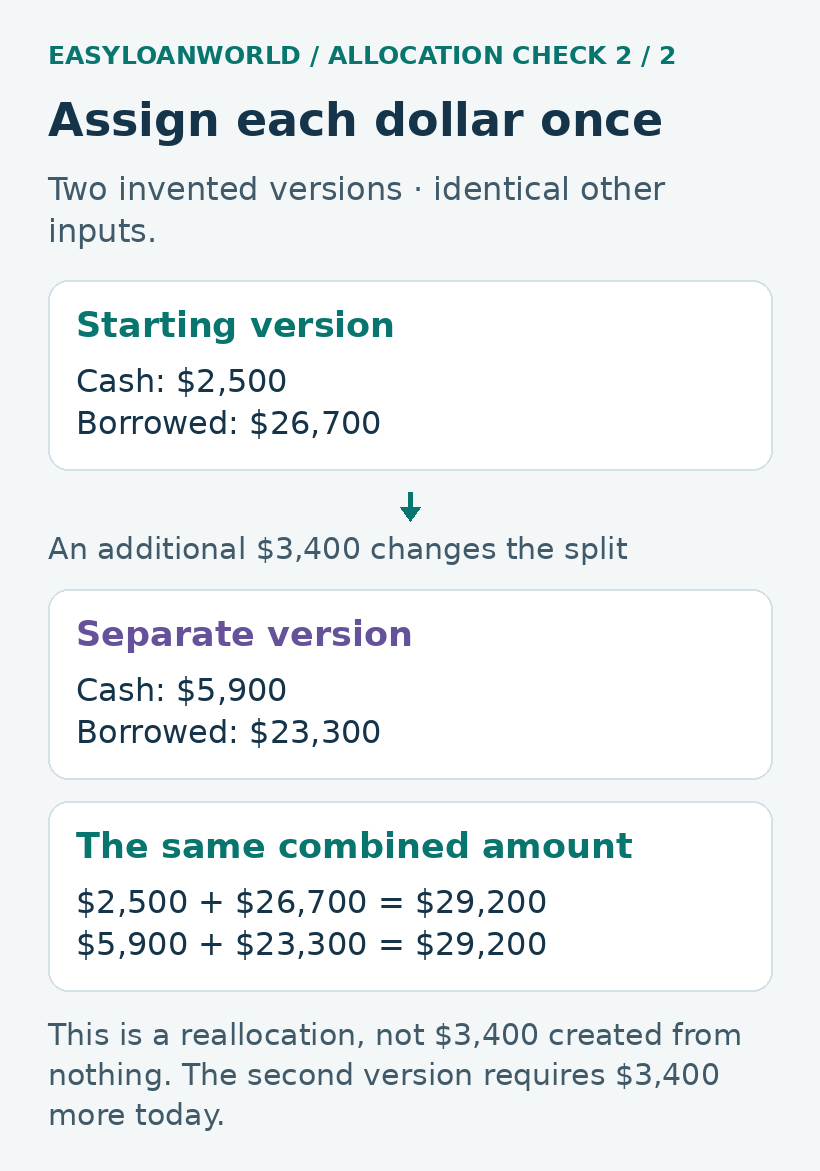
Someone with only $2,500 cannot use that same money for both jobs. Write down the total cash actually available before assigning amounts. This exercise does not decide whether using more cash is suitable for your household.
Build a settlement evidence sheet
Use these original organizational prompts beside your calculation. They are not a statutory checklist.
- Old-car file: dated payoff document, its stated applicable date and the agreed allowance.
- Replacement file: itemized price, taxes/fees and the cash receipt.
- Reconciliation: each number’s document and page, plus any unexplained difference.
- Completion record: intended payoff recipient, contact details, date checked and actual response.
Before signing, resolve unexplained amounts with the dealer. Afterward, confirm with the old lender that its loan was paid off; handing over the vehicle is not that confirmation.
For example, a proposed $27,200 balance against this worksheet’s $26,700 leaves a $500 question. Record it as “unexplained” until you have the supporting item; do not invent a fee to make the arithmetic fit.
Keep meeting existing payment obligations while resolving an uncertain settlement. This example predicts neither approval nor future vehicle values, and it does not determine state tax treatment or settlement timing. Education only; use the actual transaction documents for your own numbers.
Featured photo: A parked sedan, shown for illustration. Photo: Vitali Adutskevich / Unsplash. Used under the Unsplash license.
College Withdrawal Bill: Reconcile the School Account
Use three school records and a fictional $1,340 example to trace each adjustment, check a changed balance and organize questions for the right office.

Student Aid Credit Balance: Separate the School Ledger From Spendable Cash
Use two fictional aid snapshots and a private payment record to organize the amounts, permissions and dates behind a college-account credit.

Solar Loan Quotes: Compare the Cash Price Before the Low Rate
Match the installation scope, reconcile a fictional $6,000 financed-price uplift, and test the later payment if a planned savings payment never arrives.