California Used-Boat Financing: Plan the Purchase and First-Year Budget
Plan a California used-boat purchase with a first-year cash budget covering financing, surveys, taxes, insurance, storage, maintenance, and ownership records.
Estimated reading time: 6 minutes
A used boat’s loan payment is only one planning figure. California buyers also need distinct purchase, ownership and operating-cost checks.
Build the first-year budget before choosing a monthly payment
Separate cash needed to complete the purchase from cash needed to keep the boat. The following is an invented budget, with every cost chosen for illustration. It isn’t a California tax calculation, survey quote, insurance offer or available berth.
Assume a $40,000 boat purchase, $8,000 buyer cash and a $32,000 loan. With a fictional fixed 8% annual interest rate, 120 equal monthly periods and no financing fees, the modeled payment is approximately $388.25 a month. You can reproduce it in the loan payment calculator. That installment only covers principal and interest.
| Item | Cash allocation |
|---|---|
| Buyer contribution toward the $40,000 price | $8,000 |
| Assumed taxes, title and registration charges | $3,200 |
| Survey and haul-out allowance | $900 |
| Initial equipment allowance | $800 |
| Total initial cash | $12,900 |
| Item | Twelve-month allocation |
|---|---|
| Twelve payments budgeted at $388.25 | $4,659 |
| Insurance allowance | $1,200 |
| Berth or storage allowance at $450 a month | $5,400 |
| Maintenance reserve | $1,800 |
| Fuel allowance | $900 |
| Total recurring allocation | $13,959 |
The recurring plan averages $1,163.25 a month, even though the loan payment is $388.25. Initial cash plus the first year’s allocations totals $26,859. The $32,000 financed purchase amount isn’t added again: the purchase contribution and scheduled loan payments already track the cash leaving the buyer’s account. Loan principal repayments and money set aside in a reserve are also different from consumption expenses; this is a cash plan, not an accounting profit calculation.
Replace every allowance with your actual quotes and expected use. Include additional costs that apply to your boat, such as a trailer, separate engine survey, transport, launch fees or marina deposits. Check when annual bills fall due; dividing them by twelve helps planning but doesn’t change the insurer’s or harbor’s payment date.
Identify the boat before relying on financing
BoatUS’s lending FAQ says its partners’ rates and terms depend on the boat. Its process allows an application without a sales contract, but requires a boat to be identified; it isn’t a home-purchase-style preapproval.
The provider distinguishes used-boat book value from new-boat contract price for its loan-to-value guideline. A seller’s asking price therefore doesn’t, by itself, establish the amount a lender will finance.
Ask the actual lender which vessel characteristics and valuation it used, and what remains before closing. BoatUS describes additional closing requirements after approval, rather than treating an initial decision as completed funding. These are named-provider examples, not universal underwriting rules or a financing recommendation.
Price the survey’s actual scope
A survey is a defined service, not an unlimited inspection. Currents Marine Survey’s own service description, for example, lists a sea-trial evaluation, condition rating and a written report. Several systems receive expressly limited inspections.
Crucially, that provider excludes engine surveys from its service. A report mentioning propulsion isn’t necessarily a separate engine survey. Its description also recommends hauling the vessel for inspection of underwater areas.
When comparing survey quotes, identify the work included and any separately arranged mechanical examination or haul-out. Ask the surveyor to explain exclusions before comparing totals. This example illustrates scope differences; it doesn’t recommend this provider, certify a boat’s condition or tell you how to inspect machinery.
Keep the boat and trailer records separate
For an already California-registered boat bought from another person, California DMV describes the owner’s endorsement and a lienholder signature when there’s a lienholder. Resolve missing ownership evidence with DMV or the closing professional; this isn’t title certification.
A trailer needs its own registration and title evidence. Buying the boat and trailer together doesn’t turn them into one registration record. Match both assets to the seller’s actual paperwork.
Find the correct tax recipient
CDTFA’s vessel guide routes tax differently depending on documentation status. When use tax is due on a documented vessel, it goes directly to CDTFA. DMV generally collects it when an undocumented vessel is registered; an uncompleted registration can require direct reporting to CDTFA instead.
The rate location also differs: the principal mooring or berth location for a documented vessel, versus the registration address for an undocumented vessel. Don’t import a car quote’s address assumption without checking.
A broker may collect and report tax, but isn’t required to do so. Ask whether the actual transaction includes that service, and retain the receipt. No tax rate, exemption or personal filing deadline is calculated here.
Read total-loss and partial-loss terms separately
Chubb’s marine-insurance explanation distinguishes agreed-value total-loss settlement from actual cash value, which reflects depreciation. It also notes that some lenders require agreed-value coverage.
Partial-loss wording deserves a separate read. Replacement-cost treatment may avoid age depreciation for many repairs, but particular components can still be subject to depreciation, and deductibles matter. A reassuring total-loss label doesn’t settle every repair calculation.
Ask the insurer about wreck removal, pollution cleanup, personal property and towing, rather than assuming these follow from the hull limit. The issued policy controls; this educational comparison doesn’t select coverage or predict a claim payment. Obtain the lender’s actual insurance requirement before treating a quote as acceptable financing evidence.
Separate operator education from vessel paperwork
The California Boater Card FAQ describes evidence of an approved safety course and exam, not ownership.
For motorized vessels on California waterways, its age phase-in reached all ages on January 1, 2025, subject to exemptions. Federal vessel documentation doesn’t itself replace this operator requirement. Ask the Division of Boating and Waterways about the applicable rule; this article doesn’t determine an exemption.
The FAQ lists a $10 lifetime card fee and a separate $5 replacement fee. It also says an application left incomplete for more than a year is closed without a refund; restarting requires another application and payment. Distinguish paying an application charge from completing the required process.
Turn a berth rate into a recurring amount
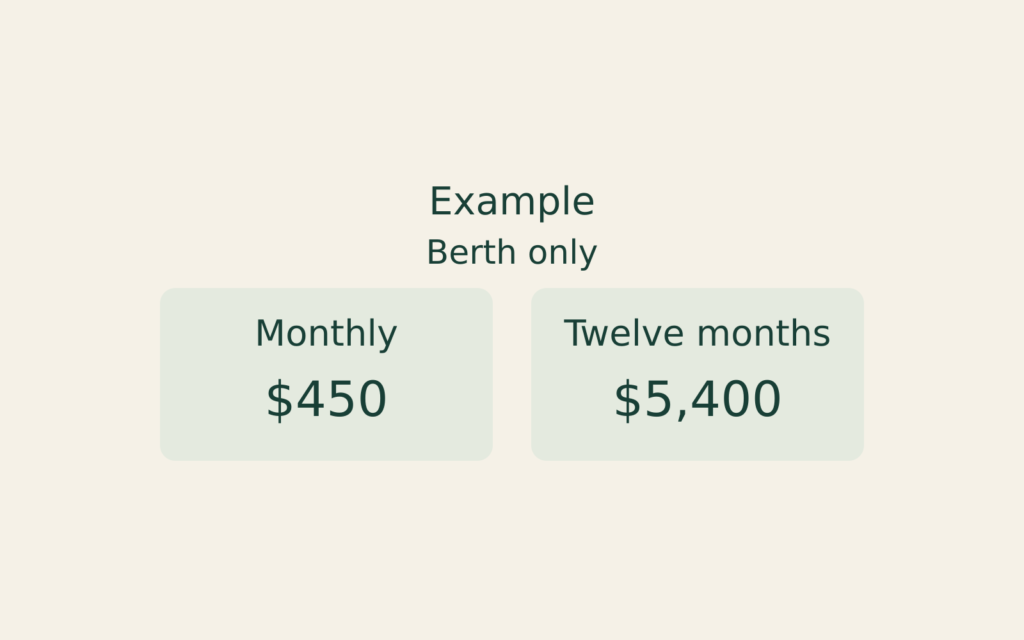
Santa Barbara’s fee summary effective July 1, 2026 assesses assigned berths monthly per foot of boat or slip length, whichever is longer. Its 30-foot berth rate is $15 per foot.
Illustrative case: assume an assigned 30-foot berth and a boat no longer than that, with the published rate unchanged throughout twelve months.
| Monthly | 30 × $15 = $450 |
|---|---|
| Twelve months | 12 × $450 = $5,400 |
This isn’t an available-slip offer or a total ownership budget. The schedule separately lists permit-transfer fees and visitor rates. Confirm the actual berth arrangement and other charges with the harbor rather than using a visitor quote as permanent storage. Add the applicable recurring amount to planning, without mistaking it for part of the loan installment.

Parent Pays Student Loan Interest: Who Deducts?
Separate payment and obligation.

Returned Loan Debit: Two Fees?
Trace the payment and fees.

Rehabilitation Payment Too High?
Check an alternative request.